
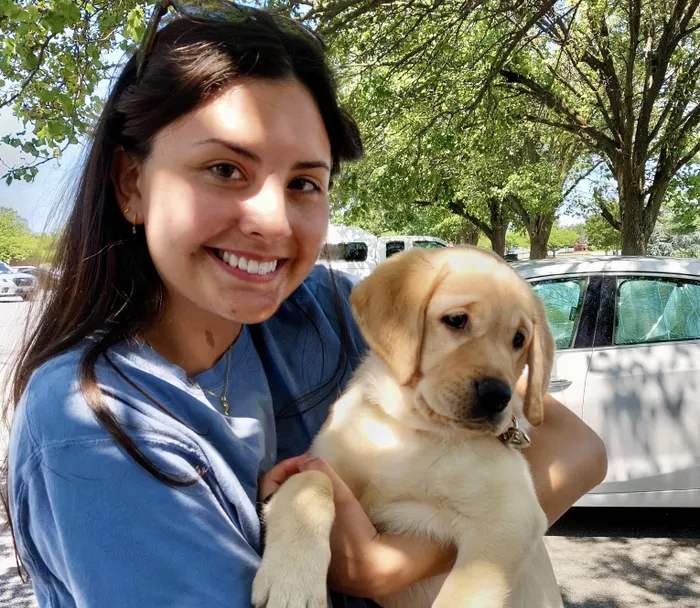
Julie Gray last summer with Hope, a dog she's raising.
Image: Supplied
Kyle Melnick
Julie Gray unzipped her navy fleece and dropped it onto the head of a puppy named Hope. The dog moved her head in confusion but stayed seated on the floor of an academic building at the University of Maryland.
“She wants her head out, but she’s not freaking out,” Gray told fellow students who held dog leashes. “So that’s what the jacket test is.”
She explained that the exercise was to prepare for a real-life scenario, when a jacket falls off a chair and onto a dog.
“You wouldn’t want them to get up, make a scene,” Gray said.
The recent training class was for student members of a college chapter for the Guide Dog Foundation for the Blind, a nonprofit that provides service dogs to people with vision impairments.
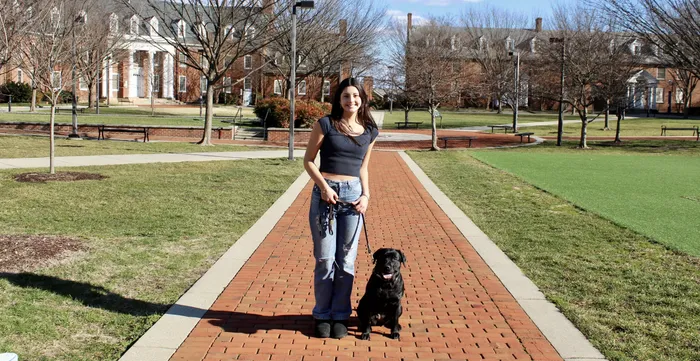
Julie Gray with Lulu, a Labrador retriever she raised.
Image: Supplied
The Guide Dog Foundation - as well as a handful of other organizations that provide service dogs - has in recent years relied on college students who are willing to have dogs with them in their dorms, in classes and in dining halls to train the pups.
The groups see college campuses as strong training grounds because they expose puppies to thousands of people and a wide range of social gatherings. Students, many of whom miss the dogs they grew up with, also benefit by having a fuzzy companion while pursuing their degrees.
At the College Park class last month, the exercises were intended to teach puppies patience and obedience so they can eventually guide their handlers at a slow pace around obstacles and on various surfaces.
Leading the class was Gray, the club’s president, who grew up in Montgomery County, Maryland, with a mixed poodle, Max, and a mixed boxer, Sora. Gray’s mother, Marcela, predicted for years that Gray would become a veterinarian because she was always stopping in public to pet strangers’ dogs.
In September 2022 - soon after Gray started attending the University of Maryland - she saw a Labrador retriever near the center of campus and asked if she could pet the dog. A student told Gray she couldn’t because the puppy - who wore a yellow vest that labeled her as an assistance dog in training - was working.
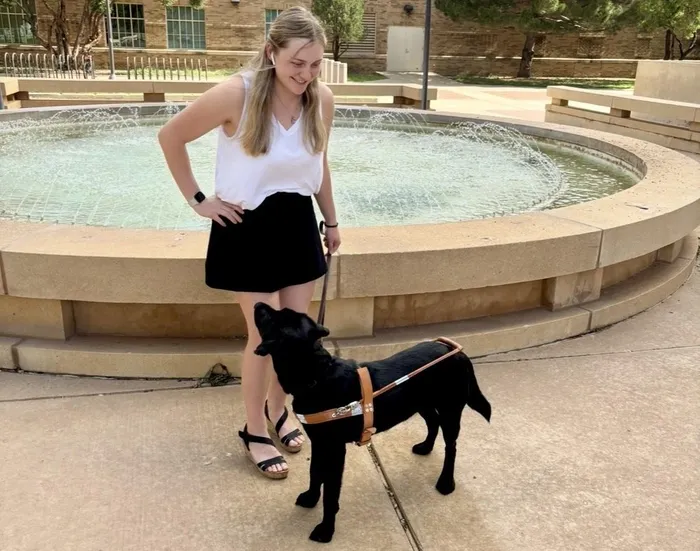
Dannielle Schutz with her guide dog, Percy, a black Labrador retriever.
Image: Supplied
Gray learned about the club, called Terps Raising Pups, and signed up a few weeks later to look after dogs when their raisers were busy - she didn’t think she had time to raise her own puppy. But that fall, a volunteer dropped out of raising Lulu, a 3-month-old black Labrador retriever.
After her roommate in an on-campus dorm agreed, Gray volunteered to raise Lulu. The University of Maryland says it allows service animals everywhere on campus except in areas where there could be health, environmental or safety hazards, like laboratories and mechanical rooms.
Gray, a neurobiology and physiology major, didn’t know how much work raising Lulu would be.
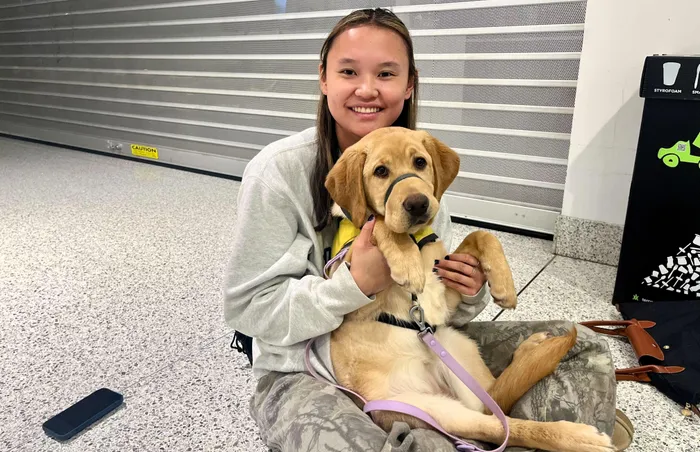
Chelsea Boyer, who trains service dogs through Terps Raising Pups, with Labrador retriever Dee Dee.
Image: Supplied
Every morning, Gray would feed Lulu breakfast, attach a leash to her and pack her supplies, including a water bowl, treats, a toy and poop bags. One of the first times Gray walked Lulu on campus, the dog began to get overheated. So Gray scooped her up and carried her - making a walk that normally took about 20 minutes close to an hour, Gray said.
Early in the morning and late at night, Gray and Lulu descended three flights of stairs so the puppy could go to the bathroom. Sometimes, before Lulu was potty trained, she did her business in the dorm - and Gray cleaned it up.
The only places Gray didn’t take Lulu were parties and her classes in laboratories. But Gray said she didn’t miss out on other activities - another club member watched Lulu when Gray was busy.
In January 2024 - after about 14 months of training - a Guide Dog Foundation volunteer drove Lulu to the organization’s headquarters in Smithtown, New York, where dogs finish training and are paired with their handlers. Gray said that after Lulu left for the job she’d been trained for, she missed the pup and cried for months.
“She was the most important thing I have done in my college career,” said Gray, who’s now raising her third and fourth service dogs: Hope, a Labrador and golden retriever mix, and Emmett, a 7-month-old black poodle.
Gray, who said raising guide dogs for the blind has motivated her to work in ophthalmology after she graduates in May, said thinking about how her puppies will help others makes her proud.
The impact of her group’s work has reached Lubbock, Texas, where Dannielle Schutz received a guide dog named Percy in June. Schutz, who’s partially blind, said she has been apart from Percy, a black Labrador retriever, only for a few hours since being paired with her.
Schutz, 23, said she wanted a guide dog as a more reliable way to navigate airports and new cities than her walking cane. Now Percy goes with Schutz to her yoga classes and on her daily walks, as well as on the bus to her job as a research coordinator at Texas Tech University.
When Percy isn’t guiding Schutz, she acts like a regular dog. Percy, 2, steals Schutz’s socks, plays hide-and-seek and carries a squeaky octopus toy that she has played with so much, it no longer has its eight arms.
“She makes my life better in so many ways,” Schutz said.
The first steps to create those bonds were seen at the training class in mid-February in College Park, where dogs practiced walking through doors and up and down stairs at students’ pace. Other students studied for exams at nearby tables and picked out snacks at an adjacent cafe.
Near the beginning of class, students tried to keep their dogs still for two minutes and 30 seconds.
Fast Eddie, a 3-month-old Labrador retriever, seemed more interested in playing with the 5-month-old Labrador beside him, Par.
“He’s usually not like this,” said Sara Khan, a freshman raising Eddie. “I think it’s the rain.”
Eddie and Par calmed down about a minute later, and Gray told the students to give their puppies chicken-and-rice-flavored kibble from pouches around their waists.
“Treating them for doing nothing is kind of what we do at this age,” said Gray, 21.
Gray’s 10-month-old dog, Hope, exemplified how much the dogs mature in a few months. She had completed similar classes more than a dozen times and almost looked bored by the exercise.
When the 2½ minutes passed, all of the students gave their dogs treats and pets while saying “good job” in high-pitched voices.
The students led their dogs for nearly an hour through exercises, including asking them to sit and wait while students held a treat in front of them. Then the students instructed their dogs to bite and release a bone-shaped toy.
“Good class, guys,” Gray concluded. “Everybody did really good.”
Some students replaced their puppies’ yellow vests with pink and light-blue raincoats and led them outside. They walked through rain and puddles to their dorms and apartments, where the dogs enjoyed a well-deserved dinner and rest after another day of work.