
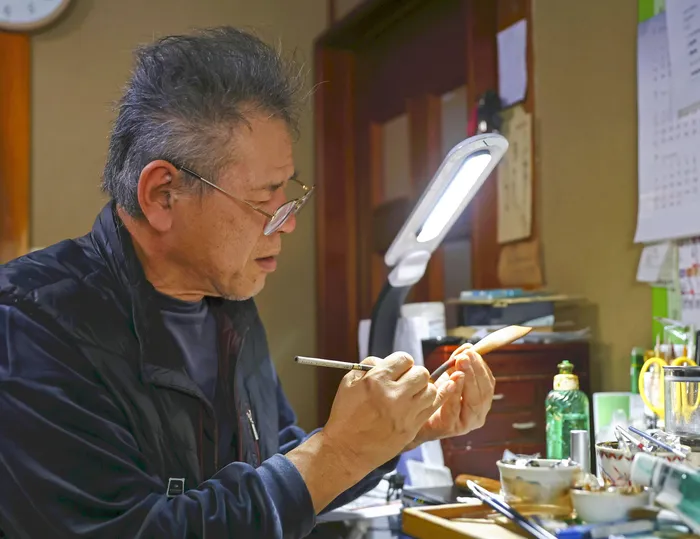
Satoshi Kiso, a Wajima lacquerware artisan from Nonoichi, Ishikawa Prefecture in Japan, applies lacquer to woodworks delivered by Shinichi Endo.
Image: Supplied
Yuki Koike
Shinichi Endo, 57, a woodworker from Ishinomaki, Miyagi Prefecture, lost three children in the Great East Japan Earthquake, while Satoshi Kiso, 64, a Wajima lacquerware artisan from Nonoichi, Ishikawa Prefecture, lost a grandchild in the torrential rains that hit the area after the Noto Peninsula Earthquake.
At a temporary housing unit for disaster victims in Nonoichi in January, Kiso silently applied lacquer to wooden butter knives and faces of table clocks sent by Endo.
“The uneven grain makes it tricky,” he said. Though puzzled by the differences compared to normal lacquerware, he carefully moved his brush.
Kiso, a craftsman with 48 years of experience, saw his home-cum-workshop in Wajima damaged in the Noto Peninsula Earthquake in January 2024. His shop burned down in a fire. Just as he and his wife began rebuilding their lives at their place of refuge, torrential rains struck in September. River flooding swept away his eldest son’s home in Wajima, claiming the life of his 14-year-old grandchild, Hanon.
Endo had been providing emotional support to children who lost family or friends after the disaster and it was he who reached out to Kiso. Endo visited the disaster-stricken areas of Noto four times, holding woodworking workshops for children. Through these activities, Endo became acquainted with Kiso and his family.
Late last year, Endo visited Kiso and said: "I understand how it feels to lose a precious treasure. Shall we work together?" Kiso accepted the offer, saying, "Absolutely." They talked about their shared hope that, if people keep items created in disaster-hit areas, the disasters won't feel like someone else's problem.
Endo has come to realise over the past 15 years that people cannot live in complete isolation.
His eldest daughter, Hana, then 13, eldest son, Kanta, then 10, and second daughter, Kana then 8, were swept away by tsunami while at home. He relentlessly blamed himself for leaving his anxious children at home to check on relatives.
Friends and neighbors pushed him forward. They spoke amiably with him at the evacuation centre. When cleaning up his workshop that was littered with timber, they helped without him having to ask.
Six-centimetre-long hyoshigi wooden clapper straps, processed from debris washed ashore by a tsunami, are among the seven types of woodwork the two produce. Just as people need the support of others, the clappers will not make a sound unless both are together. "I managed to make it this far thanks to the support of those around me," Endo said. "Now I want to be the one offering strength."
"I want people across the country to hold these pieces in their hands," Kiso said. "I want them to remember the damage done by the torrential rains and the lives lost."
Their works were planned to be sold at a reconstruction support event in the town of Rifu, Miyagi Prefecture.