
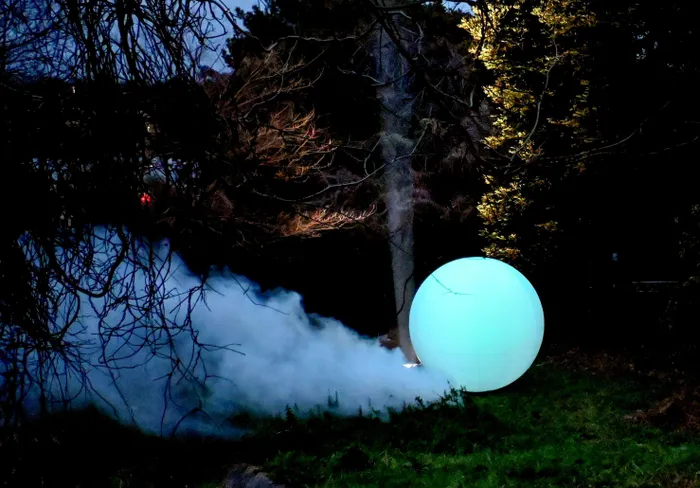
A large sphere flashes green while emitting smoke and light as part of an art installation in the forest of Umi-no-Mori Park in Koto Ward, Tokyo.
Image: Supplied
Futoshi Mori
TOKYO - Biological signals collected in real time from the vegetation at a Tokyo park were translated into sound and light at a recent exhibition by artist Yuma Kishi.
Kishi dubs AI “alien intelligence” and explores the world humans and AI create together. The show was held during the evenings from Friday through Sunday at Koto Ward's Umi-no-Mori Park, which was built on an artificial island that was once a Tokyo landfill.
Umi-no-Mori Park served as the venue for rowing and canoeing events during the Olympic and Paralympic Games held in Tokyo in 2021.
As I made my way through the forest under the cover of night, a large sphere placed in a clearing between the trees flickered green, spewing white smoke and sending a beam of light toward the sky. I heard a sound like the wind howling, and within it, Japanese words such as “plants” and “I'm sorry” could be heard occasionally.
Along the straight path through the forest, rows of smaller transparent spheres glowed green, occasionally illuminating the trees on either side in blue.
If I hadn't been able to see cars driving on a distant highway through the trees, I would have been completely absorbed by a strange, floating sensation - as if I'd lost track of where I was.
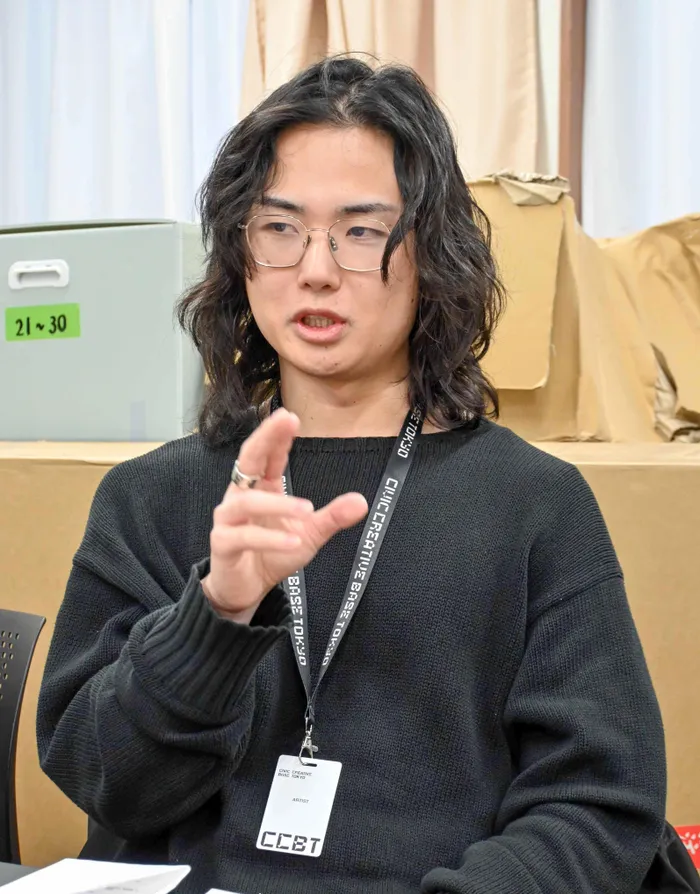
Yuma Kishi explains his thought process which led to the exhibition at Umi-no-Mori Park.
Image: Supplied
“I wonder why everyone treats AI so much like a human,” Kishi said during his talk at the venue. “It answers questions in a fraction of a second and can instantly identify the same person from among thousands of photos stored on our smartphones.
“Why do we use such sophisticated intelligence based on the premise that it's human? I've always felt uneasy about that.”
Born in 1993, Kishi studied electrical engineering at Keio University and the University of Tokyo, where he encountered research on artificial intelligence. He then majored in intermedia art at Tokyo University of the Arts and is now an artist.
“As we build society alongside AI, perhaps we should ask it to serve as a translator between us and nonhuman entities,” Kishi continued. “Couldn't it present the possibility of a different world - one even more expansive than the society and world we have built? I've been conducting research and creating my works with this in mind.”
The title of the park exhibition was “Parallel Forests.” It was inspired by “Parallel Botany,” a work by Italian children's book author Leo Lionni in which a fictional plant community sparks the reader's imagination and leads them into an unknown world.
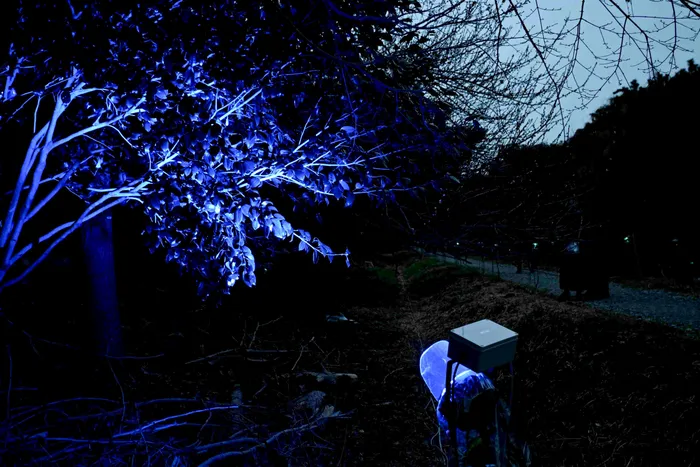
A tree illuminated by blue light as part of the installation.
Image: Supplied
Kishi installed 100 small computers in the forest of Umi-no-Mori Park. Each computer is equipped with “Botanical Intelligence” (BI), a system developed by Kishi. BI uses a large language model to interpret ecological signals - such as data on plant activity - and translate them into sound, light and vocalisations. Through this work, Kishi explored a new common space where the plant world and the human world can thrive together.
The event was organised by Civic Creative Base Tokyo (CCBT), a hub jointly operated by the Tokyo Metropolitan Government and the Tokyo Metropolitan Foundation for History and Culture.
CCBT seeks to enable people to channel their creativity into society through art and digital technology, and this exhibition was held as part of its programme.