
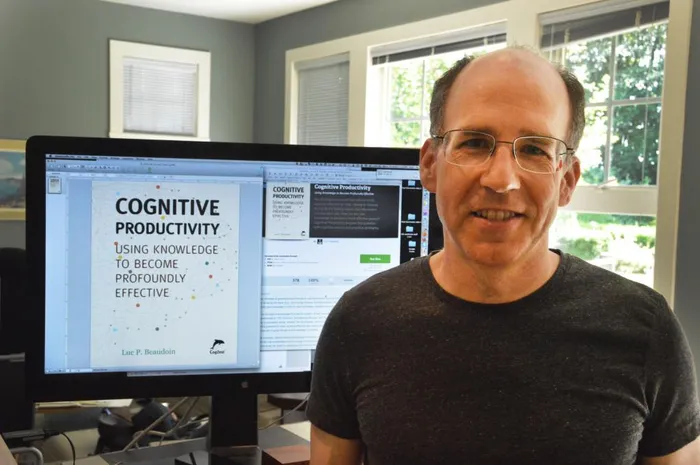
Luc Beaudoin, co-founder, CEO and Chief Product Officer of CogSci Apps Corp and Professor of Education at Simon Fraser University in Vancouver.
Image: Supplied
Maggie Penman
When Luc Beaudoin was in college, he was having trouble falling asleep.
Beaudoin was studying cognitive science and psychology, so he started experimenting on himself, and he developed a method that consciously copies what the brain seems to do naturally as we doze off.
“If you wake people up as they’re falling asleep, they often report that they’re having these little micro-dreams,” said Beaudoin, who is a cognitive scientist and professor at Simon Fraser University in Canada. These can be seemingly random images or scenes that you may not remember when you wake up, unless you’re interrupted in the process of falling asleep.
Beaudoin developed a technique to mimic this kind of “dreamlike” thinking - with the hope that he could trick his brain into falling asleep faster. He calls it a serial diverse imagining task or cognitive shuffling, because it’s almost like shuffling a mental deck of cards, each one with a different image or thought.
“I use it and it works for me,” Beaudoin said. In his research he has demonstrated that the technique works for other people, too, though he and other experts emphasized that more studies need to be done to better establish how well it works and why.
There is a paradox inherent in sleeping, said Rafael Pelayo, a sleep medicine doctor at Stanford University. We have a biological need to sleep, but we’re also more vulnerable while we’re sleeping. So we protect ourselves by frequently waking up - at least once every hour-and-a-half between sleep cycles, with even more frequent mini-arousals.
“It’s a misconception to think that people sleep through the night,” Pelayo said. “Nobody ever really sleeps through the night.”
If you generally have no problems sleeping, you probably won’t remember these brief bouts of wakefulness. But if you’re feeling anxious, you may have trouble getting out of that hypervigilant mode - making it difficult to fall asleep and stay asleep.
If you often find yourself lying awake in the middle of the night worrying, sleep experts say that cognitive shuffling might be worth a try.
Start by thinking of a word - something neutral or positive, like the word “house.” Then, think of as many words as you can that start with the first letter: horse, harmonica, honey. Try to picture each object or idea for 5 to 15 seconds, maybe even imagining a scene with yourself in it. (You’re riding a horse. ... You’re playing the harmonica. ... You’re harvesting honey!)
Beaudoin recommends against finding connections between the words. Just let the images wash over you. Whenever you find yourself having a hard time coming up with another word, move on to the next letter - in this case, o - owls, oasis, ocean and so on. Come up with images for each letter in your original word until you fall asleep. If you run out of letters before you fall asleep, pick a new word.
“It’s hard to think of random material, but this little technique helps people,” Beaudoin said. (He also developed an app called MySleepButton for people who want help with the technique.)
In addition to mimicking the kind of thinking that happens right before sleep, the method also requires a certain amount of brain power - enough to interrupt the worrying or problem-solving that often keeps us awake.
Beaudoin developed the technique for his own purposes, but after becoming a cognitive scientist, he decided to study it.
He and a team of researchers recruited participants who were having trouble sleeping, and randomly assigned them to one of two methods. One was a proven technique known as constructive worry time - journaling about your problems a few hours before bedtime. The other group tried cognitive shuffling. The researchers found that cognitive shuffling was just as effective, and had the advantage of being something you can do at bedtime or in the middle of the night, rather than something you have to make time for earlier in the evening.
The research on cognitive shuffling is still nascent, but experts see the logic in the theory behind it.
“I think there’s something to it,” said Sara Benjamin, the medical director of the Johns Hopkins Sleep Disorders Center. She said that sleep problems can be incredibly complex and require a certain amount of trial and error. But cognitive shuffling can be used any time, without any tools or side effects, which makes it a great strategy for patients to have in their back pocket. She said she often suggests it to patients who say they’ve tried everything.
“It’s nice to be able to give people these suggestions and see what works for them,” Benjamin said. She adds that it can be counterproductive for people, especially those who have PTSD or anxiety, to let their minds wander at night without a relaxation technique or a strategy like cognitive shuffling to rein in their thinking.
“Cognitive shuffling is a good technique to try if you find yourself ruminating,” Pelayo said. “Instead of lying in bed worrying about tomorrow or beating yourself up because you forgot to do something, this technique is kind of distracting you by focusing on something else.”
If you have chronic insomnia, Pelayo and Benjamin both noted that cognitive behavioral therapy has the highest level of evidence for long-term effectiveness. A psychologist who specializes in CBT for sleep can help patients with underlying anxiety or breaking out of habits or thought patterns that are reinforcing the problem.
“This is not, like, ‘tell me about your mother,’ right?” Benjamin said. “It’s very focused on sleep.”
The experts also noted that it’s important to get checked out for other health problems that can cause sleep difficulties, like sleep apnea or thyroid issues.