
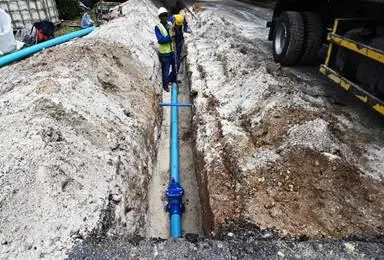
City of Caoe Town teams replace ageing water pipes to reduce water disruptions. In Japan, aging sewer pipes and the overlooked risks of hydrogen sulfide result in more than 1,000 incidents of damage leading to road cave-ins annually.
Image: City of Cape Town
Just before noon on January 9, a thunderous noise boomed through a residential area of Higashi Ward, Niigata.
The sound occurred just as a large truck passed through an intersection on a municipal road. The truck suddenly dipped while driving along on that midwinter day, as a section of the road measuring about 5 metres across collapsed, dropping 3.5 metres. The truck barely managed to avoid falling into the huge hole, and a car following behind slammed on its brakes just in time to avoid the danger.
The cave-in was caused by a degraded sewer pipe that was laid 3.5 metres underground 45 years ago. The 10-centimetre-thick concrete pipe had an inner diameter of 1.35 metres, but a roughly 1-metre section on the top of the pipe was broken. Soil and sand had apparently dropped in through the opening, creating a cavity above the pipe.
“I didn't think a pipe would corrode that quickly,” said a head of the maintenance division at Niigata city government's sewer management centre. “We underestimated the risk of hydrogen sulfide.”
Hydrogen sulfide is a gas created when bacteria found in sewage and sludge break down organic matter. This gas reacts with air to form sulfuric acid, which can corrode concrete and was the primary cause of deterioration of the pipe.
The broken section was in a location where it was easy for sewage to gush out, and hydrogen sulfide in the wastewater could cause evaporation and transpiration. A 2019 inspection by the city government detected exposed reinforcing steel bars over about 7 metres on the pipe's internal wall. Under Japan Sewage Works Association guidelines, a section of pipe in that condition will require remedial action to be taken “within five years”.
However, a regular inspection conducted by the city in 2021 did not check the state of the exposed rebar, and the hydrogen sulfide concentration was not measured. Priority was given to other pipes deemed to be at high risk of breaking, and repair of this pipe was pushed back to fiscal 2026.
“That pipe should've been rechecked after the sinkhole opened up in Yashio,” the maintenance division official said. “We must strengthen our vigilance of hydrogen sulfide and increase the frequency of our checks.”
The threat hydrogen sulfide poses was vividly illustrated by the sinkhole accident that occurred on a road in Yashio, Saitama Prefecture, in January 2025 and killed a truck driver.
The damaged sewer pipe that caused this sinkhole was laid 42 years earlier. The concentration of hydrogen sulfide that built up in the pipe exceeded 50 parts per million, a level highly corrosive to concrete. When the sinkhole appeared, the about 50-centimetre-thick pipe had been eroded to only about 10 centimetres thick.
Shortcomings in the prefecture's sewer pipe management system were laid bare in the report issued by a third-party committee on February 19. The committee was established by the prefectural government. A routine inspection in 2022 that used a floating camera to record inside the pipe confirmed that corrosion was taking place. The camera also captured images of exposed rebar but these were overlooked, and the prefectural government decided that the pipe was “not in a state that required immediate repair.” Although high concentrations of hydrogen sulfide were recorded in 2023 and '24, the authorities' view did not change.
The report stated the prefectural government “could have anticipated” a growing risk of the pipe corroding or breaking. The committee concluded there was “insufficient gathering and sharing” of inspection results and repair records, so the prefectural government “could not appropriately make an appropriate decision.” The report also pointed out that the maintenance system had been inadequate due to reasons including a shortage of personnel with extensive practical experience.
“The risks associated with hydrogen sulfide have been taken lightly for many years,” said Hiroaki Morita, a committee member and specially appointed professor at Nihon University.
In 1987, the Japan Sewage Works Agency compiled guidelines for preventing corrosion. “At a time when constructing sewer networks was a priority, corrosion is considered something that will have an impact decades from now,” said Morita, an expert in sewer engineering. “The risk of this hasn’t been properly conveyed.”
Japan's sewage pipe network stretches for a total length of 500,000 kilometres - long enough to go around the world 12 times. As these pipes deteriorate due to age, more than 1,000 incidents of damage leading to road cave-ins occur annually.
The possibility of a large accident happening, like the one in Yashio, lurks in every corner of the nation. A targeted survey by the Land, Infrastructure, Transport and Tourism Ministry on 5,000 kilometres of large sewer pipes with an inner diameter of at least 2 metres and installed more than 30 years ago found that, as of the end of September, about 75 kilometres were found requiring repair or replacement within one year. Hydrogen sulfide apparently caused most of the damage to these pipes.
Based on these findings, the ministry plans to bolster the inspection system from next fiscal year through such steps as increasing the frequency and scope of legally required inspections. However, the maintenance and management systems of local governments that will undertake this work are teetering as they grapple with a shortage of engineers in line with the shrinking population.
Morita said: “A growing number of local governments don’t understand how the sewage system works and how scary hydrogen sulfide is. The central government must come up with countermeasures such as organising specialist teams that are experts on hydrogen sulfide and dispatching them around the nation.”