
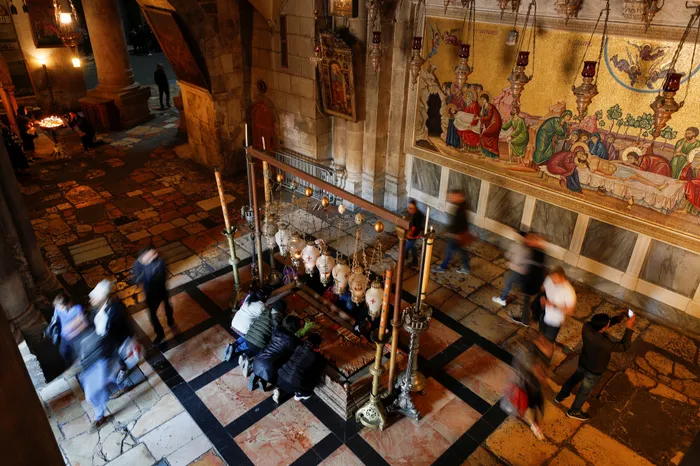
The Church of the Holy Sepulchre in Jerusalem's Old City, which Israel prevented the Roman Catholic Church's highest-ranking official in Jerusalem, Cardinal Pierbattista Pizzaballa, from accessing for a Palm Sunday service.
Image: Ammar Awad/Reuters/African News Agency (ANA)
Sammy Westfall and Anthony Faiola
JERUSALEM - The U.S.-Israeli war against Iran created a flash point in interfaith relations in this ancient holy city over the weekend, as a move to prevent a Palm Sunday Mass at the Church of the Holy Sepulchre, Christianity’s most sacred site, triggered criticism that led to a rare climbdown by the Israeli government.
The incident highlights the way in which any war involving the Holy Land can strain the delicate relations among faiths.
The start of spring is typically a crowded time in Jerusalem, as an influx of worshippers make pilgrimages to key religious sites. But restrictions imposed by Israeli authorities, citing the war against Iran, have obstructed access and dampened the holiday season for Muslims, Jews and Christians.
On Sunday morning, that policy came to a head as Israeli authorities blocked the highest-ranking official of the Catholic Church in Jerusalem, Cardinal Pierbattista Pizzaballa, from celebrating the start of Easter Week at the Church of the Holy Sepulchre, where it is believed that Jesus was crucified and resurrected. Under war restrictions, Pizzaballa also announced the cancellation of a traditional Palm Sunday procession from the Mount of Olives mountain ridge to Jerusalem.
“For the first time in centuries, the Heads of the Church were prevented from celebrating the Palm Sunday Mass at the Church of the Holy Sepulchre,” Pizzaballa’s office said in a statement. It added, “This incident is a grave precedent, and disregards the sensibilities of billions of people around the world who, during this week, look to Jerusalem.”
In the era of social media, the decision to block Pizzaballa’s Palm Sunday Mass in the 4th-century church in Jerusalem’s Old City drew swift outrage and statements of concern, including from U.S. Ambassador to Israel Mike Huckabee, who called it an “unfortunate overreach already having major repercussions around the world.”
The news also spread fast among politicised Catholics on the right and the left, particularly in the United States, presenting Israelis with the kind of optics nightmare - of a government stealing Easter - that they did not want or need.
“ISRAEL POLICE were SPYING on the Cardinal of Jerusalem,” the archconservative Catholic pundit John-Henry Westen alleged on X.
The Rev. James Martin, a prominent liberal Catholic priest in the United States, posted the news on Facebook, prompting 1,200 comments questioning and defending Israeli actions.
“I think they realised (the risk) very quickly,” said Massimo Faggioli, a professor in ecclesiology at Trinity College Dublin. “They know that what’s going on is a big test in relations between religions, and I think they understand that Jerusalem is a testing ground for these relations and there are huge uncertainties for the future of the status quo where there is a freedom of worship and access to holy sites.”
Israel immediately said the move was justified, prearranged and applicable to members of all faiths, not just Christians, because of wartime safety concerns. But early Monday, top officials reversed course, with Prime Minister Benjamin Netanyahu saying on X that he had “instructed the authorities to enable the Patriarch to hold services as he wishes.”
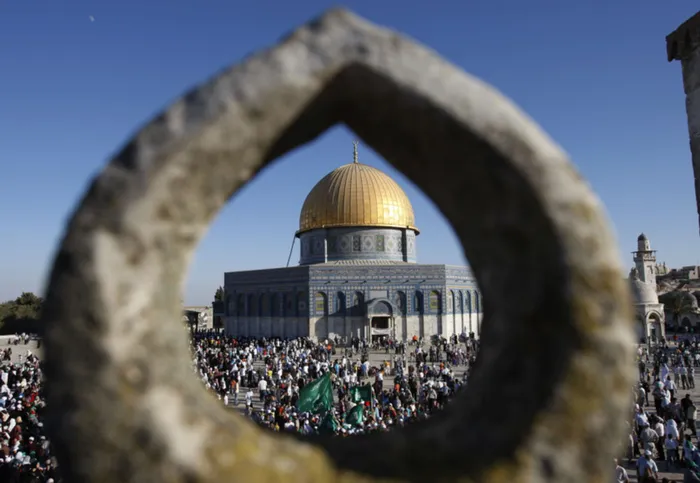
Al-Aqsa mosque compound in Jerusalem's Old City, which was closed to Muslim worshippers for all of Ramadan and Eid.
Image: Reuters
Netanyahu said Israel had “asked members of all faiths” to temporarily abstain from worshipping at the Old City holy sites. Pizzaballa was asked to refrain “out of special concern for his safety,” Netanyahu said. But critics said the reversal came too late, after the holiday had passed, and they noted that other key sites, including the Al-Aqsa Mosque and the Western Wall, remain closed to worshippers.
The Israeli police said Monday afternoon that a “productive meeting” with the cardinal helped establish a “mutual framework” for upcoming Easter ceremonies and posted a photo of a smiling Pizzaballa holding the hand of a police official. Some events will be held in a “symbolic, limited format,” police said, to ensure “freedom of worship” and “the protection of human life.”
In a statement late Monday, the Vatican said Cardinal Pietro Parolin, the Holy See’s secretary of state, and his No. 2, Archbishop Paul R. Gallagher, met with Yaron Sideman, the Israeli ambassador to the Holy See, to discuss the “unfortunate” incident. “Regret was expressed” and “clarifications were offered,” the Vatican said, adding that the two sides discussed the agreement to restart liturgies at the Church of the Holy Sepulchre.
On Monday evening, 71-year-old Shain Hevorck, was sitting on the steps of his Old City home, just a few feet from the church whose doors were locked. It’s been “many, many, many, many years” since he hadn’t prayed there on Easter. This year, he said, “I go to small churches, but this doesn’t make you feel that good.” He wishes the doors would reopen so that he could pray for food, money for medicine and an end to the war.
The facts surrounding contested access to the site remained in some dispute.
In a statement, the Israeli police said “the Patriarch’s request was reviewed (on Saturday) and it was clarified that it could not be approved,” citing threats to public safety. But Farid Jubran, a spokesman for Pizzaballa, denied in a text to The Washington Post that police had communicated that rejection to the Patriarchate.
The church has been the subject of many disputes around access over the years, including among the various denominations that share responsibility for portions of the labyrinthine building, under carefully choreographed agreements between ancient traditions that hold the location in equal esteem.
Since becoming the Latin Patriarch in 2020, Pizzaballa’s stature has risen quickly to the point that he was viewed last year as a papal contender following the death of Pope Francis.
Shortly after the October 7, 2023 Hamas attack on Israel, Pizzaballa offered to trade himself for Israeli children held as hostages. A fluent Hebrew speaker, he is seen as skilled in building bridges with the government.
However, strains appeared during the Gaza war, which Pizzaballa described in July 2025 as “morally unjustifiable.”
On Sunday morning, Pizzaballa, and Custos of the Holy Land Francesco Ielpo were heading to the Church of the Holy Sepulchre when they were “stopped en route, while proceeding privately and without any characteristics of a procession or ceremonial act, and were compelled to turn back,” according to a statement issued shortly afterward by the Latin Patriarchate of Jerusalem and the Custody of the Holy Land.
Church heads “have complied with all imposed restrictions,” according to the statement, including cancelling public gatherings. It said preventing the entry of the two men “constitutes a manifestly unreasonable and grossly disproportionate measure.”
The initial obstruction, since reversed, drew condemnation from Christians and international leaders across the globe.
Huckabee said that even with other holy sites closed, the decision to bar entry for a small group of Catholic representatives “is difficult to understand or justify” because the private ceremony fell far below the Israeli military’s wartime restriction on gatherings of 50 people or fewer.
Because of Israel’s security rules, Al-Aqsa Mosque, one of the holiest sites for Muslims, was closed to worshippers for Eid and most of the month of Ramadan for the first time since the 1967 war, compelling thousands of worshippers to pray on the streets as close to the holy site as possible. Eid usually draws more than 100,000 people to the mosque.
Italian Prime Minister Giorgia Meloni said denying entry to the patriarch and the custos, especially on Palm Sunday, “constitutes an affront not only to believers but to any community that upholds religious freedom.” Italy’s foreign minister summoned the Israeli ambassador to “obtain clarifications” on the situation.
The Israeli police defended the restrictions Sunday, saying officials had notified the patriarch that his request to enter the site would not be approved.
All holy sites in Jerusalem’s Old City were closed to worshippers “to safeguard public safety and security” during the war, police said, adding that this was especially true for locations without protected spaces that could provide shelter from an airstrike. Police said that the Old City, with its narrow streets and alleys, does not accommodate access for large emergency and rescue vehicles.
Israel, posting on an X account run by the Foreign Ministry, said “concern over a mass-casualty event in the Old City is particularly acute given the area’s density and the difficulty of deploying first responders.”
On the afternoon of Eid, on March 20, a fragment from an Iranian missile fell in the Old City, only a few hundred metres from Al-Aqsa Mosque and the Western Wall, the Jewish prayer site that is also closed to visitors, which officials cited in their explanations for blocking access to the church.
The Foreign Ministry of the Palestinian Authority called it “a crime affecting both the Christian and Islamic worlds.” In a public statement, Hamas called Israel’s actions “a dangerous precedent, not seen in centuries” and “actual implementation of the occupation’s Judaisation policy against the holy city.”