
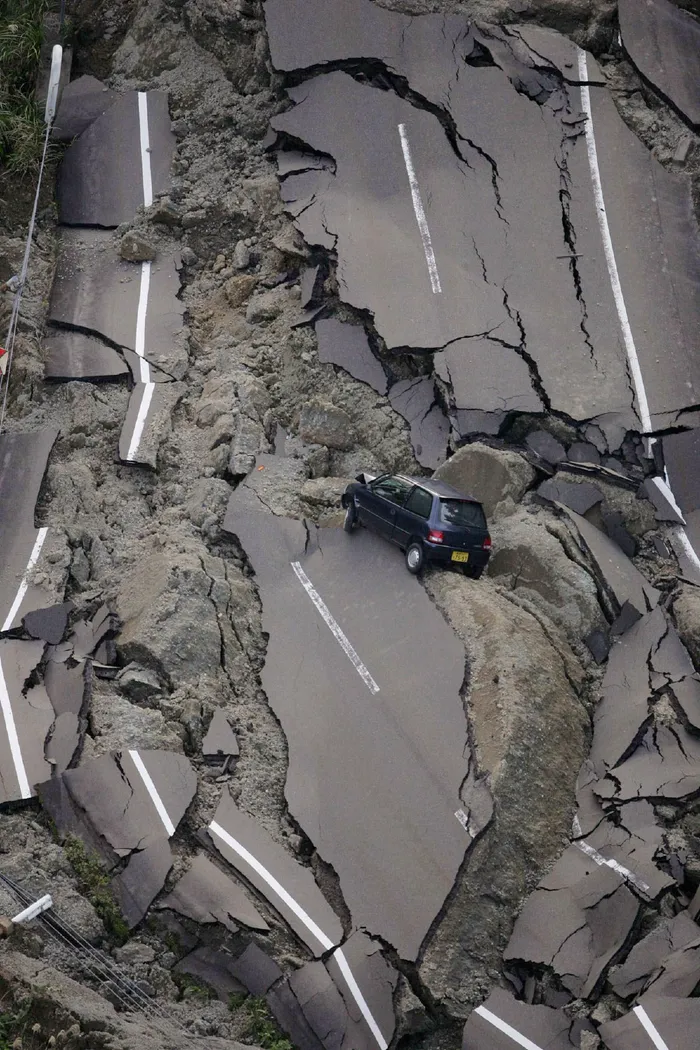
A vehicle is stranded on a devastated national highway following a series of earthquakes in Yamakoshi, north-western Japan. The country is now collaboration in research to improve safety measures and risk assessments, potentially saving lives and safeguarding communities across the nation.
Image: AP
In an effort to reduce damage caused by inland earthquakes along faults, a team of researchers at the National Research Institute for Earth Science and Disaster Resilience in Tsukuba, in Japan's Ibaraki Prefecture, will collaborate with national research institutes of the United States and South Korea to develop technology that can predict localised tremors that intensify around faults.
The researchers also aim to uncover the mechanism behind “quake damage bands,” where damage due to strong tremors is concentrated in a narrow belt-like geographic zone. They hope to make use of the technology to be prepared for a major earthquake directly beneath Tokyo and other quakes.
In the 1995 Great Hanshin Earthquake, a quake damage band was recognised in a residential area that was determined to have been hit by a tremor measuring the maximum of 7 on the Japanese seismic intensity scale. A similar phenomenon is believed to have occurred in an area affected by the 2016 Kumamoto Earthquake.
The Lawrence Livermore National Laboratory of the United States and the Korea Institute of Geoscience and Mineral Resources of South Korea will be working with the Japanese institute. The United States has high-performance supercomputers, and South Korea has strength in the relevant simulation technology.
Because little data is available on massive quakes with a seismic intensity of 7, uncertainties remain in the earthquake risk calculations that are presented by the government's Headquarters for Earthquake Research Promotion. Prediction accuracy is expected to improve by making use of individual countries' fields of strength.
Inland earthquakes, such as the Kumamoto Earthquake, could trigger strong tremors in certain locations. The strength of jolts is affected by the ground's firmness and other causes. The team therefore plans to develop technology to estimate underground structures extending hundreds of metres below ground in three dimensions and make use of that to predict quake damage bands.
The joint research is planned to continue until fiscal 2027. The study may make it possible to draw hazard maps showing expected tremors in about 100 times greater detail than the current level.
“In the Kumamoto Earthquake, serious damage occurred near faults,” said Hiromitsu Nakamura, director of the Japanese institute’s Research Division for Earthquake, Tsunami and Multi-disasters. “We want to take in effective methods from the United States and South Korea and make use of them for the country’s earthquake preparedness.”
“In order to reduce disasters caused by earthquakes, it’s necessary to raise the accuracy of quake predictions,” said Kojiro Irikura, a professor emeritus at Kyoto University. “New methods, such as using optical fibers, are believed promising for collecting large amounts of ground data. It’s important to advance research while taking in knowledge from other countries. [The new technology] is expected to be useful in urban planning and disaster evacuation support.”