
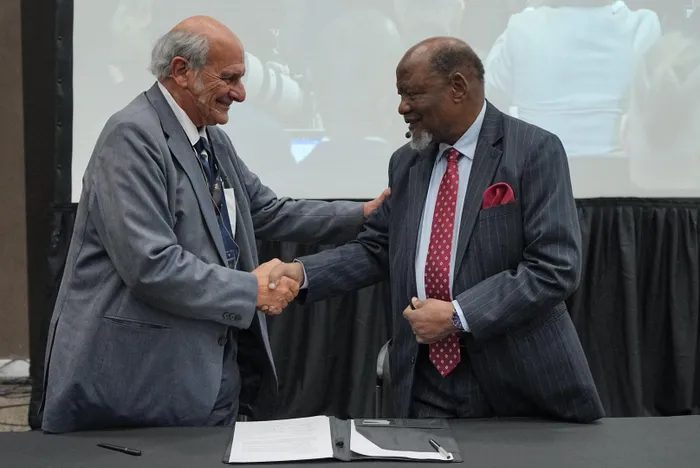
Arbitration Foundation of Southern Africa (AFSA) chairman Adv Michael Kuper and former Mozambican president Joaquim Alberto Chissano signed a Letter of Understanding at Johannesburg Arbitration Week 2026. The agreement establishes the Africa Forum Conflict Resolution Centre.
Image: Supplied
In a landmark agreement that marks a pivotal shift towards African-led peace and dispute resolution, four former Heads of State representing the Forum for Former African Heads of State and Government (Africa Forum) have come together with the Arbitration Foundation of Southern Africa (AFSA) to create the Africa Forum Conflict Resolution Centre (AFCRC). This historic pact was sealed during the opening session of Johannesburg Arbitration Week (JAW) 2026 at the Sandton Convention Centre.
With over 50 active armed conflicts currently plaguing the continent, the AFCRC aims to leverage the insights and experiences of Africa's former leaders to deliver sustainable solutions to these conflicts. The centre will emphasise a home-grown approach to mediation, building on local capacities while providing high-level negotiation support, training, and capacity building, with a particular focus on empowering African women mediators. This initiative combines the authoritative voices and real-world experiences of 37 former African presidents with AFSA's established institutional framework in arbitration and mediation.
Former Mozambican president Joaquim Alberto Chissano, the chairperson of the Africa Forum, emphasised the importance of constructive dialogue, stating, “There is no substitute to constructive dialogue that takes into account the interests of all concerned parties in conflict. Africa needs to develop and inculcate a culture of tolerance and a sense of commitment to promote an environment conducive to peace.” Chissano noted his own path from freedom fighter to mediator, reflecting on his experiences during a tense political crisis in Guinea-Bissau where he was appointed as a mediator by Kofi Annan in 2005.
Echoing this sentiment, former Kenyan president Uhuru Kenyatta remarked, “The problems of this continent are historic. We need to overcome our challenges. Now we see divisions, but forums like this can play a significant role for the continent to unite.”
Adv. Michael Kuper SC, chairman of AFSA, referred to the partnership as a "rare opportunity," stating that it represents a constructive framework that merges the wisdom of senior African statesmen with institutional capacity in the realm of dispute resolution.
A paramount goal of the AFCRC is to train and develop African women as skilled mediators and technical advisors. The centre will provide comprehensive training in conflict prevention, mediation support, and peace operations, empowering women to take significant roles in mediation teams and at peace negotiations across the continent. Former Liberian president Ellen Johnson Sirleaf, Africa’s first elected female head of state and a Nobel Peace Laureate, passionately endorsed this initiative, declaring, “Women are the backbone of peace and reconciliation. Even though women are [often] the victims, they are the ones who stand up.”
Johnson Sirleaf reflected on the transformative impact of women in resolving conflicts, highlighting the role they played in resolving political upheavals in the Gambia through collaboration within the Economic Community of West African States (ECOWAS). “When women are part of the solution, we bring a different perspective that helps deliver lasting peace,” she added.
The opening session included discussions on the nature of disputes in Africa and the vital role of mediation in tackling the underlying causes of conflict. Several judges contributed insights on the burden faced by courts due to over-demand, illustrating the challenges of navigating disputes which may be expedited through arbitration instead.
Judge Roland Sutherland noted that party autonomy is a core principle in arbitration, reaffirming that disputing parties have binding legal rights around the resolution processes, while Judge Lebo Modiba asserted the importance of respecting arbitral finality and the agreements made by the parties involved.
The discussions also highlighted the imperative for a pro-enforcement approach to arbitration, with panellists examining the need for ongoing reforms within the arbitration sector and the emergence of alternative arbitration hubs across the continent.
The future of arbitration in Africa, particularly concerning evolving trade dynamics, was a focal point during panel discussions surrounding BRICS, the African Continental Free Trade Area (AfCFTA), and the shifts in the global order. Experts illustrated how tariffs and trade tensions impact investment decisions and legal frameworks.
As the day concluded, the emphasis on empowering the next generation of legal leaders and adapting to changes in the mining sector through legislative reforms in countries such as Zambia and Kenya underscored the proactive spirit of AFSA and the Africa Forum.
This new initiative heralds a new chapter for conflict resolution in Africa, driven by the transformative power of dialogue, mediation, and the recognition of the essential role women play in fostering peace in society.
IOS