
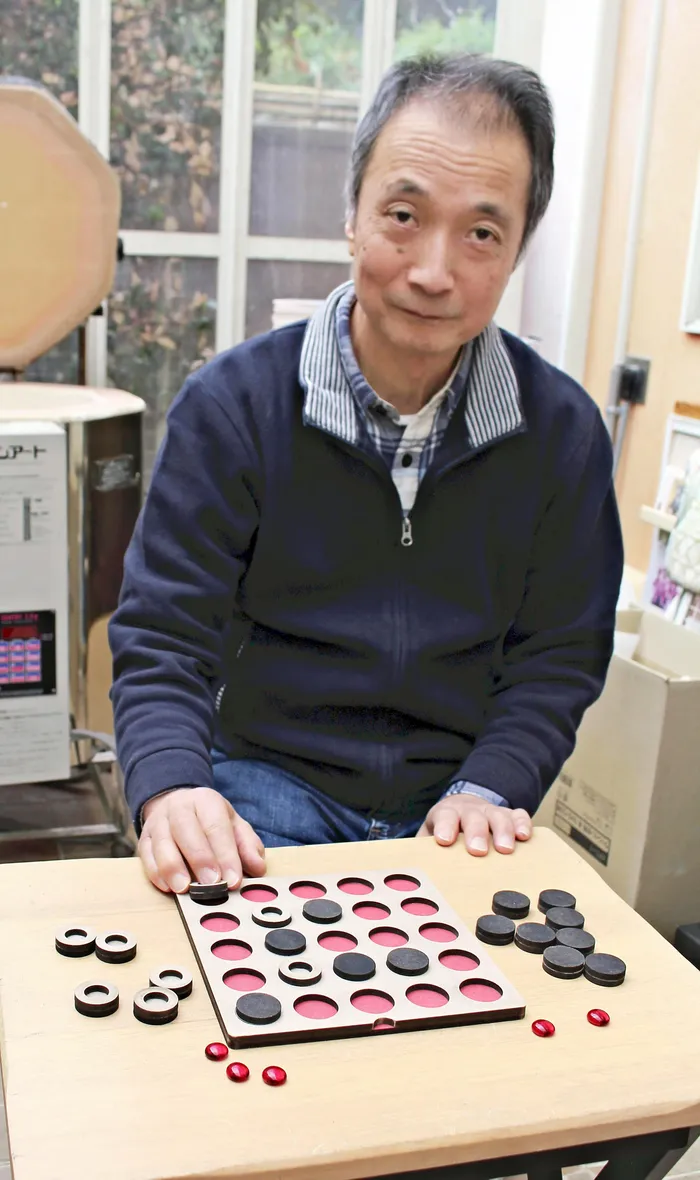
Mitsuo Yamamoto speaks about one of his board games.
Image: Japan News
Akiyoshi Suzuki
Board games for the blind designed by Mitsuo Yamamoto, a craftsman from Okutama, Tokyo, were featured at an exhibition in Hamura, Tokyo.
The April event included a special session in which Yamamoto explained the rules while participants experienced the games with their eyes closed.
Yamamoto, who originally produced ceramic interior goods, turned his attention to original board games about 30 years ago. Since then, he has developed approximately 80 different titles, which he sells through his company's website.
About eight years ago, Yamamoto was approached by a blind person who requested a game that could be played without sight. This prompted him to experiment with the tactile features of the pieces, modifying their shapes so they could be identified by touch alone.
The outcome of his efforts was “megateh,” a version of a four-in-a-row game where players match pieces by type and height. Yamamoto chose to make pieces from wood instead of ceramics to allow for holes to be drilled into them for tactile recognition.
A Swiss firm now sells the game under a licensing agreement.
Yamamoto has continued to expand his collection, developing three types of games and dice designed for the blind.
At the exhibition in Hamura, he introduced redesigned versions of his older games, with pieces made from wood to ensure they can be enjoyed by blind people.
Yamamoto's board games are almost entirely handcrafted, with production beginning only once an order is placed. Since he carries no inventory, each piece requires significant time and cost to deliver to customers.
To address these hurdles, Yamamoto has launched a crowdfunding campaign to purchase a laser cutter for processing game boards and pieces.
With a laser cutter, Yamamoto said he would be able to redesign and remake not only his own works but also traditional games like shogi and go, as well as more modern games, for blind people at a lower cost.
For his newest game, Yamamoto relied on an acquaintance with a laser cutter to process the pieces based on his designs. “Having my own laser cutter is essential for small-scale production,” Yamamoto said, as he called for public support. | Japan News