
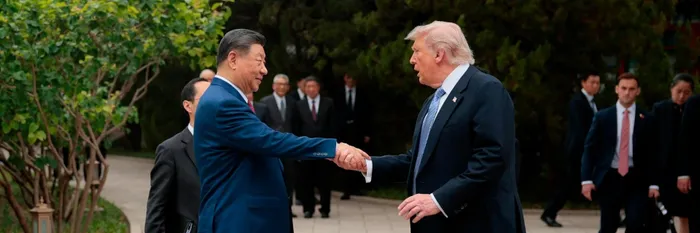
US president donald Trumps oddly uncomfortable 14-second handshake with Chinese president Xi Jinping last week.
Image: AFP
Last week, United States President Donald Trump and Chinese President Xi Jinping shook hands outside China’s Great Hall of the People, in Beijing, for 14 seconds. Almost immediately, we saw various pundits trying to interpret the meaning of the interaction.
A brief look at the history of the handshake, however, reveals the complexity of this gesture’s symbolism.
Handshakes can be traced back to ancient societies, but the exact origins are somewhat mysterious. It is often said – although difficult to prove – that the gesture developed as a symbol of good faith, with the participants showing their hands to be empty of weapons.
A further theory is that the shaking was intended to jiggle any hidden weapons loose from the sleeves – somewhat undermining it as a display of trust.
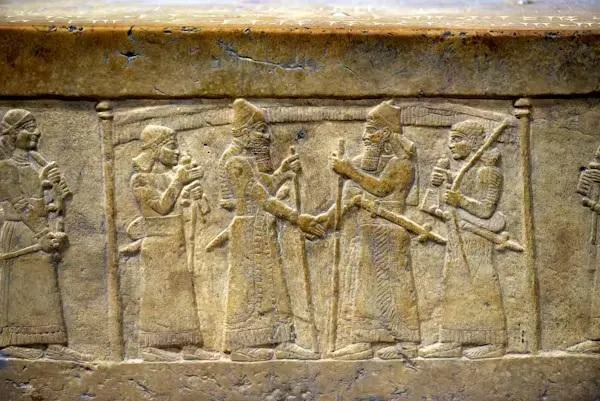
Shalmaneser III greets Marduk-zakir-shumi, King of Babylon, surrounded by guards. This dais was carved in the 9th century BCE, and is on display at the Iraq Museum in Bagdad.
Image: Wikimedia
The oldest known depiction of a handshake comes from the 9th century BCE, and represents a diplomatic display of unity.
On a limestone relief found in modern-day Iraq, King Shalmaneser III of Assyria and King Marduk-zakir-shumi I are shown shaking hands, symbolising renewed treaty relations between Babylon and Assyria, and an alliance between the two rulers.
Relations between the two great Mesopotamian powers had long been problematic, but the peaceful image of the handshake lingered in this artistic depiction, even as the rivalry grumbled on.
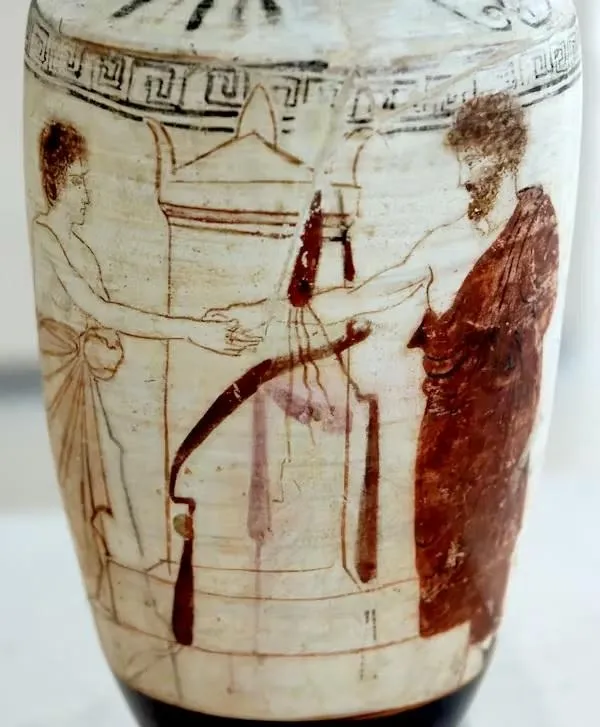
A dexiōsis (handshake) scene in a funeral context, on an ancient Greek jug.
Image: Wikimedia
Although more commonly considered a signal of greeting, the handshake has also been used as a powerful farewell gesture.
In Classical Greek art, grave reliefs depict the dead clasping hands with the living. This motif is known as dexiosis, meaning the “joining of the right hands”. It signals the end of the embodied connection between the pair, as well as the continuation of their loving bond in the afterlife.
Handshakes can sometimes also have a religious meaning. In ancient Rome, the right hand was strongly associated with Fides, the divine force of trust and good faith, so the hand clasping was a sacred bond.
The “joining of right hands” (known as the dextrarum iunctio) was a gesture of unity that could be used to symbolise weddings, as well as other social and political bonds. It was also closely linked with the Roman goddess Concordia, who was the divine personification of harmony.
The image of peace and harmony presented by the handshake shouldn’t always be taken at face value; the handshake symbolism can also be used to conceal a union in trouble. The Roman emperors Caracalla and Geta offer a clear example.
After the death of their father, emperor Septimius Severus, in 211 CE, the brothers ruled together. Imperial imagery shows them with right hands extended in harmony.
Yet before the year was out, Caracalla was plotting his brother’s murder. He arranged a meeting with Geta under the pretence of reconciliation, where Geta was killed – reportedly in the arms of their mother.
Even among heroes, a handshake didn’t guarantee a happy ending. In ancient Greek art, Herakles is depicted shaking hands with the centaur Pholos, symbolising a warm welcome from the hybrid being. Sadly, their greeting ends in tragedy: Herakles is attacked by intoxicated centaurs, and Pholos dies after being struck with a poisoned arrow.
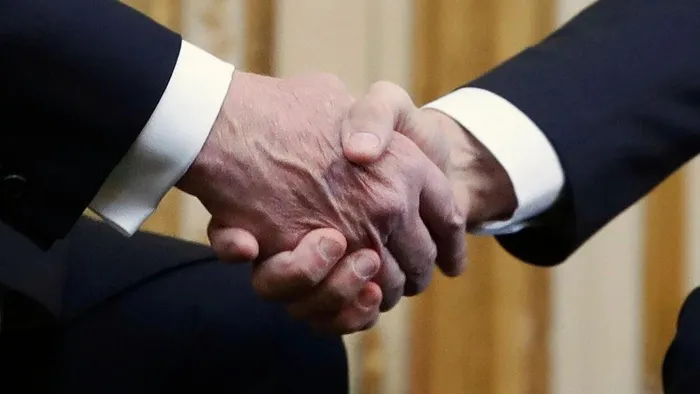
A close-up of the handshake of President Donald Trump, left, and French President Emmanuel Macron during their meeting inside the Elysee Palace in Paris. The handshake lasted a white knuckled 26 seconds.
Image: AFP
Australian politics has its own (significantly less bloody) version of the doomed handshake. On the eve of the 2004 federal election, the two party leaders, Mark Latham and John Howard, met outside ABC studios.
Latham’s exaggerated handshake made good political theatre but is generally viewed as a misstep. His party went on to lose the election, with the image looming large in the minds of voters.
In Assyrian art, the handshake is static. But in modern politics, handshakes are filmed in motion, replayed on news bulletins, clipped for social media, and analysed by audiences the world over. In this context, the handshake can become something of a power play.
Donald Trump’s handshakes are frequently read as tests of dominance, with long grips and close stances.
When Trump and French president Emmanuel Macron met in Brussels in 2017, their handshake was widely described as a white-knuckled contest. Macron later characterised the exchange as a deliberate “moment of truth” designed to show he would not be pushed around. Macron said he wished to signal he wouldn’t make concessions – “not even symbolic ones”.
Last year, the pair once again clasped hands in front of the cameras, for 26 seconds.
The symbolism attached to handshakes also means the rejection of an offered hand carries a powerful sting. During the 2020 Australian Black Summer bushfires, Prime Minister Scott Morrison tried shaking a firefighter’s hand while visiting the fire-ravaged town of Cobargo, New South Wales.
“I don’t really want to shake your hand,” the firefighter said. Morrison took his hand anyway.
When COVID came, people wondered if the new era might mark the end of the handshake. There were widespread health warnings against shaking hands, resulting in a rise of alternative physical greetings.
These included the fist bump – a gesture with complex origins of its own. The fist bump is a type of “dap” greeting associated with Black American soldiers during the Vietnam War.
Yet, from ancient Assyria to modern China, the handshake endures. More than a greeting, it’s a deeply symbolic tradition carrying a multitude of meanings.