
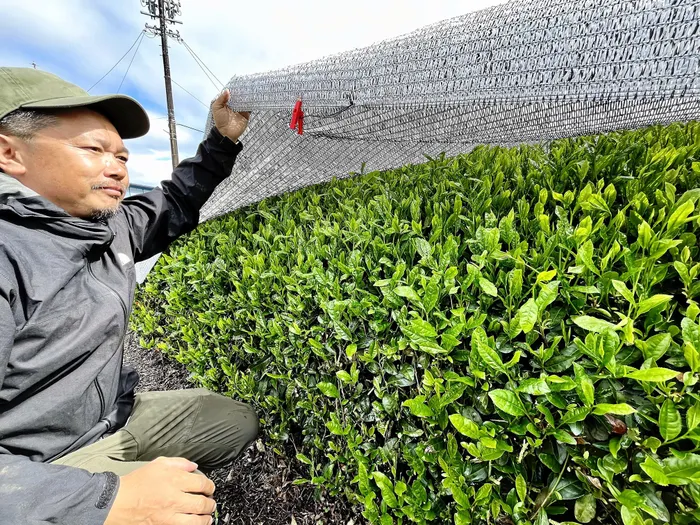
Tetsuya Matsunaga checks tencha, the tea leaves from which matcha is made, he is growing in Aoi Ward, Shizuoka.
Image: Japan News
Ayaka Higuchi
Powered by growing matcha demand overseas, exports of green tea - including matcha - climbed to a record-high value of 72.1 billion yen in 2025. But with supply unable to keep up with overall tea demand, the price of sencha green tea, commonly sipped at Japanese dining tables, is soaring.
Matcha has become popular worldwide as a healthy drink containing nutrients such as catechins and vitamin E. Its vibrant green is tailor-made for eye-catching photos on social media, and the deluge of posts showcasing matcha has been a major factor behind its growing popularity.
Foreign tourists account for about 70% of customers at The Matcha Tokyo, a matcha specialty store that opened in Omotesando, Tokyo, in 2018. On the back of the matcha boom, the operator now runs six stores in Japan and 54 overseas, including in Southeast Asia and Canada.
"Health-conscious young people in particular are choosing matcha over alcohol and coffee as their preferred drink," The Matcha Tokyo Co. Chief Executive Officer Masahiro Nagata said.
According to Finance Ministry figures and other sources, the volume of green tea exports in 2025, including matcha, topped 10,000 tons for the first time in about 70 years. The United States was the biggest destination, taking in more than 30% of these exports, but growth was also evident in Taiwan and elsewhere in Asia, as well as in Europe in countries like Germany.

A foreign tourist drinks a matcha beverage in Shibuya Ward, Tokyo, in April.
Image: Japan News
To make the most of the boom, the government is supporting farmers making the switch from sencha cultivation to tencha, the tea leaves from which matcha is made. Although sencha and tencha can be grown in the same fields, tencha bushes are covered with sheets before harvesting to block sunlight. The Agriculture, Forestry and Fisheries Ministry is providing subsidies for the purchase of these sheets and machines that process tencha leaves.
"Matcha is a leading export item," a ministry official told The Yomiuri Shimbun. "We'll support those seizing the opportunity to gain a bigger slice of the global market."
Ashikubo Teaworks, a cooperative association formed by tea farmers in the renowned tea-producing area of Aoi Ward, Shizuoka, in 2025 utilized subsidies provided by the government and other sources to bring in machinery and equipment worth 200 million yen. Tencha, previously grown on less than 10% of the 17 hectares of its tea fields, is now being cultivated on about 70% of that land.
The price of tencha in 2025 was about six times higher than in 2024. "That stunning price has motivated farmers," said Tetsuya Matsunaga, head of the association.
Amid this boom, domestic tea production has been unable to keep up with skyrocketing demand.
According to the agriculture ministry, tea farmers are an aging population, and many have a shortage of successors. Consequently, tea production came to 75,100 tons in 2025, a 25% drop from 20 years earlier. Even if new tea fields are planted, it takes about five years until leaves can be harvested, making it difficult to quickly increase production volumes.
Furthermore, the growing switch to tencha production has compounded a sencha shortage that has sent prices soaring. In April, the average price for new tea leaves sold at the season's first auction in Kagoshima Prefecture, the nation's largest producer of unrefined leaves, was 6,573 yen per kilogram, an increase of 60% from 2025.
These conditions are pushing up the prices of bottled green tea beverages. In March, Ito En, Ltd. and Coca-Cola Bottlers Japan Inc. hiked the prices of 600- to 650-milliliter bottled drinks by about 10%.
"If production tilts excessively toward tencha, sencha price surges will continue and that might lead to a decline in tea consumption," said executive director of the Japan Tea Central Public Interest Incorporated Association. "Sencha and tencha production need to be balanced."
Preventing imitation products and boosting matcha quality are also key challenges.
Uji matcha is a famous green tea brand from Uji, Kyoto Prefecture. However, imitation products bearing the words "Uji matcha" are reportedly circulating in China. An official of the prefectural government who oversees tea production said, "This could harm the Uji matcha brand. We'll press China to take stronger measures."
China has been rapidly expanding its tea production to cash in on the matcha boom. "Tea produced in China could become a threat for the processed matcha used in, for example, confectionery items," warned Kyoto Prefecture's tea industry research institute.
The aroma and flavor of some tea grown in China reportedly rival that of tea produced in Japan. “We need to further refine the quality of Japanese matcha and take steps to ensure our brands stand apart from the rest,” the institute said. | Japan News