
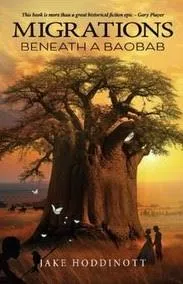
The debut novel of Jake Hoddinott who has been described as the new Wilbur Smith.
Image: Supplied.
AS a schoolboy, Jake Hoddinott found history rather dull. But years later, he would go on to write Migrations Beneath the Baobab, a historical romance rooted in events that unfolded more than a century ago.
In his literary debut, Hoddinott explores how history continues to shape the present through land rights, identity and the issue of belonging, going back to 1835. It tells the story of the Great Trek, how Boers left the Cape Colony to escape the British, and how they came up against a Matabele regiment moving across the country, determined to crush everything in its way.
“As I spoke to people and they told me stories and you heard of these legends of people that had gone before us, I got quite interested in it. Then I started reading a lot and building a knowledge base and along the way, I thought, well, there's so much I actually want to write a book one day.”
However, he makes it clear that his aim was not to write a textbook, but to tell history in a way that would form a connection with his readers. While the history is meticulously researched, Hoddinott says its the love story which forms a common thread and weaves it all together.
At its centre is 14-year-old orphan William Langford, an 1820 Settler, who goes in search of the love of his life, Marijke, the daughter of a prominent Trekboer who has been swept away in the Great Trek. His search takes him into areas filled with conflict and uncertainty, where his fate becomes tied to that of one of Mzilikazi’s most esteemed generals, Zenzo Khumalo. The two form an unlikely alliance before eventually being pitted against each other on the battlefield.
This book, like the others still to come, is structured around a 2,000-year-old baobab tree which serves as an intersection for the characters’ lives.

Former game ranger Jake Hoddinott who has launched his debut book, Migrations Beneath A Baobab.
Image: Supplied.
Hoddinott says his interest in the past deepened through his work as a game ranger and later as an entrepreneur. Living in a game reserve in the Greater Kruger region, he found that the landscape provided a string connection to the past and the world of his characters.
“It made it more realistic,” he says. “The environment I live in has many similarities to what it would have been like back then. That helped me visualise the story and set the scene.”
His experiences also showed him that history has many layers and that versions differ based on the perceptions of those who lived through it. Hoddinott drew on both written and oral history, which often differed.
“The most interesting thing about reading history,” he says, “is that the more you read, the more you realise there are multiple versions of the same story. Over time, you start to build a clearer picture of what actually happened.”
He says many South Africans feel aggrieved because of land loss and land seizures, going back tens of thousands of years, from the time of the San, to the arrival of the Bantu and then the European settlers. He wanted to understand why there was so much “angst” around the issue.
“That question was bugging me and that was probably the catalyst just to dig deeper into what was happening at the time.”
He said the romance ran parallel to all the historical events.
“Because so much had happened, it was just this light thread that pulled everything together, and it flowed beautifully with five or six fictional characters who were essentially the eyes and ears for the reader to immerse themselves in the plot.
“I just wanted people to understand what happened back then. We need to know that things are the way they are now because of what happened then. Most of us don't have a clue of what happened. We know a few things that a few politicians throw around, and they'll pick and choose what parts of history they want to focus on.
But very few of us actually understand the bigger picture, and this was just a nice, easy way of telling the story of our land,” said Hoddinott.
Early readers of Migrations Beneath the Baobab have drawn comparisons to the television series Game of Thrones, because of the rivalry, changing alliances and struggles over land which mirror the many layers of history in the book.
He says many readers who are not into history enjoyed the book because of the storyline, while others say it revealed things that they didn’t know had actually occurred in the country.
“I think the more of our history that can be told, the better, whether that’s in a visual medium or in print,” said Hoddinott.
“But I think the important thing to know is that there were good people on both sides and there were bad people on both sides.”
Hoddinott is already working on the second book, The Rivers Beneath a Baobab, which will be launched in the next few weeks.
Migrations Beneath the Baobab retails for R350 and can be ordered from SULA: https://sulabookdistributors.co.za/ | Email: laura@sula.co.za