
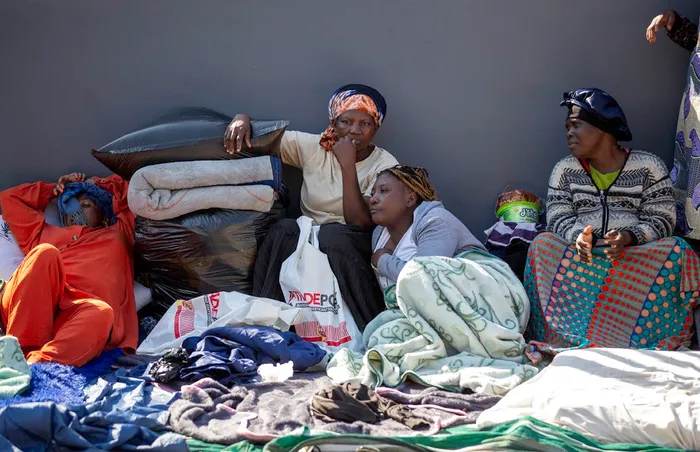
Photographer Hundreds of migrants have been camping outside the Department of Home Affairs’ Durban Refugee Reception Office in Glenwood where anxiety and uncertainty continue to mount amid warnings that they have until 30 June to leave the country
Image: Leon Lestrade/Independent Newspapers
THREATS of possible mobilisation against foreign nationals on June 30 are circulating widely on social media, fuelling concern about potential unrest in parts of the country.
Over the past weeks, foreign nationals have reportedly fled their homes, particularly in Durban where protests and attacks are said to have become more violent, forcing some families to abandon businesses, trading spaces, their homes and their daily routines in search of safety.
However, analysts and civil society voices say the anger is less about foreigners themselves and more about deeper problems; unemployment, poor services, corruption, and an economy that continues to leave many people struggling on the margins.
Authorities say they are monitoring the situation, although there is no confirmed threat.
Acting police commissioner Lieutenant General Puleng Dimpane said police were tracking anti-foreigner sentiments and any related mobilisation.
“Operational plans are in place to ensure that law and order is maintained at all times. Police will continue to act decisively against any acts of violence, intimidation, incitement, destruction of property, or unlawful conduct directed at any individual or group.”
Dimpane said 1 891 undocumented foreign nationals were arrested nationwide this week under Operation Shanela. From January 1 to May 17, more than 29 000 were arrested, with over 76 000 in the past year.
In Durban, the centre of recent protests and attacks, the eThekwini Municipality said rumours of a 30 June uprising were “receiving attention” from law enforcement.
Metro Police spokesperson Colonel Boysie Zungu said they were preparing officers to be deployed on the day to ensure the safety of “all residents and visitors”.
“At this stage, there are no specific areas identified as having higher tension than others,” Zungu said.
He said some foreign nationals had already left certain areas, and some foreign-owned shops were not operating, but it was still too early to measure the full impact of the rumours.
The SANDF has dismissed social media claims that it would be deployed ahead of planned marches, calling the reports “false, unfounded, and deliberately misleading.”
As rumours spread online, foreign nationals have turned to humanitarian organisations, churches and support centres for help. Some have also spent nights outside public spaces. Many foreign nationals slept outside the Diakonia Centre last week after clashes with police at the Durban Central police station during which rubber bullets were reportedly used.
The group says they are now pleading for protection and shelter after being forced out of their homes.
Some are still sleeping outside the Lawyers for Human Rights offices in Durban, saying they have nowhere else to go.
Nyiko Manyusa, an attorney at Lawyers for Human Rights, said the situation had gone beyond organised groups and was now affecting ordinary people acting on perception rather than fact.
“Even general members of the public feel like they can assault someone who appears to be not a South African citizen or take over their business,” he said.
Manyusa said trading spaces had been badly affected, with reports of people being attacked or losing stock and businesses during unrest. Many have also fled their homes.
“People have been assaulted, especially at their trading spaces. They had their stock taken over, they had their salons taken over,” he said.
“It’s displacement. You lose everything. You lose your business. You lose your life. You lose your home.”
He said the violence was not limited to undocumented migrants.
“It’s not about being legal or illegal,” he said. “We have had reports of people who are legally documented being assaulted. Some have been naturalised as South African citizens and were still targeted in the streets where they trade.”
Manyusa said confusion around immigration status was making things worse, with people often targeted based on appearance, language or perceived nationality rather than any legal fact.
He also warned that the language used in public talk was adding to the problem.
The repeated use of terms such as “illegal foreigner”, he said, risks blurring legal categories like asylum seekers, refugees and undocumented migrants, and increases the chance of wrongful targeting.
He suggested that some of the rising hostility may be politically driven, especially ahead of elections, and criticised what he called a cautious response from some political leaders.
He said public frustration should be dealt with through legal and democratic channels, not violence.
“The anger, if there is anger, is directed at the wrong people,” he said.
He added that people do have the right to challenge laws and government policy through courts and democratic processes, but “what we strongly condemn is the situation where people take the law into their own hands.”
Manyusa said it is “almost impossible” for people who are afraid to return home and carry on as normal.
“For asylum seekers, going back home is not an option because that is the very reason they came here. But now there is another dilemma in South Africa. They can’t live in their houses. They are in danger again in their host country.”
Migration experts and civil society groups say frustration over unemployment, housing shortages and failing services is increasingly being directed at visible and vulnerable targets rather than the real structural causes.
They have also warned that repeated use of broad labels risks inflaming tensions and deepening confusion about migration status.
Political analyst Sandile Swana said anti-immigration rhetoric is distracting from South Africa’s deeper economic crisis. “The anti-immigration campaign is a clear diversion of attention,” Swana said.
He said attention has shifted away from government failures and weak economic development.
“Our unemployment is 76% long-term,” he said.
Swana warned that rising anger and harsh rhetoric could spill into wider instability.
“Unfortunately, there’s the danger of breaking out into uncontrollable violence,” he said.
Professor Rozena Maart, SARChI Chair for the Study of the National Question at UKZN, said failing basic services are adding to daily pressure in communities.
“The lack of properly run basic services has meant that families often spend days and sometimes weeks without water and electricity. This is completely unacceptable,” she said.
She said many communities are carrying the weight of inequality and state failure in their everyday lives. “Trust is earned. Struggling communities have trusted our leadership and feel that they have been failed,” she said.
Economic Freedom Fighters leader Julius Malema has described anti-immigration mobilisation as “Afrophobia”, saying migrants are being wrongly blamed for government failures.
“Poor Africans from Zimbabwe, Mozambique, Nigeria, Somalia, or elsewhere on the continent are not responsible for unemployment, inequality, or collapsing public services,” he said.
GOOD Party secretary-general Brett Herron described anti-immigrant rhetoric as “untrue, morally bankrupt, and a dog-whistle for public violence.”
“Nobody will benefit from another bout of xenophobic-driven looting and savagery such as that of 2008, which claimed 62 lives,” he said.
The SA Human Rights Commission and the Department of Home Affairs had not responded by the time of going to print.