
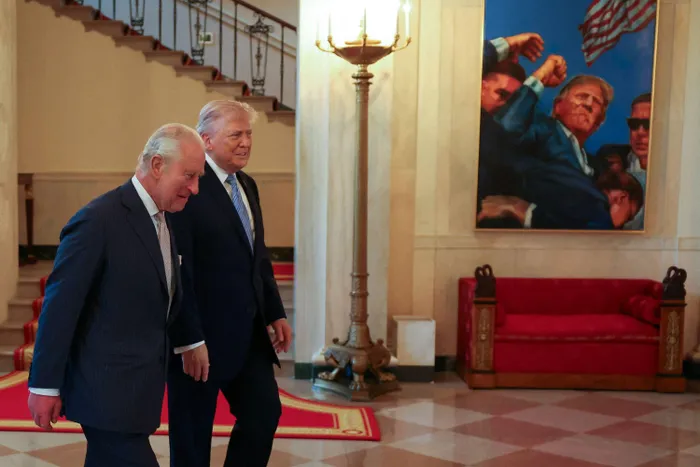
Britain's King Charles III and US President Donald Trump walk past a painting depicting Trump's assassination attempt in 2024 while touring the White House in Washington, DC.
Image: Suzanne Plunkett / POOL / AFP
Emily Heil
When it comes to state dinner menus, diplomacy is always on the table. In the modern era, such dinners - which are the most formal of White House social occasions - are often a chance to highlight American products and honor the visiting dignitaries with subtle nods to their country’s cuisines.
For the white-tie dinner honouring Britain’s King Charles III and Queen Camilla, which followed the monarch’s address to Congress on Tuesday, President Donald Trump and first lady Melania Trump seem to have gone old-school with a menu that leans on classically formal French preparations - with a few personal touches.
According to the White House, diners attending the soiree dined on the following menu:
First Course:
Garden Vegetable Velouté
Hearts of Palm
Toasted Shallots
Micro Mint
Second Course:
Spring Herbed Ravioli
Ricotta Cheese
Morels
Parmesan Emulsion
Third Course:
Dover Sole Meunière
Potato Pavé
Spring Ramps
Snow Peas
Parsley Oil
Dessert:
White House Honey & Vanilla Bean Crémeux
Flourless Chocolate Gâteau
Almond Joconde
Crème Fraîche Ice Cream
The wine list for those who partake (a list that doesn’t include the president) was designed to “complement the menu while honouring the shared heritage and enduring friendship between the United States and the United Kingdom, and [celebrate] the strength of American winemaking today,” according to the White House. It included Hopkins Riesling “Heritage” 2024, the Penner-Ash Pinot Noir “Willamette Valley” 2022, and the Newton Chardonnay “Unfiltered” 2022.
The dinner is a rare honour - it is only the second of Trump’s second term and his fourth overall, so a closer look at what was on the plates seems in order.
The White House chefs, who typically draw up the menus weeks ahead of time with input from the State Department (in addition to the president and first lady) about the dietary preferences and any cultural or religious taboos for their guests, often borrow influences from the visiting dignitaries’ cuisine. And the dinner might have been a moment to nod to the current vogue that British food is enjoying on the other side of the pond, with in-the-know diners suddenly chuffed with jacket potatoes and upscale pub food. But the choice to lean on the kind of fine French style that previous administrations served at dinners honouring Queen Elizabeth II was perhaps a conscious one, designed to honour an era when the relationship between the United States and the United Kingdom was more … settled.
Sole Meunière, in which the flaky white fish is bathed in a sauce of lemon and butter, is about as old-school French as it gets. But it has a place in modern American food iconography - it’s the dish that first turned Julia Child on to the wonders of cooking, according to Child’s memoirs. The star of the first course, velouté, is a sauce considered to be one of the “mother sauces” of French cooking, codified by Auguste Escoffier in his 1903 Le Guide Culinaire.
Dessert was another display of Francophilia, with all four components of the dish hailing from the country that notably served as America’s ally against the British in the Revolutionary War. European influence made another appearance in the second course, where two cheeses from Italy - ricotta and parmesan - decorated the ravioli, one of Italy’s iconic pastas.
That’s not to say the menu didn’t include any hat-tips to their guests. The honey, which was sourced from the White House hives, was seemingly a tribute to the king and queen, who have an interest in beekeeping. Earlier in the day, the first lady took the royals to visit the White House’s bees, and her ceremonial gift to the king was a sample of the honey along with a set of Tiffany’s English King sterling silver teaspoons.