
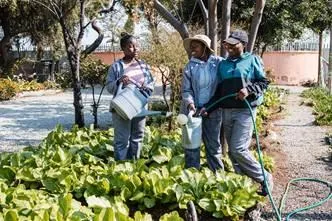
Young "agripreneurs" at work in Afrika Tikkun’s Green Acres Hydro-Coop, an initiative enabling young people to build income-generating micro-farming businesses.
Image: Supplied
South Africa is grappling with an alarming combination of persistently high youth unemployment rates and a decline in local food production. In a bid to address these interconnected challenges, non-profit organisation Afrika Tikkun has launched a pilot programme that cultivates a unique solution: transforming unemployed youth into micro-farming entrepreneurs.
The Green Acres Hydro-Coop programme, situated at Afrika Tikkun’s Green Acres Farm in Diepsloot, is designed to equip a select cohort of 20 individuals — 19 resilient young women and one determined young man with a disability — with the skills necessary to establish micro-farming ventures. These ventures not only promise a source of income, but also play a critical role in bolstering local food security and fostering economic growth.
The Hydro-Coop unit at the heart of this initiative is a state-of-the-art farming system that blends poultry production with hydroponic vegetable growing. These solar-powered, compact units are remarkable for their efficiency: they consume significantly less water than traditional farming and can operate in urban, rural, and remote settings with minimal infrastructure. The adoption of biodiversity-friendly, sustainable farming methods allows participants to acquire innovative agricultural skills, a vital asset in modern-day farming.
Since its inception in February, the programme has entered a practical development phase wherein participants transition from training to actual business operations. Over the course of this transformative 12-month programme, the cohort has engaged in comprehensive training covering hydroponics, farm management, and entrepreneurship, while simultaneously launching their own micro-enterprises.
In a significant development, Afrika Tikkun has partnered with Garden Fresh at Nine Yards, a prominent green town square in Johannesburg, and other retail outlets to sell the produce. This collaboration allows participants to experience hands-on training in sales and customer service within a customer-designed retail space, further enriching their entrepreneurial journey.
If the ambitious targets are met, these 20 enterprises are expected to generate impressive outcomes annually, including:
Marc Lubner, Group CEO of Afrika Tikkun, emphasises the importance of merging skills development with long-term mentorship. “When skills development is combined with long-term mentorship, farming stops being just a chore and becomes a sustainable career,” he says. “These youth aren't just farming for today; they are building the businesses of tomorrow. It is crucial to ensure this path remains accessible for them.”

Afrika Tikkun’s Green Acres Hydro-Coop uses compact solar-powered systems to produce both chickens and vegetables.
Image: Supplied
Notably, the cohort primarily comprises women who often encounter significant barriers to formal employment and business opportunities. This intentional focus reflects the broader economic reality where young women face elevated unemployment rates, lower business ownership levels, and limited access to start-up capital compared to their male counterparts. Instead of merely providing temporary employment, the project is anchored in the principle of ownership.
Agricultural initiatives like this have the potential to act as significant catalysts for job creation, entrepreneurship, and community growth. “By giving young people access to infrastructure, practical training, and market opportunities, we empower them to build viable businesses and long-term income,” Lubner adds. This model not only aims to support the participants but also addresses local food security comprehensively.
The Green Acres Hydro-Coop model is part of a broader framework that strengthens Afrika Tikkun’s agricultural programmes by blending training, enterprise development, and commercial operations. “Agripreneurship is a lifeline for our youth, creating avenues for unemployed individuals to ascend into entrepreneurship through Afrika Tikkun’s Cradle to Career model,” Lubner explains.
A shining example of this transformation is Debra Dagada, who progressed from an agricultural learnership with Afrika Tikkun to launching her micro-farming operation after receiving essential support and mentorship. Now an independent farmer at Northern Farm in Diepsloot, Dagada’s journey is a testament to how targeted training can yield tangible success.
UrbanFarm Africa, a local agritech service provider, also underscores the programme's potential; they have executed 271 smart farming projects while training over 7,500 individuals, collectively generating R250 million over five years.
“We believe in backing solutions that are both practical and enduring,” says Zakiya Khan, Head of Investments: Social Entrepreneurship at E Squared. “What stands out in this model is its focus on enabling young people to meaningfully participate in the economy, not just through skills development, but through ownership and the ability to generate income over time.”
Looking to the future, Afrika Tikkun plans to introduce another cohort of 20 participants in 2027, with aspirations to scale this transformative model across more communities in South Africa, paving the way for a new generation of agripreneurs.
IOS