
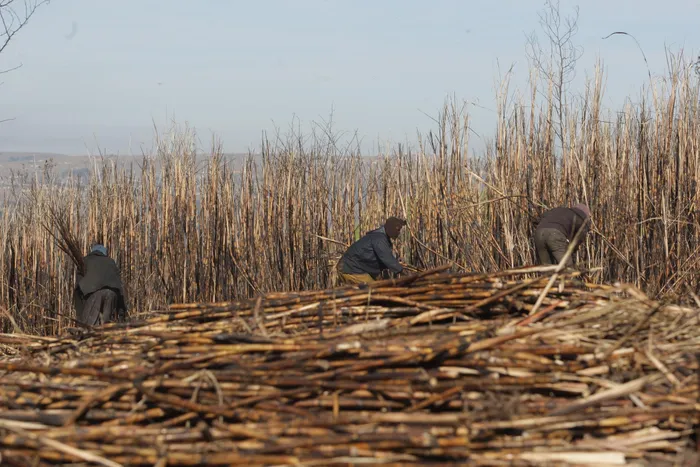
Ahead of the liquidation hearing for Tongaat Hulett, sugarcane growers have united in an initiative aimed at saving the company from going under.
Image: Bongani Mbatha/African News Agency(ANA)
As the liquidation hearing for Tongaat Hulett looms just weeks away, a coalition of sugarcane growers has embarked on a bold initiative aimed at securing the financial lifeline the company needs to avert disaster. The newly established GrowerCo seeks to raise funds vital for keeping Tongaat Hulett’s mills and refinery operational, which play a critical role in ensuring the survival of South Africa’s sugar industry.
Unlike conventional private-equity strategies that often prioritise short-term profits, GrowerCo’s vision focuses on the long-term sustainability of Tongaat Hulett. The initiative involves both small- and large-scale growers becoming equity partners, emphasising a collaborative model that seeks to maintain milling operations, protect jobs, and sustain economic activity across rural KwaZulu-Natal.
The 130-year-old Tongaat Hulett is more than just a company; it is a vital economic cornerstone for countless communities, directly supporting an estimated 35,000 to 40,000 jobs across farming, milling, and refineries, said Pratish Sharma, a grower supplying the Maidstone mill. “The future of KwaZulu-Natal is intricately tied to the future of Tongaat Hulett. The long-term economic and societal consequences of its liquidation would far exceed the liabilities on the company’s balance sheet,” he said.
Tongaat Hulett sources sugarcane from more than 17,500 of South Africa’s 28,000 producers, the majority of whom are small-scale farmers. A staggering 77% of South Africa’s sugar industry revenue is generated in KwaZulu-Natal, underscoring the region's importance for economic stability.
“GrowerCo not only makes sense because it puts Tongaat Hulett under the ownership of people with a long-term commitment to the sugar industry in South Africa, but it is also a beacon of what true economic transformation can be,” said Nicholas Ngobe, a grower associated with the Amatikulu mill. The model not only positions small-scale growers as equity partners but promises them returns from both their sugarcane production and participation in future equity growth. This unique revamp allows those whose ancestors may have toiled as indentured labourers in the sugar fields to become owners in one of the country's oldest sugar companies.
With a boost from long-term, patient capital, GrowerCo believes it can unlock sustainable value and foster the long-term viability of one of South Africa’s key agricultural sectors. Current estimates reveal that if Tongaat Hulett is sold as a going concern, creditors might recover between R3 billion and R4.5 billion. In stark contrast, liquidation could result in recovery plummeting to as little as R1 billion to R1.5 billion.
“Under this model, every creditor recovers more,” said Sharma. “GrowerCo is a stakeholder-inclusive plan to avoid a liquidation scenario and to ensure that Tongaat Hulett's South African sugar operations can continue as a going concern. It has been designed by the people who supply the cane, operate the mills, and depend on the industry.”
The interconnected nature of Tongaat Hulett’s operations creates a complex, integrated rural economy involving growers, mill workers, transporters, food producers, retailers, and consumers. A grower-led ownership structure could stabilise both ends of this critical value chain, ensuring sustainable operations and underpinning the livelihoods of thousands, Sharma said.
IOS