
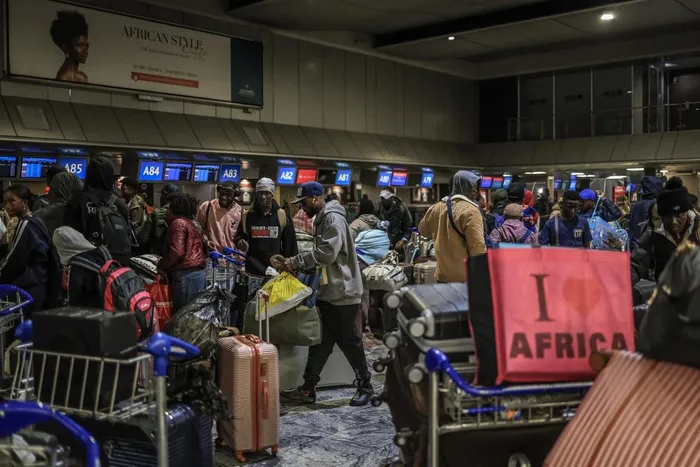
Ghanaian nationals stand at the check-in desk for an evacuation flight at OR Tambo International Airport, as anti-migrant protests expose the reality that South Africa’s anger may be rooted less in immigration than in household financial collapse.
Image: AFP
As the sun set on Africa Month, South Africa found itself grappling with a dual narrative: the celebration of unity envisioned by the African Union and the discord stemming from rising economic tensions. While May 25 marked Africa Day with flags raised and speeches delivered, the atmosphere was marred by protests against migration in major cities, reigniting the debate on the economic implications of foreign nationals living in the country.
The protests, organised by the March and March movement, unfolded in Johannesburg, Tshwane, and Durban, prompting Ghana's diplomatic mission to caution its nationals in South Africa, suggesting they close their businesses and consider repatriation. In a striking echo, Nigerian community associations echoed similar warnings, while Human Rights Watch called for urgent action from the South African government in response to the rising tide of anti-migration sentiment.
At the heart of this ongoing discourse lies a potent economic argument. Many South Africans perceive foreign nationals as competitors for limited job opportunities, blaming them for wage suppression and additional strain on public systems. However, these sentiments are met with resistance from migrant communities, which argue they contribute positively to the economy by paying taxes, establishing businesses, and fulfilling critical skills shortages.
Sebastien Alexanderson, Head of National Debt Advisors, points out that navigating these competing narratives requires a nuanced examination of the facts. “Both claims deserve scrutiny, and neither side is getting it,” he said. The economic landscape in South Africa is undeniably challenging: unemployment stands at a staggering 32.7%, with youth unemployment soaring to 60.9%. The contrasting realities of foreign nationals and local citizens have sparked heated discussions.
“Non-national dominance in spaza shops and street trade is seen as crowding locals out, while remittances are viewed as money leaving South Africa,” Alexanderson said. Yet he emphasises the reality that migrant businesses not only create jobs, but also support the economy through local spending.
“Both can be true at once,” Alexanderson remarked. “The real question is which effect is larger, where, and for whom.” This complexity is often overshadowed by the personal strain faced by both South Africans and foreign nationals, caught in a credit squeeze worsened by rising living costs.
Illustrating the gravity of the household crisis, Alexanderson highlighted how 75% of South Africans who borrowed money last year did so primarily to purchase food, rather than luxuries or assets. Similarly, many foreign nationals face severe financial pressures, managing multiple currencies and precarious finances without the refuge of formalised help due to fears regarding their immigration status.
This financial distress on both sides offers insight into the public anger resonating within the March and March protests, a collective frustration with the status quo. Yet, as Alexanderson argues, immigration alone cannot explain the high levels of unemployment and crisis that have haunted South Africa for decades. Structural issues such as the energy crisis, skills mismatch, and the fallout from COVID-19 have all systematically contributed to the current economic landscape.
The movement has effectively channeled the anguish surrounding financial instability towards immigration, a misdirection that merits discussion but does not address the underlying economic realities. As such, discussions of informal trade and the strain on local public services must be met with sensitivity, shedding xenophobic attitudes in favour of genuine dialogue around creating solutions.
In reflecting on the juxtaposition between the AU’s dream of a borderless continent and the realities faced in settings like Johannesburg and Tshwane, Alexanderson urges a re-examination of priorities. “When I look at consumers facing a debt crisis walking through our doors every day, I don’t see an immigration debate. I see a cost-of-living crisis wearing different faces.” It is this shared experience, rather than divisive rhetoric, that promotes understanding and, ultimately, solidarity.
IOS