
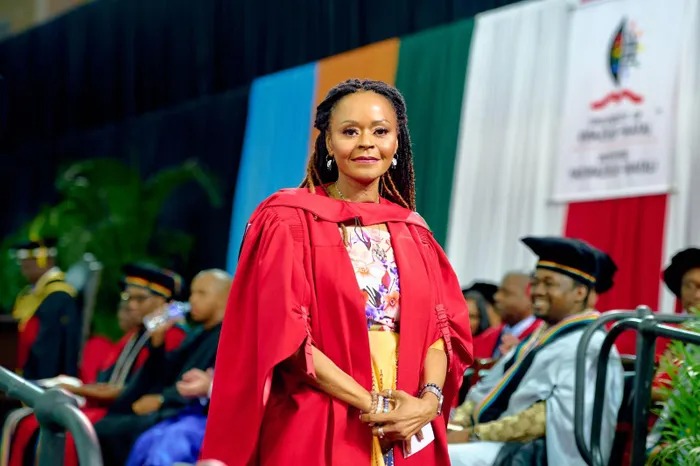
Executive Director of Corporate Relations, Dr Normah Zondo, donned the coveted red gown as she graduated with a doctoral degree.
Image: Sethu Dlamini
A senior University of KwaZulu-Natal (UKZN) communications strategist has stepped from behind the scenes of graduation ceremonies into the spotlight, earning her doctoral degree while reflecting on the very student journeys she helps showcase each year.
Dr Normah Zondo, Executive Director of Corporate Relations at the University of KwaZulu-Natal, graduated this week with a PhD that explores international student mobility as a complex, long-term developmental process rather than a single academic exchange.
For years, Zondo has played a central role in shaping UKZN’s graduation ceremonies. This time, however, she was among the graduates wearing the institution’s symbolic red gown.
“Before leaving, students rely on the University to navigate a ‘hidden curriculum’. Abroad, they undertake significant emotional and relational work to find a sense of belonging in unfamiliar spaces. Yet upon return, many lack the support needed to translate those global experiences into local academic and professional success,” she said, summarising one of the key findings of her research.
Her doctoral study was motivated by what she describes as a disconnect between institutional narratives of mobility and the lived realities of students participating in international exchange programmes.
Instead of focusing solely on statistics, her work examined the full student mobility lifecycle, from preparation and departure, through the challenges of studying abroad, to reintegration upon return.
A central insight of her research highlights inequality within these experiences, particularly for students without strong pre-existing networks. Zondo found that such students often carry a heavier emotional and social burden during their time abroad, making the experience both transformative and exhausting.
By reframing mobility as an ongoing developmental journey, her work aims to inform more equitable and supportive institutional practices in higher education.
“My research shifts the focus from just granting access to ensuring quality support throughout the entire process. Ultimately, it’s about helping students build confidence and agency on a global stage,” she said.
Balancing her academic work with senior leadership responsibilities and her role as President of the International Education Association of South Africa required what she described as disciplined time management and institutional support.
“The process was complex and exacting. Balancing concurrent responsibilities required careful calibration and sustained attentiveness to competing demands. What made this dual leadership possible was not only personal commitment but the strength, reliability, and collective professionalism of the teams with whom I worked,” she explained.
Much of her research and writing was done outside formal working hours, often in early mornings, late evenings, and weekends.
“The journey was a constant recalibration of energy. Managing high-level executive responsibilities meant doing the heavy lifting in the margins of time. I realised that persistence isn’t just about pushing through, it’s about strategic adjustment and maintaining a clear sense of purpose over a long period,” she said.
For Zondo, receiving unanimous approval from her thesis examiners marked a defining moment in her academic journey.
“Receiving unanimous approval from all three examiners was a deeply gratifying moment; it confirmed that these often-overlooked student narratives actually carry immense scholarly weight,” she said.
She added that the red graduation gown symbolised more than academic achievement.
“To me, the red gown symbolises that endurance. It represents the transformation of my own thinking and a commitment to lifelong learning, even within a demanding leadership role. It’s a marker of purpose sustained,” she said.
Zondo emphasised that her doctorate is not an endpoint, but part of a broader commitment to higher education transformation.
“This PhD is not an endpoint; it is a continuation of a life dedicated to ensuring that the transformative power of Higher Education is not just accessible, but celebrated for all,” she said.
IOL News