
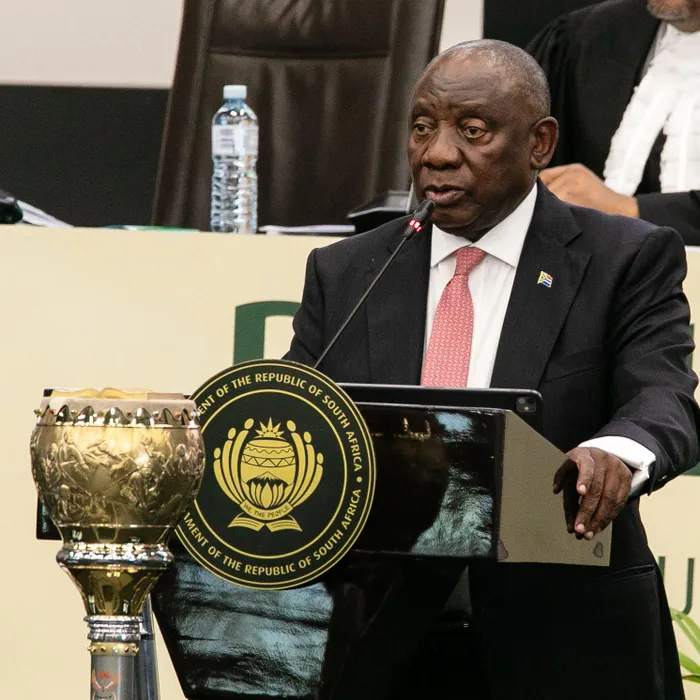
President Cyril Ramaphosa says government is exploring new financial aid solutions for students who do not qualify for Nsfas funding but still cannot afford the full cost of tertiary education.
Image: GCIS
President Cyril Ramaphosa says the government is developing a new funding model to help “missing middle” students who do not qualify for National Student Financial Aid Scheme (NSFAS) funding. but still cannot afford higher education. This as student debt at universities continues to rise.
Ramaphosa was responding to a question from ANC Member of Parliament (MP) Gaolatlhe David Kgabo in the National Assembly on Thursday on whether government would consider introducing innovative debt relief measures for students, similar to interventions previously implemented in sectors such as energy and municipalities.
Kgabo asked whether government would introduce measures to address student debt, which he said continues to perpetuate poverty and inequality by preventing students from graduating, obtaining certificates, securing employment or pursuing further studies.
In response, Ramaphosa said government had previously intervened in debt relief efforts within higher education, including a 2019 intervention aimed at assisting students with historical debt owed to NSFAS.
“This includes in 2019 the provision of debt relief to historically held debt that was due to Nsfas for qualifying students to the amount of R967 million,” Ramaphosa said.
He explained that the intervention targeted debt accumulated before the introduction of the new financial aid model in 2018.
Ramaphosa said Nsfas currently supports close to 900,000 students annually from low-income and working-class families to access higher education.
“Students supported by Nsfas who apply on time and meet the academic eligibility and progression requirements should graduate from institutions of higher learning with no debt,” he said.
“In other words, they will benefit from what you would call free university and college education.”
Despite this, Ramaphosa said universities continue to face growing student debt, which he said had reached approximately R23 billion in 2024.
“Now this debt is not held by the government but by public universities themselves. This is a concern for the financial sustainability of universities,” he said.
Ramaphosa said efforts to develop a long-term solution for student funding have been underway for several years.
“In 2022, the Minister of Higher Education and Training reported that a ministerial task team had provided advice on the development of what we would call a comprehensive student funding model,” he said.
Ramaphosa said the challenge largely affects students classified as the “missing middle”, who do not qualify for Nsfas assistance but are also unable to fully fund their studies independently.
“This model would address financial aid for students who are considered to be in the so-called missing middle,” he said.
“This is a diverse group of self-funded students, including those who do not meet NSFAS’s financial eligibility criteria and those who may struggle to access other forms of funding.”
Ramaphosa said work on the funding model was still underway and the department was in the process of finalising it.
“I’m hopeful that we will be able to have a new model that will assist those students who are in the missing middle, where they are able to afford certain levels of funding but not the complete funding that is required for their education,” he said.
He added that government wants to reduce student debt significantly to ensure greater access to higher education.
“So we would like to see the student debt reduced quite substantially so that all our young people are able to access education on a fair basis,” Ramaphosa said.
IOL Politics