
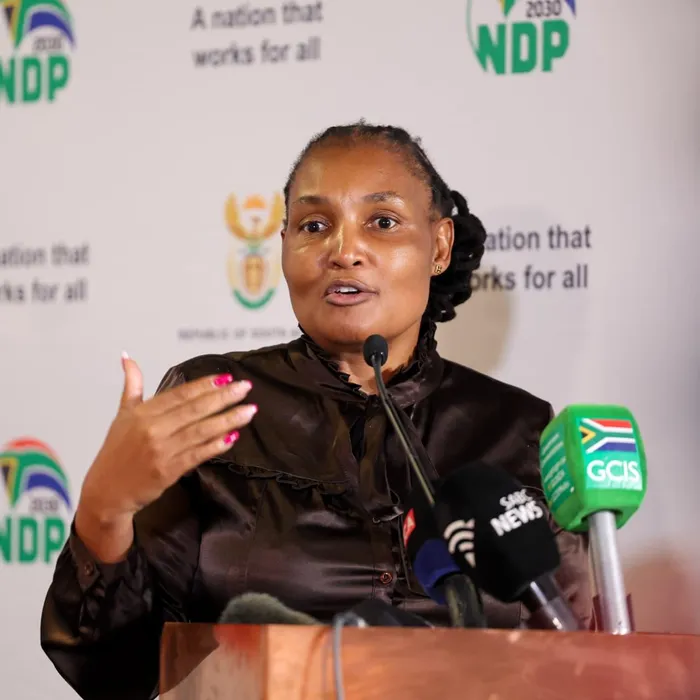
Minister Thembi Simelane says the PIE Amendment Bill has been published for public comment, aiming to strengthen eviction laws, curb illegal land occupations, and improve enforcement and legal clarity.
Image: Department of Human Settlements / X
Minister of Human Settlements Thembi Simelane says the Prevention of Illegal Eviction from and Unlawful Occupation of Land (PIE) Amendment Bill of 2026 has been published for public comment following Cabinet approval, marking a step in strengthening South Africa’s eviction and land occupation laws.
Simelane was speaking at a media briefing on Thursday, where she said government is reviewing and strengthening existing legislation governing illegal occupations and evictions.
“We are undertaking this process to review and strengthen the laws governing illegal occupations and evictions.
“This work will culminate in amendments that will strengthen the PIE Act, to ensure it is effective, easier to understand and simpler to enforce,” she said.
She said the intervention comes amid a rise in unlawful land and building occupations, which she said place a financial and administrative burden on government and the private sector.
Simelane said the proposed amendments are intended to empower municipalities, state entities and private property owners to respond more decisively to illegal occupations.
She added that one of the key challenges identified in the current law is inconsistent interpretation, which often leads to lengthy court processes and increased costs.
“The new Bill aims to close these gaps, thus providing greater clarity for everyone involved,” Simelane said.
She confirmed that the Bill has been gazetted for public comment, calling it a milestone in ensuring transparency and public participation.
Simelane said government is now calling on South Africans to participate in the process during the 60-day public comment period, which runs until mid-June 2026.
She said public consultation sessions will be held across the country, with the first engagement scheduled for 05 May 2026 in Ekurhuleni.
Simelane said inputs from stakeholders are essential in ensuring the legislation is balanced and fair.
“We wish to underscore that the inputs from all stakeholders and interested parties are vital in ensuring that this legislation is balanced, fair, and responsive to the needs of all who live in our country,” she said.
She added that government has consulted SALGA, provincial departments and other state institutions during the drafting process.
Simelane said the Bill also protects vulnerable people who may require alternative accommodation after eviction.
At the same time, she said the Bill takes a firm stance against criminal activity linked to land invasions.
“It targets those who unlawfully sell land or property that does not belong to them and those who incite unsuspecting people to unlawfully occupy land,” she said.
She said stronger measures are proposed, including forfeiture of assets and fines for offenders, as well as new offences for those who organise illegal occupations.
Among the proposals, Simelane said courts could impose a fine of up to R2 million or imprisonment of up to two years, or both, for those who incite illegal occupation.
She said courts may also order forfeiture of assets obtained through such offences and allow municipalities to apply for urgent interdicts even when they are not the landowner.
Simelane said the Bill introduces mandatory joinder of municipalities or state organs in eviction cases and mediation processes to reduce lengthy court disputes.
She said courts will also have discretion to determine alternative accommodation periods and may order demolition or removal of structures where necessary.
Simelane said the reforms aim to restore balance between property rights, municipal support, and protection of vulnerable communities.
“We firmly believe this Bill will contribute meaningfully to the development of sustainable human settlements and create a more stable and predictable environment for investment and growth,” she said.
hope.ntanzi@iol.co.za
IOL News