
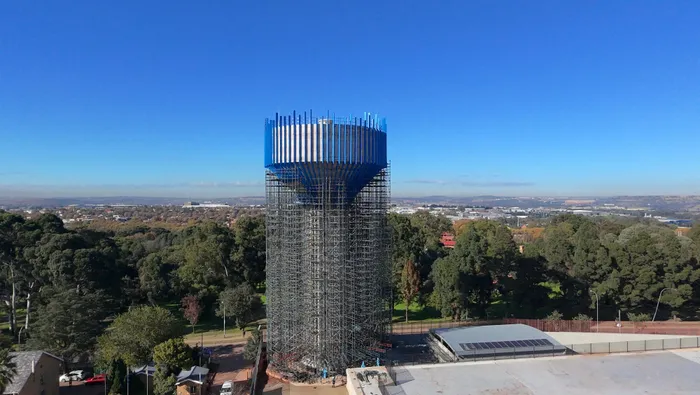
The City of Johannesburg led by Mayor Dada Morero and other dignitaries have welcomed the opening of the new reservoir in Brixton, Johannesburg.
Image: City of Joburg
The Water Crisis Committee in the City of Johannesburg has reacted positively to the opening of the Brixton Water Reservoir on Wednesday.
The committee, comprising residents from various neighbourhoods, including Kensington, Eastgate, Jeppe, Westdene, and Parktown, all grappling with recurring water shortages, welcomed the opening of the city's R2.1 billion water reservoir in Brixton.
Ravi Singh, one of the committee leaders, cautioned against being too optimistic, adding that it will take more than the completion of one infrastructure programme to resolve all the water challenges in parts of Joburg.
On Wednesday, the Minister of Water and Sanitation, Pemmy Majodina, in the company of Gauteng Premier, Panyaza Lesufi, and City of Joburg Mayor, Dada Morero, officially inaugurated the Brixton Water Reservoir.
This essential infrastructure project aims to address the ongoing water supply challenges in the region. Morero, who presided over the ceremony, highlighted the significance of the new facility in the city’s efforts to enhance water reliability and capacity.
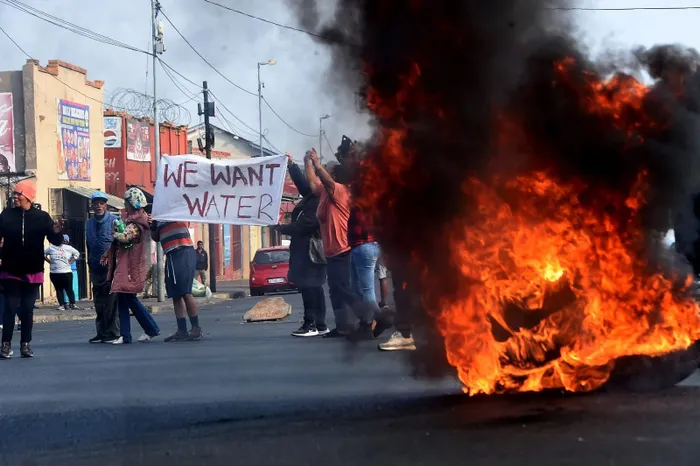
Service delivery in South Africa remains a big challenge for municipalities. This is largely due to municipalities not having the required resources to fulfil the delivery of basic services.
Image: Itumeleng English / Independent Newspapers
Equipped with a 26 megalitre ground reservoir, a two megalitre tower, and a state-of-the-art pump station that boasts a capacity of 200 megalitres per second, the Brixton Reservoir is poised to alleviate the prolonged water cuts and shortages that have plagued certain areas of the city. Morero indicated that the project represents a significant capital investment of R1.2 billion.
“This development forms part of the city’s broader effort to strengthen water system fundamentals and meet future demand, despite financial constraints and competing priorities,” Morero said.
Despite these advancements, the mayor acknowledged that the city faces significant hurdles, particularly regarding the current budgetary backlog, which stands at an alarming R27 billion.
“Overcoming this backlog will be challenging, and the current budget cannot fully address it,” Morero remarked.
He reassured residents that the city, with the backing of the National Treasury, is implementing strategies to empower service entities towards self-sufficiency.
“Service trading reforms have already been tabled in council, and we are proposing various strategic shifts to ensure the company operates as a ring-fenced entity.”
Singh, echoing Morero's sentiments, said: “We welcome development that will hopefully alleviate the plight of residents supplied by this reservoir. However, the City of Joburg and Joburg Water should not drop the ball. They must continue fixing the aging infrastructure in areas surrounding the inner city.”
Singh further noted that only sustained efforts will yield the desired results, which is due to ailing infrastructure and financial constraints.
“We need sustained action to reduce water losses through leaks and to ensure that the supply is consistent. It must be noted that this is a positive step forward, but it will not resolve the crisis on its own. We call on Joburg Water to implement its strategy, and that strategy must be fully funded with transparent spending.”
The recent completion of the Brixton project has also been celebrated by the Gauteng premier, who called the development a groundbreaking achievement in the city’s quest to strengthen water provision across Johannesburg.
“The project comprises a 26-megalitre ground reservoir, a 2-megalitre elevated water tower, a 200- litre-per-second pump station, and associated pipeline infrastructure. In addition to improving service delivery, the project has supported local economic development by engaging 25 SMMEs and creating 86 job opportunities,” Lesufi stated.
siyabonga.sithole@inl.co.za