
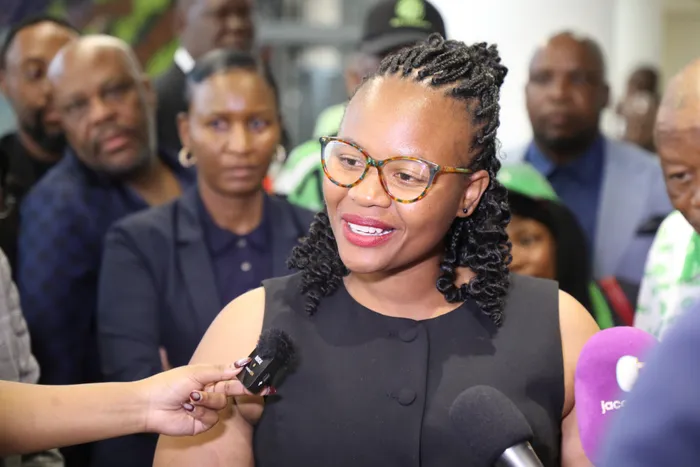
City of Tshwane mayor Dr. Nasiphi Moya insists that there is no water crisis in the country's capital.
Image: Oupa Mokoena / Independent Newspapers
Tshwane mayor Dr. Nasiphi Moya has denied that the municipality is experiencing a water crisis despite some parts going days without supply.
On Thursday, while delivering her second state of the capital address and the last before the local government elections at the University of South Africa in Tshwane, Moya denied that the city was experiencing a crisis.
“There is no water crisis in the City of Tshwane. The challenge is water losses caused by ageing infrastructure, leaks, and inefficiencies, not a lack of bulk supply,” she said.
However, she admitted that Hammanskraal and Bronkhorstspruit remain key pressure points but that the municipality was committed to restoring water supply after decades of shortages.
“In Hammanskraal, progress has been made in restoring access to clean and drinkable water through the completion of key infrastructure (projects),” the mayor stated.
The National Treasury has acknowledged that there is water crisis in the country; with water services becoming increasingly unreliable.
“Too many communities now experience intermittent supply, infrastructure failures and declining water quality,” Treasury said last month.
According to Moya, the City of Tshwane meets the demand of between 800 and 900 million litres per day. She said water losses are being reduced through control, repairs, and monitoring. “The goal remains unchanged: to build a water-secure city,” Moya stated.
She said meeting the demand is done through a mix of bulk procurement and internal production.
The mayor of the capital city explained that bulk procurement accounts for 72% of supply and this is mainly sourced from Rand Water, which supplies over 600 million litres per day.
The municipality also gets an additional bulk supply is sourced from Magalies Water and has an internal production accounts for 28% of supply, which comes from Rietvlei Dam and Roodeplaat Dam.
In addition, it also includes groundwater sources such as Grootfontein, Fontana and Sterkfontein, according to Moya.
“When we took office, non-technical losses were at 39% driven by theft and unbilled usage, especially in region one (including Klip-Kruisfontein, Ga-Rankuwa, Mabopane, Winterveldt and Soshanguve), alongside infrastructure over 50 years old,” she said.
Moya added that her administration introduced a water stabilisation plan to stabilise bulk supply, improve reservoirs and pump stations, manage pressure, fix leaks, reduce illegal connections and strengthen monitoring and metering.
“This restores system control while improving long-term performance. In Mamelodi, the areas of Ikageng and Mahube Valley Extension 3 went without reliable water supply for more than six years,” she explained.
Moya said water has now been restored, with residents once again able to access water in their taps.
She explained that in Winterveldt, Olievenhoutbosch, Mabopane and Bronkhorstspruit interventions are improving consistency and restoring control and that as of this month reservoir and water storage infrastructure is performing strongly.
Moya said the projects the municipality has implemented will improve storage capacity and strengthen the reliability of its water supply system.
Treasury has noted that 105 out of 144 Water Service Authorities (WSAs) scored poor or critical in terms of the performance of their drinking water systems (Blue Drop) and/or wastewater systems (Green Drop) in the most recent reports.
“This means that water and sanitation services are failing in 73% of WSAs – widespread failure of municipal water and sanitation services indicates a systemic problem. By September 2025, 53 out of the 105 worst performing WSAs had not yet produced corrective action plans to address their 2023 Blue, Green and No Drop report results,” Treasury added.
It warned that water demand is expected to exceed supply in several regions due to population growth, urbanisation, inefficient water use and climate change.
“These pressures are already evident in major economic centres across the country, impacting on development and economic growth. Although South Africa is naturally water-scarce, the current crisis is primarily driven by municipal infrastructure and governance failures, while the uncertainty introduced by climate change multiplies all water related risks,” the Treasury stated.
Additionally, it cautioned that high water losses, ageing and poorly maintained infrastructure, weak financial management as well as growing municipal debts to water boards were placing the entire water value chain at risk and that water revenues are rarely reinvested into maintaining and upgrading infrastructure.
loyiso.sidimba@inl.co.za