
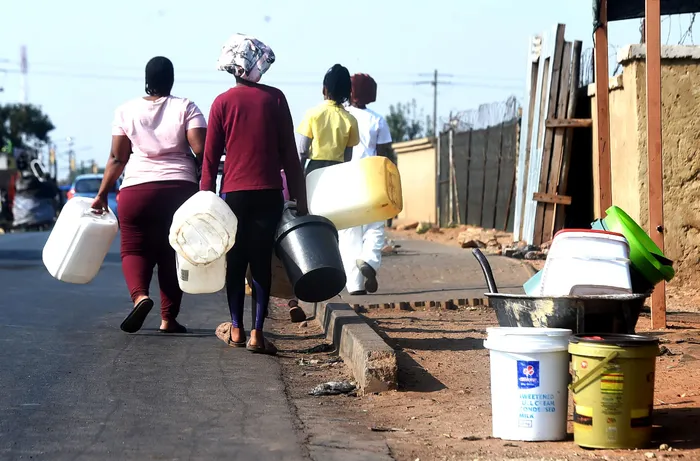
Years of water crisis in Pietermaritzburg has been attributed to illegal pipe connections, which has left communities relying on tankers for the supply.
Image: Itumeleng English/ Independent Newspapers
To have their communal tap water reinstated, residents of Willowfountain in Pietermaritzburg must first disconnect water they have illegally connected to their homes.
This rural community, where former health and Cooperative Governance and Traditional Affairs minister Zweli Mkhize comes from, is among many in the country that rely on water supplied by trucks daily.
Hundreds of residents from Willowfountain marched to the KwaZulu-Natal capital’s City Hall to demand basic services, with tap water being their top priority.
In response to the demands, their Ward 14 Councillor Sibusiso Mkhize said the ward is among many in the Msunduzi Municipality facing a water crisis.
He stated that the crisis in his ward, home to 6,000 residents, is due to illegal connections.
“The biggest problem is the illegal connection because in Willowfountain, there are few homesteads with water meters, and the rest should be accessing water through communal taps.
“Because everyone wants water in their yards, we often resort to illegal connections,” said the councillor.
He said the village has two reservoir tanks, the main being in the KwaKhuzwayo area, which supplies the one in the KwaPhuphu area.
“You will find that water will end up in the KwaKhuzwayo area because KwaKhuzwayo residents connect pipes illegally to their homes, which prevents water from reaching the reservoir in the KwaPhupha area,” said Mkhize.
He said the Willowfountain area does not have the capacity to supply water to each homestead as the system was designed for communal taps.
He said in 2024, Mayor Mzimkhulu Thobela held a community meeting where he requested the removal of illegally connected pipes and for residents to return to communal taps.
Msunduzi is yet to respond to questions sent to its spokesperson, Ntobeko Ngcobo, and Mzimkhulu.
“The community has been resistant. On Wednesday, another meeting, which the deputy mayor and the official in charge of infrastructure attended, was intended to secure an agreement to remove illegal connections and revert to communal taps, but many people refused to consider it,” Mkhize said.
Residents suspected that the municipality's contract with private water tankers was the reason their taps remained dry for years.
Mkhize said the water shortage affected many areas in Pietermaritzburg and that tankers were introduced as temporary measures.
He said another problem is that people would illegally open the reservoirs and illegally connect the water directly.
“The reservoir valves would be switched off in the evening so that water can be filled up throughout the night, but people can switch on the valves, which prevent the reservoir from filling up.
“We have a problem with water, but as people, we make it worse through illegal activities, which is a crime,” said Mkhize.
He said the municipality was looking at the possibility that some of its water department officials were hired to do illegal connections.
He said it would be costly for the municipality to provide security for the reservoirs.
“We are going to return to the community on Wednesday (May 20) to give instructions that all illegal pipes should be removed, and for everyone to go back to communal taps.
“If you don’t have municipal water meters in your yard, you have to either go out to collect water or you dig a borehole.
“Many households cannot afford boreholes as they are expensive, as I have heard that the cheapest boreholes cost around R20,000 or R30,000,” said Mkhize.
Besides cooking, drinking, and bathing, some residents need water to flush toilets.
Mkhize said tankers were not allowed to drive into each homestead to fill up Jojo tanks, but residents can only use 25-litre containers to collect water from the trucks.
Local community leader, Slindokuhle Zuma, the convener of the May 15 protest, said Willowfountain has enough water to feed the whole community, but tankers were the cause of the problem.
She based her argument on the Pietermaritzburg-based Witness newspaper’s May 12 report that the municipality has spent R17 million hiring 12 private water tankers, “while nearly 10 of its own tankers remained broken down and parked at municipal workshops”.
They deliberately switch off the water because they are promoting private water tankers.
“In Willowfountain, no problem with accessing water, but the problem started in 2016 when they introduced water tankers, and it continued till today,” said Zuma.
She said the area of KwaPhupha has been relying on tankers for the past 10 years.
“But lately, the whole Willowfountain does not have water, and tankers sometimes do not come for a month. We would have to beg for the tanker to come as if they were doing us a favour.
“We will spend a month without water, and when the tanker comes, it will bring us dirty water, which makes us suspect that they are drawing it from the river,” said Zuma.
Residents said: “We are tired of being treated as voting cows, we demand our basic services as per the Freedom Charter.”
In their memorandum, they accused the municipality of violating four sections of the Constitution, which oblige the government to provide services sustainably, accountably, and transparently in response to the people’s needs.
“Municipal Systems Act 32 of 2000 obligates councillors and municipalities to engage communities and address service delivery concerns effectively. Municipal Structures Act 117 of 1998 requires councillors to represent the interests of their communities responsibly and accountably.
“Batho Pele Principles emphasise consultation, transparency, responsiveness, and service excellence,” read the memorandum.
They gave the municipality 14 days to respond to their grievances and also demanded a formal meeting.
Msunduzi Local Municipality spokesperson Ntobeko Ngcobo acknowledged that the municipality is facing water supply challenges.
According to Ngcobo, some areas experience intermittent supply interruptions as a result of factors such as ageing infrastructure, rapid population growth, illegal connections, land invasions, increased household connections, waterborne sanitation upgrades, and broader supply constraints affecting the system.
“Water tankers are, therefore, utilised as a supplementary intervention measure to ensure that residents continue receiving access to water while permanent infrastructure solutions are being implemented,” she said.
Ngcobo rejected allegations that the shortage of tap water was deliberately meant to benefit companies that operate tankers.
“The use of water tankers is purely a service delivery intervention aimed at assisting affected communities during periods of intermittent supply, infrastructure breakdowns, curtailment, and maintenance-related disruptions.
“All procurement and appointment processes are conducted in accordance with applicable legislation and municipal policies,” she said.
She also said water provided by tankers undergoes regular quality testing and monitoring by the Environmental Health Section to ensure compliance with potable drinking water standards and to safeguard public health.
bongani.hans@inl.co.za