
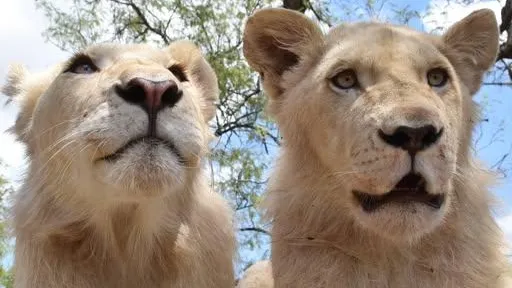
The lions in the pcture may look like they indicate the successes of African conservation efforst, but it's what's happening outside of the picture that's making our big parks less tenable.
Image: File
Guillaume Bonn
Not long ago, humans needed protection from wildlife. Today, wildlife needs protection from humans. And it’s losing ground even in places created to give it every advantage.
I have spent my career documenting this contradiction: The billions spent on “saving” Africa’s wilderness have failed to save much at all. Conservation has become a global industry - an expensive illusion that soothes consciences in London or Washington while leaving behind broken systems and bitter communities.
The model of “fortress conservation” - protecting what’s inside a park while ignoring what happens outside - was born in the colonial era. The system was flawed from the start. When the first African national parks were created, hunter-gatherers who had coexisted with elephants and lions for centuries were expelled from ancestral lands. They were told that entering a park made them poachers.
Today, many of Africa’s parks feel like open-air zoos. Animals migrate with the rains, but fences stop them. People need land to farm and fuel to cook, yet conservation policies rarely consider what happens beyond park borders. Meanwhile, around the edges, unmonitored dwellings mushroom.
The discontinuity can be jarring, but it is normally cropped out of the wildlife images the world sees. A photo of a lion prowling an unpeopled grassland suggests unspoiled wilderness. The sprawl just out of frame tells a different story.
Human encroachment, poverty and the demands of tourism, often fueled by corruption, have led to an explosion of hotels and lodges, further straining fragile ecosystems.
It is easier to raise funds to fight poaching than to question these deeper structural failures. Yet poaching is just a symptom. The real crisis lies in how conservation has been managed - and by whom. Conservation in Africa remains dominated by money and influence, often controlled from abroad. Western donors and nongovernmental organizations hold the purse strings, while African communities have little say.
I have seen glimmers of real, community-led conservation. Richard Bonham, once a hunter, works with the Maasai to compensate herders when lions kill livestock, replacing resentment with coexistence. The Namunyak Community Conservancy, established in 1995 by the Samburu people, protects critical wildlife habitat and serves as a seasonal migration corridor for elephants moving between the Mathews Range, Mount Kenya and the Ngare Ndare Forest. These programs are rooted in respect, not charity. But they are small, isolated successes, showing the limits of what individuals can do without systemic change.
Nairobi, where I grew up, has become a sprawling metropolis of around 5 million. The wild places of my childhood are disappearing. As Kenya’s population grows, land pressures will only intensify. Wildlife corridors are narrowing. When those passages close, ecosystems could collapse. Across the continent, wilderness is fragmenting into shrinking islands of life surrounded by human expansion.
If there is one lesson I’ve learned, it’s that good intentions are not enough. Money is not enough. Charity, when divorced from accountability and humility, becomes another form of power.
What system, then, could replace the one that is failing? Conservation cannot continue to be managed from abroad; to succeed over the long term, it must be directed by the people whose lands and livelihoods are most at stake.
That means making conservation funding transparent and accountable. It also means shifting power - to give communities who live with wildlife real authority over how land is used and protected. Because they are the only ones who can truly make the trade-offs - such as limits on tourism and protection of migration corridors - necessary to restore harmony between what’s in the majestic photo and what stands outside the frame.