
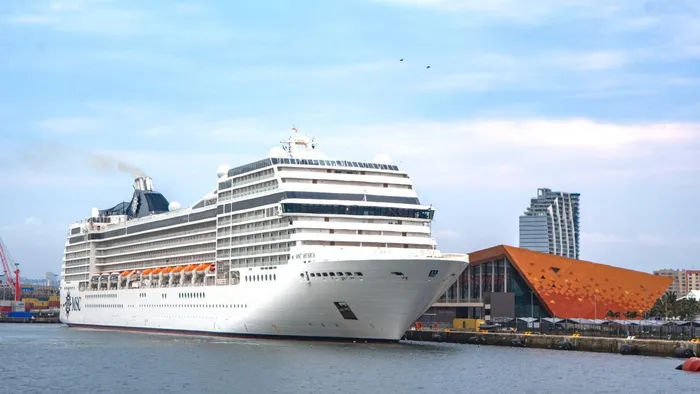
MSC Cruises is optimistic about the future of crusing in Durban and KwaZulu-Natal.
Image: Supplied
MSC Cruises says South Africa’s cruise industry is continuing on an upward trajectory, with growing passenger demand, increased vessel activity and stronger investment in cruise infrastructure, positioning the country as a key player in the African tourism economy.
In an interview with "Independent Media Lifestyle", Ross Volk, managing director of MSC Cruises South Africa, highlighted several standout trends from the latest cruise season, including the growing number of women travellers and the continued importance of KwaZulu-Natal as the company’s operational hub in Southern Africa.
Volk said more than 65% of MSC Cruises’ passengers during the latest season were women, describing it as one of the most significant travel trends emerging from the local market.
“We’ve had just over 75,000 guests this year, which has been great to see,” said Volk.
He added that increased cruise activity at Durban’s terminal was another encouraging sign for the province and the country’s tourism sector.
“The premier alluded to about 27 vessel calls coming to Durban, which I think is very positive for the province and the country in general,” he said.
Durban continues to play a pivotal role in MSC Cruises’ Southern African operations, serving as the company’s primary gateway to Mozambique and its main regional cruise hub.
Volk said the city’s strategic importance extends beyond tourism, contributing significantly to the broader KwaZulu-Natal economy through accommodation bookings, transport services and visitor spending.
“Durban is our centre, it’s our hub,” he said.
“We obviously bring a huge volume of passengers down to KZN. So you have all the ancillary transport, hotel stays, and tourism spend within the greater KZN economy.”
According to Volk, the company intends to strengthen its long-term relationship with KwaZulu-Natal through continued collaboration around infrastructure and cruise development.
MSC Cruises recorded around 80,000 passengers in KwaZulu-Natal during the latest season, although Volk noted that the figure was slightly lower than previous years due to the deployment of a smaller vessel better suited to current market conditions.
He explained that global cruise deployment decisions are often made years in advance and are influenced by international economic conditions and operational strategies.
“This was a strategic decision to try and best fit the ship for South Africa in terms of entertainment [and] the type of vessel that exists,” he said.
Despite the temporary reduction in passenger numbers, Volk indicated that larger vessels could return to South African waters in future seasons as market demand continues to grow.
While unable to disclose specific details, Volk confirmed that MSC Cruises is engaged in discussions around future investments linked to Durban and KwaZulu-Natal’s cruise infrastructure.
He reiterated that Durban remains central to the company’s long-term strategy in the region.
“Everything we do is centred around the infrastructure development of Durban and KZN and the cruise industry from this particular province,” he said.
MSC Cruises has already played a significant role in the development of the Durban Cruise Terminal, which has strengthened the city’s position as one of Africa’s leading cruise destinations.
Volk said affordability and accessibility continue to drive cruise demand among South Africans, particularly among younger travellers, families and first-time cruisers.
The company is now refining its future product offerings and marketing strategies to better align with these growing consumer segments.
He revealed that upcoming strategic discussions in Geneva will focus heavily on tailoring cruise experiences to families, young travellers and women passengers.
“Our marketing strategies are designed to integrate that into our overall market plan,” he said.
Looking ahead, Volk believes the long-term success of South Africa’s cruise industry will depend heavily on infrastructure development, destination marketing and improved transport networks.
He said the country has the potential to unlock exponential growth similar to major international cruise markets if investment continues across tourism infrastructure.
“The cruise industry in South Africa needs to focus on infrastructure development in various centres,” Volk said.
“That would incorporate road networks, hotels, destinations and marketing around that to facilitate exponential growth.”
Volk added that MSC Cruises intends to remain at the forefront of the industry’s expansion across Southern Africa.
“MSC is the leading cruise brand in South Africa and Southern Africa, and we are going to continue to set the pace,” he said.