
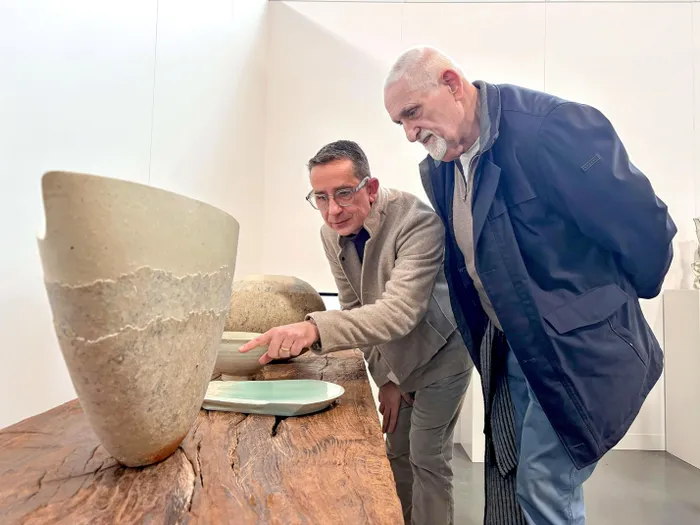
Visitors to the Ceramic Brussels fair held in Brussels view a work by Ryuichi Kakurezaki on January 21.
Image: Hiroshi Uesugi/Japan News
Hiroshi Uesugi
Interest in Japanese ceramics has been on the rise in Europe in recent years.
At an international ceramics fair held in Brussels, many pieces by Japanese ceramic artists were showcased from January 21 to 25. Ceramic Brussels hosted about 70 art galleries from more than 10 countries, primarily in Europe, including France.
Belgian Didier Delville, 66, exhibited works by about 10 Japanese artists, including Ryuichi Kakurezaki, 75, a designated holder of Okayama Prefecture's important intangible cultural property in the field of Bizen ware.
Delville primarily collects Japanese ceramics, having purchased 500-600 pieces to date. He met Kakurezaki during a visit to Bizen and Setouchi in the prefecture in the autumn of 2024. Delville took a deep liking to the Japanese artisan's personality and work and commissioned him to contribute to his exhibition.
Delville said that an appeal of Japanese ceramics is the Japanese philosophical concept that something living dwells in clay and water, a concept that does not exist in the West, giving the works and their artists distinctive narrative qualities.
At the fair, he told visitors that each region in Japan has its own distinct ceramic techniques and history.
According to Delville, when he first became interested in Japanese ceramics about 10 years ago, there was virtually no market for the works in Europe. Since then, however, Japanese ceramics have been featured at various art fairs and other events across Europe, gradually growing in popularity.
Heinz Schauffele, who visited the fair from Germany, was seen gazing intently at the exhibits. He said that ceramics produced in Europe and the United States were generally smooth, and it was interesting that Japanese artisans deliberately retained roughness and cracks on their ceramics.
Ceramic Brussels started in 2024 and was held for the third time this year. While many art fairs feature paintings and sculptures, the fair has been drawing attention for specialising in ceramics.
The Japanese Ambassador to Belgium, Takeshi Osuga, who visited the fair, intends to emphasise the appeal of Japan's traditional kogei - craft-based art that combines refined aesthetic sensibility with particular function, rooted in everyday life and sustained by skilled handwork - to a worldwide audience. "I want to lend a hand to spread the charm of Japan's traditional kogei aiming for them to enjoy the same kind of massive worldwide popularity as Japanese food," he said.
Behind the exhibition of Kakurezaki's work at Ceramic Brussels lies a proactive strategy by the city of Bizen to expand the presence of its ceramics overseas.
In the spring of 2024, the city participated in the Milan Design Week fair in Italy along with Bizen ware artists. The effort was supported by an organisation called Kitamae-bune Koryu Kakudai Kiko, which aims to connect and revitalise areas that prospered with Kitamae-bune trading ships in the past.
During that trip, officials from the city met Delville through the mediation of Etsuro Ninomiya, a former counsellor at the Japanese mission to the European Union and currently a director of the finance minister's secretariat.
Delville later visited Bizen at its invitation. While in the city, he purchased four of Kakurezaki's works for the Brussels fair and was able to sell two of them at the event.
Kakurezaki said, "I've been developing a 'Shiroi Bizen-yaki' (white Bizen ware) series as a new genre of Bizen ware, and Delville seemed to have taken a liking to it."
“Our mission is to take the traditional kogei techniques and knowledge passed down to us and create future-oriented works,” Kakurezaki added. “Ninomiya shares our sense of duty to spread [the kogei] throughout the world as an important part of Japanese culture. I’m deeply grateful for that.”