
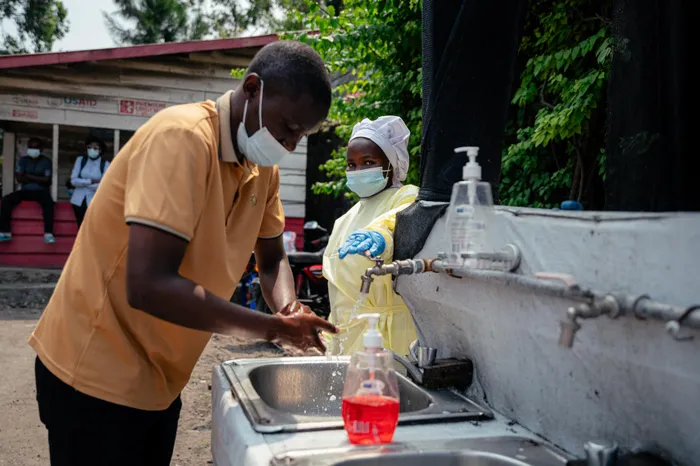
A visitor washes his hands before entering Kyeshero Hospital at a checkpoint for hand washing and temperature screening for all visitors and patients entering the hospital, as part of Ebola prevention measures in Goma this week.
Image: JOSPIN MWISHA / AFP
Lena H. Sun and Lauren Weber
Public health authorities and experts warn the world is confronting a dangerous convergence of factors that could make the latest Ebola outbreak extraordinarily difficult to contain: a fast-moving epidemic in a conflict-ridden region, involving a strain with no approved vaccine, at a moment when the global health infrastructure built after past Ebola crises has been weakened by funding cuts and political upheaval.
The concern comes as the United States on Monday tightened entry rules for some travelers and disclosed that an American infected with the deadly disease was flown to Germany for treatment.
The outbreak is suspected to be linked to 88 deaths and more than 300 infections, prompting the World Health Organization to declare an international public health emergency in Democratic Republic of Congo and Uganda on Sunday. Experts warn the toll is likely to rise sharply in the coming weeks as investigators continue tracing infections across the region.
The suspected death toll has already topped previous outbreaks of this particular strain of Ebola, which has a 25 to 50 percent case fatality rate.
In past outbreaks, the world learned of cases gradually before numbers mounted, said Craig Spencer, an emergency physician who contracted Ebola while treating patients in Guinea during the 2014 West Africa epidemic.
It is problematic that hundreds of suspected infections, spread through direct contact with blood or bodily fluids, had already occurred before the outbreak was recognized.
“What has me worried is that we learned way too much, way too quickly, for this to be anything but bad,” Spencer said.
Dieudonné Lossa, a resident of the affected Ituri region in Congo, said he knew five people who had died of Ebola and their deaths had brought so much fear in the community.
“Before this one, the last one did not spread much but we are seeing that now this one has spread so much. Before we knew it was Ebola, so many people were already dead, and people would gather, cry there and that’s how many people got it,” he said.
While the risk to the United States remains low, here’s what Spencer and other public health experts have pointed to that could make this outbreak challenging to manage.
By the time health officials recognized the Ebola outbreak in Congo spreading through a remote eastern region, the virus had already gained a foothold unlike any seen before: far more cases, far more deaths and far less ability to stop it quickly.
“This outbreak already has a tremendous amount of momentum,” said Jeremy Konyndyk, a former U.S. Agency for International Development official. Konyndyk helped coordinate U.S. Ebola efforts during the West Africa epidemic that began in 2014, the largest Ebola outbreak in history. When that outbreak was formally detected, authorities had identified only 49 cases and 29 deaths, said Konyndyk, president of Refugees International.
In the current outbreak, the toll was already far higher by the time authorities understood what they were facing, raising fears that transmission chains may already stretch across multiple communities and borders. Congo and Uganda declared the outbreaks Friday; by then there were already 80 suspected deaths.
The U.S. Centers for Disease Control and Preventionsaid it was notified Thursday by Congo of its outbreak, and on Friday by Uganda of its outbreak.
By Sunday, the WHO had declared the outbreak in Congo and Uganda an international public health emergency. The global health agency also said Sunday in a statement: “There are significant uncertainties to the true number of infected persons and geographic spread associated with this event at the present time. In addition, there is limited understanding of the epidemiological links with known or suspected cases.”
Congo, which is experiencing its 17th Ebola outbreak since 1976, has often succeeded in containing Ebola outbreaks quickly when they are detected early and response teams can move safely.
But eastern Congo has repeatedly proved more difficult. The geography is remote. Logistics and infrastructure are limited. Political instability looms large, along with armed militias that operate across parts of the region. Violence routinely disrupts humanitarian operations, and deep mistrust of government authorities and outside health workers can hamper contact tracing and isolation efforts, according to public health experts who have worked on Ebola outbreaks.
During past outbreaks, treatment centers were attacked and responders threatened, slowing efforts to contain the virus.
Spencer said he is particularly concerned about this outbreak because transmission has moved into populated areas, with unrelated cases spanning many miles of hard-to-navigate terrain. That indicates spread has been uncontrolled for weeks and case counts are likely to explode exponentially.
Cases have already spread into neighboringUganda, where armed conflict, constant movement of workers across loosely controlled borders and limited access to testing could make tracking harder, said Anne Rimoin, an epidemiology professor and director of the Center for Global Health Security at UCLA’s Fielding School of Public Health.
“That makes containment much more difficult,” Rimoin said.
This time, officials are also confronting a strain for which no vaccine or treatments exist. In an Ebola outbreak in the same region in Congo that started in 2018, responders were able to deploy an effective vaccine against a different strain,the Zaire strain, along with other proven countermeasures that helped curb transmission.
Experts say they are facing many of the same conditions that complicated earlier outbreaks - insecurity, displacement and weak health infrastructure - but without one of the most effective weapons used in recent years to stop Ebola from spreading.
“We’re looking the same context, same challenges of the context, same potential scale, but without having a vaccine as a tool in our tool kit to limit spread,” Konyndyk said. “So that’s hugely concerning.”
There have been two previous outbreaks of Bundibugyo virus, according to the CDC. A 2007 Uganda outbreak had 131 cases with 42 deaths, and a 2012 Congo outbreak had 38 lab-confirmed cases and 13 deaths, according to the CDC, much smaller than the current suspected outbreak.
Some of the biggest challenges will come in terms of lack of staff and lack of facilities to treat Ebola, which spreads through direct contact with the body fluids of an infected, sick or deceased people. Treating Ebola requires vast amounts of water to wash away bodily fluids, such as vomit and diarrhea.
Megan Coffee, the communicable disease adviser for the International Rescue Committee, which has worked on Ebola outbreaks in the past, compared the effort of stopping the spread of disease to “spilling sand all over a sofa and trying to pick it out.” Once the disease has started to spread, she said, “it is incredibly hard to contain.”
At the same time, many of the international systems created or strengthened after earlier Ebola crises have been weakened, public health experts and former U.S. officials said. The United States played a central coordinating role in previous Ebola response efforts. Funding and logistics and emergency operations deployed from USAID and CDC expert teams were sent to outbreak zones from the CDC’s Atlanta headquarters or through assignments from the WHO, where they were embedded.
But that infrastructure has been significantly diminished following Trump administration cuts. USAID no longer exists, CDC global health programs have been sharply reduced and the United States officially withdrew from the WHO this year. Experts warn that could hamper the speed and scale of the international response.
“This is the most striking example so far of how much the dissolution of USAID and destruction of CDC’s role around the world is threatening our national security,” said Stephanie Psaki, who was U.S. coordinator for global health security in the Biden administration.
Authorities need to get money and supplies to the response quickly, she said. Previously, that was handled through USAID’s budget, she said, which had a line item for emergency response. Contracts with organizations on the ground are critical to be able to pivot to contact tracing and communications, she said.
Within two days of learning about confirmed Ebola cases, the State Department said it launched an emergency response and committed an initial $13 million to help contain the outbreak. The money will support efforts to track the spread of the virus, expand testing, educate the public, safely bury victims and care for infected patients, officials said in a statement. State Department officials said additional U.S. funding for outbreak response and humanitarian aid is expected as health authorities learn more about the scale of the crisis.
The WHO has also been weakened by staff layoffs and funding losses following the U.S. withdrawal from the agency, depriving it of support from its largest donor at a moment when global health officials are scrambling to mount a large-scale response, experts said.
Additionally, it is investigating the hantavirus outbreak linked to an expedition ship that involves passengers and crew from 23 countries.
Konyndyk said the world now has an “an underfunded, understaffed response architecture to go fight an advanced outbreak in some of the most forbidding geography in the world, with no medical countermeasures available.”
He added: “There is a lot of nervousness among Ebola watchers.”
Rael Ombuor and Rachel Chason contributed to this report.