
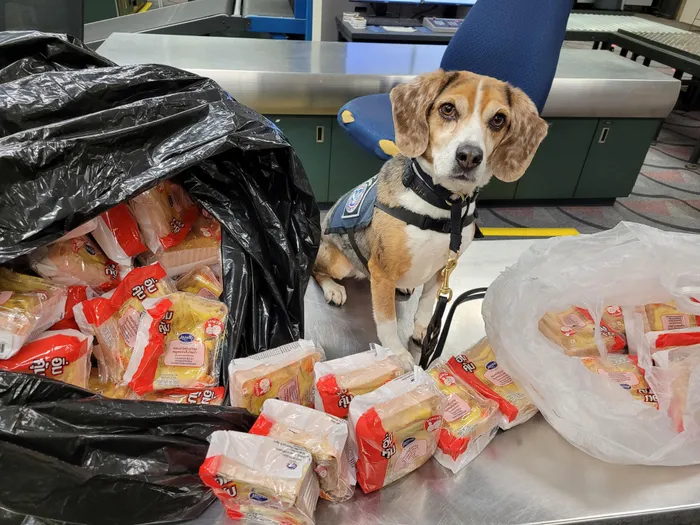
Merla with the 100 illegal sandwiches she discovered at the Minneapolis airport.
Image: Courtesy U.S. Customs and Border Protection
Andrea Sachs
Two duffels appeared on a baggage carousel in Minneapolis-St. Paul International Airport, looking as unremarkable as the hundreds of other pieces of luggage arriving on that afternoon’s Seoul flight.
But Merla’s nose knew differently.
During her Feb. 24 shift, the little hound, a federal employee with the Beagle Brigade, got a whiff of the bag and immediately sat on the floor, alerting her handler to potential contraband inside. After a secondary screening involving a hand search, Customs and Border Protection officers confirmed Merla’s hunch: The two passengers were carrying 100 pork sandwiches from Thailand, all illegal.
“Merla earned what her canine handler likes to call the Jackpot Award,” said Eric Trelstad, a CBP agriculture specialist. “It’s multiples of favorite treats all at once.”
Despite her big bust, Merla’s snout was still on the clock. So, with a belly full of treats, she trotted back to work in search of the next piece of forbidden fruit or meat.
“We have three beagles in the passenger environment who work diligently to find any kind of prohibited or restricted agriculture material, whether it be foreign animal, plant, soil or insects coming into the United States,” Trelstad said.
By day’s end, a 10-hour shift that included several naps and water breaks, Merla had ferreted out beef sausages from Kenya; pork possibly from Serbia; milk products, pork sausage and hamburgers from Japan; plant roots from Tanzania; beef sandwiches possibly from Lebanon; and millet from India, plus the inevitable half-eaten sandwich or orange innocently tossed in a traveler’s backpack or tote.
Merla, who joined the Minneapolis team in June 2024 after a stint at Dallas Fort Worth International, comes from a long line of detector dogs trained by the US Agriculture Department’s Animal and Plant Health Inspection Service. The department determines which food and wildlife items are banned from entering US entry points because of the risk they may pose. CBP and its Snoopy corps then enforce the law.
In 1984, USDA created the Beagle Brigade to help safeguard the agricultural industry and public health system from potentially devastating pests and pathogens concealed in animal products, fruit, vegetables, plants and other organic matter.
The pack grew from one dog and one trainer at Los Angeles International Airport to about 120 beagles at 21 international airports, including 19 of the busiest. The dogs, who are donated by private owners, breeders or rescue shelters, learn their trade through a 10- to 13-week programme at the National Detector Dog Training Center, about 65km southwest of Atlanta.
Trelstad said beagles are the best breed for the job because of their high food drive and sharp sense of smell. According to USDA, their noses contain about 220 million scent receptors, at least 40 times more than humans. In addition, the hounds, which come in two compact sizes (13- and 15-inch), are disarmingly cute.
“They have a very gentle disposition,” Trelstad said. “The public generally likes to see the beagles.”
Unless, that is, the traveler is carrying an Iberian ham sandwich from Spain, meat-filled mooncakes from China or a banana from the airplane galley.
“Enjoy it while you’re there,” Trelstad said, “but we always ask you to not bring it back into the United States to prevent the potential spread of disease and pests, or declare all agricultural items so CBP can determine their admissibility.”
During their training, USDA teaches the beagles to identify five scents: apple, citrus, mango, beef and pork. However, because the dogs are actively sniffing day in and day out, year after year, some members of the brigade can expand their olfactory menu to nearly 50 odours, according to USDA.
“Once they start working, they just naturally want to take a guess on similar scents,” said Trinity Augesen, a supervisory CBP officer. “We don’t necessarily train them to be able to detect monkeys, monkey meat or bush meat, or a lot of the teas or medicines. If they smell something that seems a little off, they’ll alert, and then they’re rewarded if they guess right.”
So far this year, Merla’s scavenger hunt has turned up 100 pounds of cowskin, star fruit, egusi (dried cucumber seeds) from Nigeria and what appeared to be akuamma fruit, a new find to add to her life list. She and her colleagues, Steelor and Boone, have also detected minced camel meat, a delicacy from Somalia. (The Minneapolis-St. Paul area boasts the largest concentration of Somalis in the country.)
Beagles have a high success rate. After six months to a year of experience, USDA said they will correctly recognize banned materials about 80 percent of the time. After two years, their accuracy rises to 90 percent. Merla, who is 7½ years old, has been on the force for roughly half her life.
The dogs are also much quicker sniffers than their human counterparts.
“With an X-ray machine or physical inspection, it can take us five minutes,” Thalsted said, “whereas a canine’s nose can find it instantly.”
At the airport, the dogs will nose around passengers’ belongings at passport control, baggage claim and the exit of the international arrivals hall.
Travelers who do not declare their agricultural goods are subject to a civil penalty of up to $1,000. After Merla flagged the duffels, its owners informed CPB officers that they may have tucked a sandwich into their bag. The officers accepted the statement as a declaration, absolving them of a fine. Their decision did not affect Merla, who still earned her just reward.