
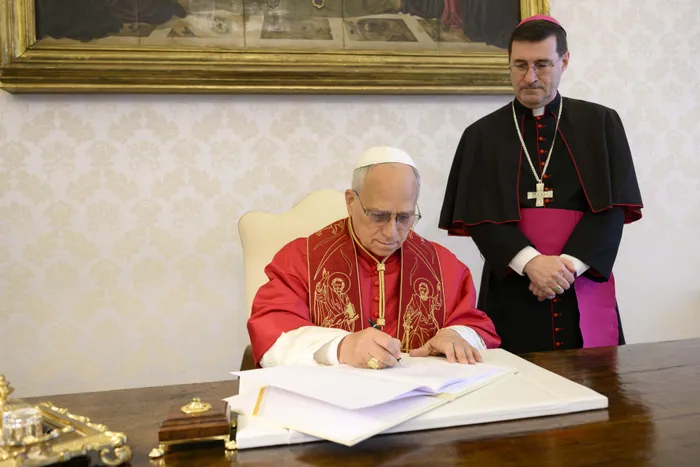
Pope Leo XIV signing his first Encyclical Letter “Magnifica Humanitas”, focused on the rise of artificial intelligence, on May 15 in The Vatican.
Image: VATICAN MEDIA / AFP
Anthony Faiola, Michelle Boorstein, Gerrit De Vynck and Stefano Pitrelli
In his first encyclical, Pope Leo XIV put forth a defense of human dignity in the era of AI, delivering a far-ranging treatise on the morality of technology that included a dramatic plea for guardrails to ensure that artificial intelligence eases - rather than exacerbates - inequality and poverty.
Leo urged that AI be used to improve conditions for workers and he called for limiting the power of technology companies over the vast computing resources that could reshape how human beings live.
As he addressed social ills related to technology, Leo also delivered an apology for the Holy See’s complicity in the slave trade.
Previous popes have apologized for the historical role of Christians in slavery, but Leo drew a connection to the papacy itself, writing of its “past complicity and blindness in the face of the injustice of slavery” and asking for “pardon.”
An encyclical is among the highest forms of papal documents, and Leo’s first - his most important writing to date - positions AI as the catalyst of a new kind of industrial revolution, a cognitive one that has already begun to redefine how the world works, lives, plays, loves and wages war.
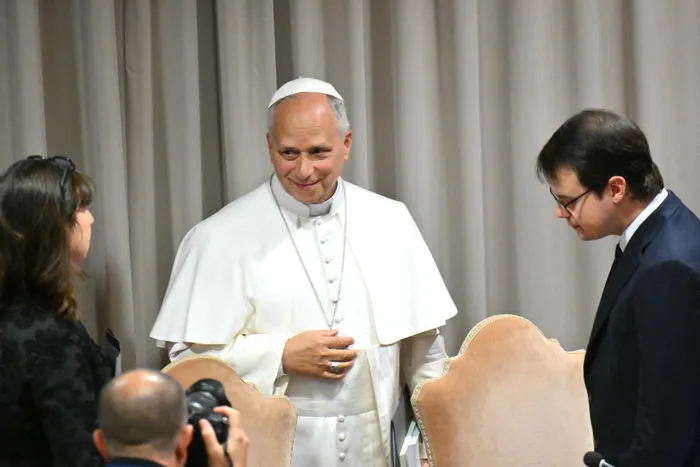
Pope Leo XIV speaks with Co-founder of US artificial intelligence (AI) company Anthropic, Christopher Olah (Right) and the Professor of Catholic Social Thought & Practice at the Durham University, Anna Rowlands, at the end of the presentation of the first Encyclical Letter “Magnifica Humanitas”, focused on the rise of artificial intelligence, in The Vatican on May 25.
Image: Alberto PIZZOLI / AFP
The document sets a clear tone for Leo’s early papacy, elevating the ethics of AI to a religious imperative in the same way Pope Francis did with the fight against climate change a decade ago.
In the encyclical, called “Magnifica Humanitas” - “Magnificent humanity” - the tech-savvy, U.S.-born pontiff makes a resounding defense of pacifism. He also urges that humanity embrace its own limitations rather than pursue single-mindedly to overcome them.
Leo has emphasized AI since he became pope, and the new document also warns of the risks of control over humankind’s digital space shifting to the for-profit corporations of Silicon Valley and away from governments.
“As with every major technological shift, AI tends to amplify the power of those who already possess economic resources, expertise and access to data,” Leo writes. “In light of the common good and the universal destination of goods, this raises serious concerns, since small but highly influential groups can shape information and consumption patterns, influence democratic processes and steer economic dynamics to their own advantage, undermining social justice and solidarity among peoples.”
Though released Monday, the encyclical was signed May 15, a nod to a historic document penned by his papal namesake - Leo XIII − in 1891.
The dramatic unveiling of the new encyclical overshadowed the document itself in some ways. In an unprecedented move, Leo personally presided over its presentation and sat on a panel at the Vatican with not only leading theologians, but also Christopher Olah, 33, the billionaire co-founder of top AI company Anthropic.
In formulating the document, Leo said he had listened to scientists, engineers and political leaders as well as parents and teachers concerned for “the future of younger generations.”
He spoke worryingly of biased algorithms that can block access to health care and employment, and sounded an alarm over “increasingly autonomous weapons systems practically beyond any human reach to govern them effectively.”
The decision to invite Olah fueled criticism ahead of the encyclical’s release that the Vatican was tacitly lending its seal of approval to a tech juggernaut and dancing with the very digital devil that “Magnifica Humanitas” purports to warn the world against.
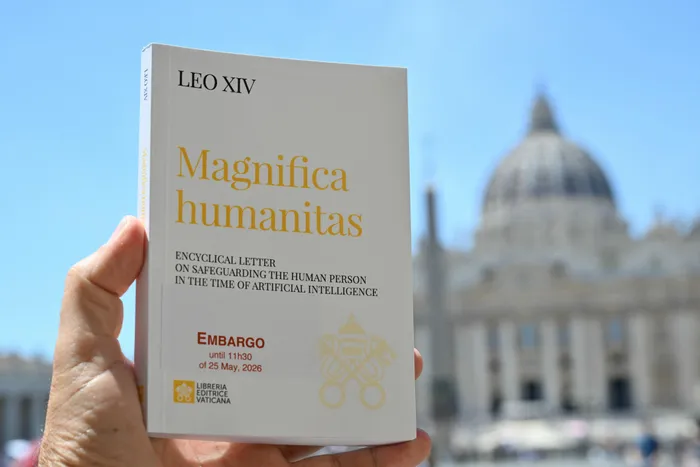
A picture shows Pope Leo XIV Encyclical Letter “Magnifica Humanitas”, focused on the rise of artificial intelligence, in The Vatican on May 25.
Image: ALBERTO PIZZOLI / AFP
Speaking while seated not far from pope, Olah conceded that tech giants operate on interests often at odds with the common good, and portrayed the Vatican’s involvement as necessary. “We need informed critics who will tell the labs when we are failing,” he said. “We need moral voices that the incentives cannot bend.”
Despite concerns of a Vatican white wash, the encyclical fired a broadside at tech giants and their vast control over AI and how it’s developed.
Tech companies have pushed the White House to oppose regulation. But Leo, like his predecessor Francis, forcefully argues in favor of such guardrails. He then goes further, calling for a moral reassessment of powerful tech platforms and the concentration of computing resources in the hands of private corporations and billionaires. That dynamic, Leo said, risks AI’s benefits and harms being distributed unfairly, as well as massive environmental damage from energy-gobbling data centers.
The document couples the computational mind of a pope who holds a mathematics degree from Villanova University with the values of his Augustinian roots. Leo proffers a cajoling, even quaint, argument: In an age of technological disrupters and a pursuit of limitless wealth and power by nations and individuals, the nonstop race for more, better and faster may undermine the fundamental messy beauty of being human.
Leo frames the document as scripture come to life. Humanity, he writes, has a choice between two biblical stories. One, the Tower of Babel, in which humans try to ensure their dominance over everything and build to the sky. The other, of the Israelites’ reconstruction of Jerusalem, which begins with fasting and prayer and emphasizes shared work and community.
“The primary choice is not between a ‘yes’ or ‘no’ to technology, but rather between constructing Babel or rebuilding Jerusalem; between a power that claims to dominate the heavens and a people who work together in the presence of God to rebuild the walls of fraternal coexistence,” the pope writes.
The culmination of an unlikely 10-year dialogue between Silicon Valley and the Holy See - with benefits and risks for both - the encyclical also courses with a message of peace and unity, the defining themes of Leo’s papacy. Once again, he warns against unchecked political power and the rejection of multilateral institutions, while railing against false rationales and defenses of war - particularly at a time when AI, he writes, is rendering war “more impersonal.”
On the heels of President Donald Trump’s high-profile verbal attacks on Leo - and the pope’s stoic but unbowed response - some verses in the encyclical’s chapter focusing on the nature of modern power easily could be interpreted as criticism of the White House. This is especially so when Leo expands on his recent assertions that God does not justify war.
That phrasing could also be interpreted as criticism of the Israel Defense Forces, the Ukrainian Armed Forces and other militaries that have begun using AI to target their enemies in bombing and assassination campaigns.
Some experts cautioned against interpreting the encyclical - a document by the leader of the world’s 1.4 billion Catholics that is intended to be read and reinterpreted for centuries - as part of a feud between the American pope and the American president.
“I think the danger for an American audience is funneling everything solely down to some kind of drama between Trump and Leo,” Anna Rowlands, a British theologian who was among the encyclical’s presenters, said in an interview. “Certainly, there would be questions that can be asked for the U.S. when you read that section on power, but there are questions for other global leaders, as well, and also for the tech industry itself.”
The encyclical - a papal letter to the faithful and all people of “good will” - was portrayed by the pope as a corollary to the 1891 encyclical issued by Leo XIII called “Rerum Novarum” (“Of New Things”), which addressed questions of human dignity during the great leaps of the Industrial Revolution and laid the groundwork for the modern Catholic Church’s advocacy for the poor and for labor rights.
The core spiritual challenge now, Leo writes, is the dehumanization of human beings - by flattening their differences, reducing them to “data and performance,” turning them into means, working endlessly to perfect them. “Building for the common good means accepting the limits and weakness of humanity without considering them an error to be corrected,” he writes.
Charles Camosy, a moral theologian at Catholic University and co-author of a brief backing Anthropic in a recent tug-of-war with the Pentagon over how the military can use its technology, said Leo was meeting a moment. “It seems to me Leo has maybe even been elected as pope in part to marshal the Catholic response that’s going to be analogous to our response to the Industrial Revolution,” Camosy said.
“So many people are searching around for kind of ways to make sense of what’s happening here,” he continued. “And religious institutions and traditions have some of that, like at our fingertips to say, ‘This isn’t the first industrial technical revolution we’ve lived through. You know, here’s how we responded with Catholic social teaching in the past.’”
Inviting an Anthropic executive to participate in the document’s presentation at the Vatican sent its own set of signals. The company positions itself as more aware of the risks of AI technology than its competitors and has invited religious leaders, including Catholics, to advise it on how to develop AI that acts ethically in a diverse range of situations.
The text of the encyclical also suggests influence from Anthropic. In a section describing why AI technology is unpredictable, it notes that programmers don’t directly code AI software, but instead create a scaffolding upon which AI “grows.” That’s the same language Anthropic has used to describe its technology.
“It makes me nervous,” Paolo Carozza, a law professor at the Catholic university Notre Dame who works on ethical issues as chair of the Meta Oversight Board, said of a partnership that could whitewash an industry long resistant to oversight. “I have no doubt the frontier AI companies would love to co-opt religious communities to bring an ethical imprimatur to their work.”
The Rev. Andrea Ciucci, chancellor of the Pontifical Academy for Life in Rome, pushed back against the criticism. “Those who create the technology also have to bear responsibility,” Ciucci said. “So we need to talk to them.”
Prominent tech leaders have ridiculed those who call for stricter regulation of AI or for a slowdown in technological advancement as “decelerationists” or “doomers.” The tech mogul Peter Thiel, for instance, has said “in the 21st century, the Antichrist is a Luddite.”
Leo counters these voices directly, arguing that asking for caution in how AI is developed does not mean opposing progress in general. Human society must develop strong legal frameworks and oversight of AI before it is allowed to advance further, he says.
He explores technology’s tendency to create new addictions, as platforms vie to capture users’ time and attention. And he delves into other ills, including human trafficking, offering a striking mea culpa for the Holy See’s historical role in slavery that some experts called more specific on the Vatican’s institutional complicity than apologies by past popes.
“Already in the early modern period, the Apostolic See of Rome, responding to requests from Sovereigns, intervened several times in order to regulate and legitimize forms of subjugation, and, in certain cases, the enslavement of ‘infidels,’” Leo writes. “It was only in the nineteenth century that a formal, absolute and universal condemnation of slavery was clearly articulated, notably under Pope Leo XIII.”
He calls such actions “a wound in Christian memory,” writing: “It is impossible not to feel deep sorrow when contemplating the immense suffering and humiliation endured by so many.”
Leo adds: “For this, in the name of the Church, I sincerely ask for pardon.”
The words of a pope do not hold the same weight as they did in generations and centuries past. But the document comes as Leo, now a year into his papacy, is increasingly embraced globally as among the world’s most influential defenders of human dignity and peace.
His stature has soared amid Trump’s recriminations and as Leo has spoken out more forcefully about the rise of political tyranny and the hijacking of religion for political purposes, especially going to war.
Some observers described the encyclical as an intellectual flex that would further expand Leo’s influence.
This pope is “recognized to be speaking inspired by the Gospel, not corrupted by economic interests or interests to confirm personal power,” said the Rev. Rocco D’Ambrosio, a political philosophy professor at the Pontifical Gregorian University in Rome. “People are responding to that.”
For a Catholic Church diminished by its handling of clerical sexual abuse scandals, the AI issue has provided an opportunity to reassert moral authority. Leading tech companies, meanwhile, have been eager to win the church’s seal of approval, as the industry grapples with the public relations challenges of a technology that could automate - and eliminate - jobs, amplify misinformation and create new cybersecurity risks.
“The Rome Call for AI Ethics,” a document that counted the Vatican, Microsoft and IBM among its original signatories in 2020, has emerged as a gold standard of best AI practices. Pope Francis, who was an early target of deepfakes through an infamous image of the Argentine in a Balenciaga puffer jacket, became the first pope to address a Group of Seven forum of world leaders, delivering a speech that delved into the “cognitive-industrial revolution” set off by AI.
Leo’s deep dive now, however, is seen as more expansive than Francis’s ample writings on AI, elevating the issue in the same way that Francis’s landmark encyclical “Laudato Si” (“Praise Be to You”) sought to reframe the fight against climate change as part of Catholic teaching.
That 2015 document by Francis also spoke of human limits.
“I think Leo is saying the same thing,” Carozza said. “But this time it’s about our very selves.”