
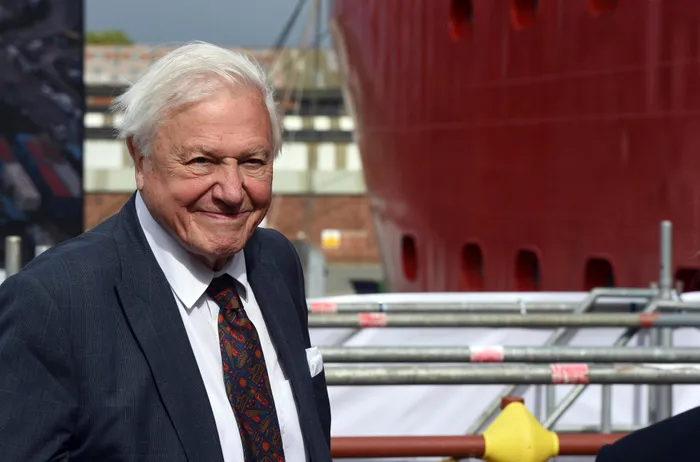
Sir David Attenborough at the launch of the 'Ocean' documentary to save our seas.
Image: Asadour Guzelian/AP
SIR David Attenborough will mark his 100th birthday on Friday 8 May, and tributes are already pouring in for the broadcaster whose voice and films helped shape modern public understanding of wildlife and conservation.
“David Attenborough brought to me and so many others the wonders and beauty of the biodiversity of our natural world,” said Gill Simpson, executive director of Wild Rescue.
“For so many years he has managed to open horizons and bring the splendours of the wilderness into our living rooms.”
The centenary will be marked with a staged production at the Royal Albert Hall on 8 May, while the BBC will air a week of special programming, including Making Life on Earth: Attenborough’s Greatest Adventure, a new documentary revisiting the making of his landmark 1979 series Life on Earth.
Attenborough has appeared in nearly 400 television and film productions since 1953. His work has spanned continents, but Africa has remained central to his career.
His connection with the continent began in 1954, when he travelled to Sierra Leone — his first trip outside Europe. He later said he was “just simply blown sideways” by the abundance and variety of life he encountered there.
That fascination continued through productions such as Africa, filmed over four years and across 1,598 days on location. The series captured wildlife and landscapes from False Bay to a protected rhino habitat in Namibia.
South African ecosystems have featured prominently in Attenborough’s later work. The Green Planet showcased the fynbos biome of the Western Cape, while the recent documentary A Gorilla Story: Told by David Attenborough revisits his celebrated encounter with mountain gorillas in Rwanda.
Simpson said Attenborough’s influence extended far beyond television.
“He inspired us to appreciate nature and make a positive difference for our special planet,” she said.
“In celebration of David Attenborough’s birthday, let us all look around and outside ourselves with awareness and wonder at our natural biodiverse world, and do our bit to help safeguard the environment.”
The anniversary comes as conservationists warn that biodiversity loss is accelerating globally. The United Nations’ 2026 State of Finance for Nature report found that for every dollar invested in protecting nature, far more continues to flow into activities that damage ecosystems.
Attenborough himself has repeatedly warned of the consequences of human pressure on the natural world. Reflecting on the shrinking wild spaces of the planet, he once said: “I just wish the world was twice as big — and half of it was still unexplored.”
Born in 1926, the same year as Queen Elizabeth II and Marilyn Monroe, Attenborough has lived through a period in which the global population has risen from about 1.9 billion to more than 8 billion.
Knighted in 1985, he remains one of the most recognisable voices in natural history broadcasting. More than 50 species of plants and animals have been named after him — a rare scientific tribute, and a reminder that at 100, his legacy is already rooted in the living world itself.