
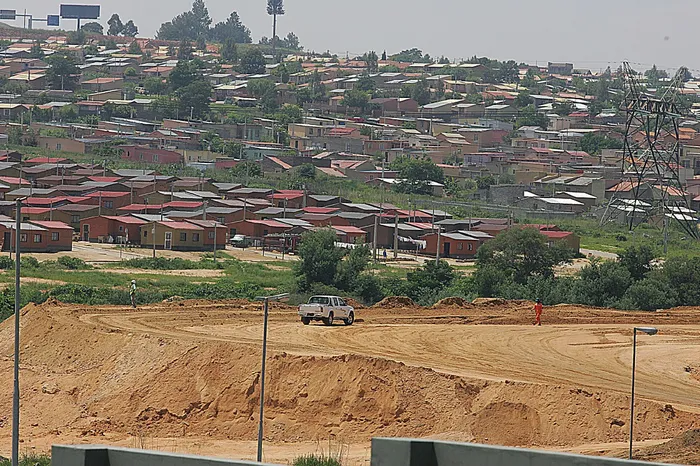
The West bank of alexandra Township looms in the distance as workers make way fo The rate increase compresses this further by increasing monthly instalments at a time when financial flexibility is already limited.
Image: Steve Lawrence
The financial environment where households are already under significant strain will be reinforced by the 25‑basis point interest rate hike announced by the South African Reserve Bank.
On Thursday, May 28, Lesetja Kganyago, the Governor of the South African Reserve Bank (SARB) said the Monetary Policy Committee (MPC) decided to increase the policy rate by 25 basis points, to 7%, effective from Friday, May 29.
He said four members preferred this action, while two favoured no change.
It is less about the size of the increase and more about the compounding effect of higher borrowing costs alongside rising fuel and food prices, says Lee Naik, CEO at TransUnion South Africa.
He says this is not a new shock - it is an amplifier of pressure households are already managing. “The combination of higher instalments and rising living costs is where the real impact is felt.”
“The increase also confirms a shift we are already seeing - from cautious optimism at the end of 2025 to a more defensive financial posture, with consumers adjusting spending and credit behaviour in response to sustained pressure.”
The provider of commercial, consumer, insurance and auto risk information solutions says a 25 basis point increase is modest in isolation, but in the current environment its impact is more pronounced because it compounds existing pressures.
It says households are already navigating rising fuel costs, re‑accelerating food inflation and increased reliance on credit.
“The rate increase compresses this further by increasing monthly instalments at a time when financial flexibility is already limited.”
R1 million bond → ~R170/month
R5 million bond → ~R850/month
R10 million bond → ~R1,700/month
According to Naik, while these increases may appear manageable in isolation, it is important to recognise that this reflects only the home loan impact. He adds that in reality, the total cost pressure is broader.
“It excludes the knock‑on effect on vehicle asset finance, insurance premiums, fuel and food costs. When considered holistically, the overall household impact is materially higher and places additional strain on monthly budgets.”
The CEO says buyers become more cautious; qualification thresholds tighten and purchasing decisions become more closely aligned to long‑term affordability rather than short‑term opportunity.
“Homeowners may begin to feel early signs of strain in managing total monthly obligations. For tenants, the pressure remains structural, with affordability constraints limiting rental escalation but not necessarily easing cost burdens. Developers and investors, meanwhile, face a narrowing window between viable pricing and constrained demand.”
The company says in this environment, the appropriate response is proactive. It says households need to act early, reviewing affordability holistically, prioritising repayments, and reducing reliance on short‑term credit.
“For market participants, the imperative is adaptation - aligning pricing, product, and development strategies with a consumer that is fundamentally recalibrating spending behaviour.”
A 25‑basis point increase does not signal a downturn, but rather a rebalancing toward affordability‑driven growth, TransUnion South Africa says.
•More selective buyer behaviour
•Moderation in price growth in some segments
•Slight softening in transaction volumes
“Demand is not disappearing - it is narrowing, becoming more closely aligned to what households can realistically sustain over time.”
According to Naik, the most important shift is not the rate decision itself, but what it represents.
“We are moving out of a traditional rate cycle and into an affordability cycle, where fuel, food and broader living costs are playing an equally important role in shaping consumer behaviour. The property market remains resilient, but that resilience is now more conditional - increasingly tied to financial sustainability rather than short‑term demand.”
Any time interest rates go up for existing bond holders, it means they have to pay more every month, which is not great, says Benay Sager, the Executive Head of DebtBusters. He says it probably reduces interest in potential new property sales, depending on how these are going to be funded.
“Generally speaking, higher interest rates are not great for the property sector but we also need to contextualise it in relation to what’s happening in the world and why this is necessary, and it then makes sense. In terms of how to deal with it, consumers should have a budget in place and make sure that they are accounting for the potential bond payment increases.”
The executive head says they are expecting one more rate increase in the next few months.
“It’s unclear when that would be, but I think if inflation continues on the path of the last couple of months, then it will be difficult for the Reserve Bank to not increase the interest rates again.”
The announcement by the Monetary Policy Committee (MPC) to increase the repo rate by 25 basis points to 7%, bringing the prime lending rate to 10.5%, marks the first rate increase since May 2023, a decision that is disappointing says Rhys Dyer, CEO of the ooba Group, given the already fragile state of the consumer.
“While the increase places additional pressure on already strained consumers, the move was largely anticipated given rising fuel prices, municipal tariff hikes and increased electricity costs, all of which contributed to consumer price inflation (CPI) climbing to 4% in April - up from 3.1% in March.”
He adds that South Africa’s interest rate outlook remains delicately balanced as global geopolitical tensions persist and oil prices remain elevated, clouding the broader economic outlook.
The fragile ceasefire between the US and Iran has done little to calm global markets, with ongoing shipping disruptions and elevated oil prices continuing to place upward pressure on fuel costs worldwide.
“Locally, this is likely to translate into further petrol price increases, adding to inflationary concerns and squeezing already constrained household budgets,” he adds.
Independent Media Property