
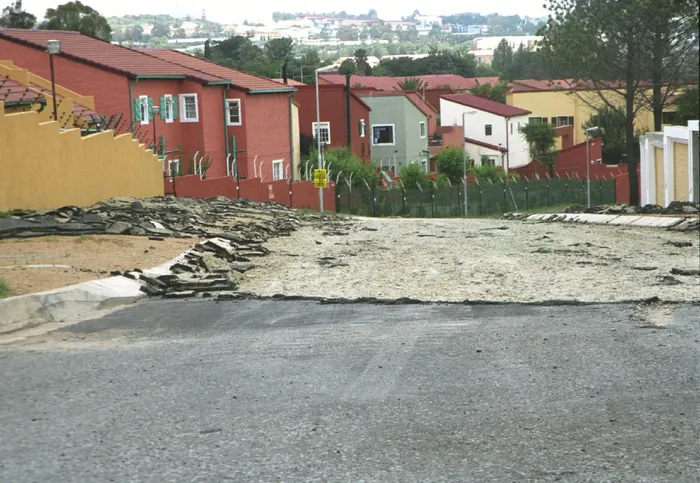
03/12/04 Disgruntled construction workers, at corner of Harry Gaulum and Norfolk South Africa needs a growth compact that brings monetary policy, fiscal policy, infrastructure investment, housing delivery, municipal reform and private-sector participation into one coherent national recovery agenda.
Image: Lebohang Mashiloane
While higher interest rates may tame inflation, they cannot build houses.
South Africa recently experienced another painful reality: interest rates have increased by 25 basis points at a time when the economy is already fragile, households are already stretched and consumers are already fighting to survive, says a property investment company RB Property Group.
Delivering the Statement of the Monetary Policy Committee (MPC) on Thursday, May 28, Lesetja Kganyago, Governor of the South African Reserve Bank (SARB) said the committee decided to increase the policy rate by 25 basis points, to 7%, effective from Friday, May 29.
Meanwhile, Rob Buthelezi, chairman at RB Property Group, believes that the country cannot interest-rate its way out of a structural economic crisis, says Rob Buthelezi, chairman at RB Property Group.
Buthelezi says when rates rise, the cost of delivering housing rises.
“When the cost of delivery rises, affordability declines. When affordability declines, sales slow down. When sales slow down, projects are delayed. When projects are delayed, jobs are lost or never created. This is the chain reaction that ordinary policy language often fails to capture.”
The company says interest rates cannot fix logistics, cannot create serviced stands, cannot approve building plans. It adds that they cannot fund bulk infrastructure.
“They cannot employ young people. They cannot revive townships. They cannot turn idle land into productive assets. They cannot replace the urgent need for coordinated economic leadership.
“This is why interest rate decisions cannot be viewed in isolation from the real economy.”
According to Buthelezi, this is not just a technical monetary policy decision. The chairman says it is a decision that flows directly into the lives of ordinary South Africans. He adds that it affects the bond repayment of a young family buying its first home.
“It affects the small business owner trying to keep workers employed. It affects the contractor waiting for development finance. It affects the pensioner, the single parent, the unemployed graduate and every household trying to stretch one income across food, transport, school fees, rent, electricity, debt repayments and basic survival.”
The property investment company says official justification is inflation targeting. It adds the argument is that higher interest rates are necessary to contain inflation expectations, protect the value of the rand, and prevent second-round price effects.
“These are legitimate policy concerns. But equally, no responsible economy can ignore the human and developmental cost of tightening financial conditions in a country already battling deep unemployment, weak growth, declining household affordability and rising social distress.”
SA is not an economy overheating because consumers are spending too much, Buthelezi says. He says the country is not facing excessive demand driven by broad-based prosperity.
“We are facing a structural crisis of low growth, high unemployment, weak investment, poor service delivery, infrastructure bottlenecks, rising municipal debt, energy pressures, logistics failures and declining household confidence.”
In this context, Buthelezi says using interest rates as the dominant weapon against inflation risks treating the symptom while worsening the underlying condition.
He says consumers are hit by a double-edged sword: on one side, higher interest rates increase debt repayments, and on the other, inflation continues to erode purchasing power. The burden lands squarely on households, homebuyers, and small businesses alike, he says.
For millions of South Africans, inflation is not an abstract percentage, RB Property Group says.
It adds this is the price of bread, transport, electricity, rent, school uniforms, insurance, building materials and municipal services. When interest rates rise, the company says consumers are hit twice: first by higher debt costs, and simultaneously by the persistent effects of inflation.
“Bond repayments rise. Vehicle finance becomes more expensive. Credit cards and personal loans become more difficult to service. New home ownership becomes less affordable. Developers face higher finance costs. Businesses postpone expansion. Jobs are delayed. Investment slows.”
The company says SA needs price stability, but it also needs hope. It says the country needs discipline, but it also needs development.
“It needs inflation control, but it also needs job creation. It needs credible institutions, but it also needs policies that understand the lived reality of households at breaking point.”
This is why the latest interest rate increase should trigger a much deeper national conversation, Buthelezi says.
He argues the country cannot build an inclusive economy if the cost of capital continues to rise while unemployment remains at crisis levels.
“We cannot expect the construction sector to create jobs if development finance becomes more expensive. We cannot expect first-time homebuyers to enter the property market if affordability keeps deteriorating. We cannot expect small businesses to grow if working capital becomes harder to access. We cannot expect households to absorb higher repayments when their incomes are already under pressure.”
At RB Property Group, they say they believe the country requires a more balanced economic approach. Inflation must be managed, but growth must also be protected.
Price stability matters, but so does employment.
Currency stability matters, but so does household survival. Financial discipline matters, but so does development, they says.
The chairman says the property and construction sectors are among the strongest engines for economic recovery. He says a single development activates architects, engineers, quantity surveyors, contractors, artisans, estate agents, conveyancers, banks, bond originators, material suppliers, transport operators, security companies, landscapers, fibre installers, solar providers, insurance companies and local SMMEs.
“Housing delivery is not merely a social programme; it is economic infrastructure. It creates jobs, expands the rates base, unlocks household wealth, supports municipalities and stimulates local economies.”
SA needs a growth compact that brings monetary policy, fiscal policy, infrastructure investment, housing delivery, municipal reform and private-sector participation into one coherent national recovery agenda, he adds.
“We need government to accelerate serviced land release. We need banks to expand responsible access to end-user finance. We need development finance institutions to support blended funding. We need municipalities to unlock bulk infrastructure and approvals."
"We need pension funds and institutional investors to invest in bankable, shovel-ready projects. We need private developers to deliver responsibly, transparently and at scale. Policy must treat affordable housing, student accommodation, township redevelopment, inner-city regeneration and mixed-use precincts as productive national assets.”
According to Buthelezi, the latest rate increase should not simply be accepted as another routine monetary policy event. It should be a wake-up call, he says.
“If we continue to make decisions that protect models while households collapse, we will deepen the very fragility we claim to be managing. If we continue to fight inflation without fighting unemployment with equal urgency, we will fail the next generation."
"If we continue to raise the cost of capital without unlocking productive investment, we will slow the economy at the very moment when it needs acceleration.”
The Group says it believes SA’s recovery must be built, not merely managed.
It says it must be built through housing. “Built through infrastructure. Built through partnerships. Built through investment. Built through youth employment. Built through township and rural development. Built through bankable projects that convert land into value, value into jobs and jobs into dignity.”
The company further argues that the conversation can no longer be only about inflation targeting. It says it must also be about growth targeting. “Employment targeting. Housing targeting. Investment targeting. Dignity targeting.
“Because when the economy is fragile and households are at breaking point, every interest rate decision is not just a number-it is a double-edged sword, carried by the people themselves,” Buthelezi says.
Meanwhile, Sandra Gordon, an independent research economist says planned building activity rebounded in early-2026, with the number of residential plans passed rising by 28% in the first quarter, driven by a 50.6% jump in entry-level homes and a 43.3% rise in flats and townhouses.
She says the Western Cape is once again leading the upturn as total approvals in the province surged by 62.7% from a year earlier, with flats and townhouses up 130.4% and entry-level homes up 71%. “The province accounted for 48% of all plans passed nationally in Q1'26, up from 37.8% a year ago, while Gauteng slipped from 35% of all plans to just under 22%.
The surge in Western Cape multi-unit residential (flats & townhouses) approvals reflects a rare alignment of policy direction, shifting buyer preferences and market forces.
“In Cape Town - which drives the province's multi-unit pipeline - densification policies, faster approvals and more flexible zoning have tilted the economics decisively toward higher-density development," says Gordon.
He added: "Still, strong semigration inflows and a strengthening rental market are lifting demand for smaller, well-located units, while high land and construction costs make hiaher density projects a more attractive investment option for developers.”
She says that Gauteng, however, remains the country's largest first-time buyer market and still anchors national housing demand, even as the Western Cape leads the current surge in multi-unit development.
“Its total approvals fell by 20.5% in Q1 - including a 60.1% decline in flats & townhouses - but its entry-level housing segment rose by nearly 30%, underscoring the province's deep, underlying demand base.”
Independent Media Property