
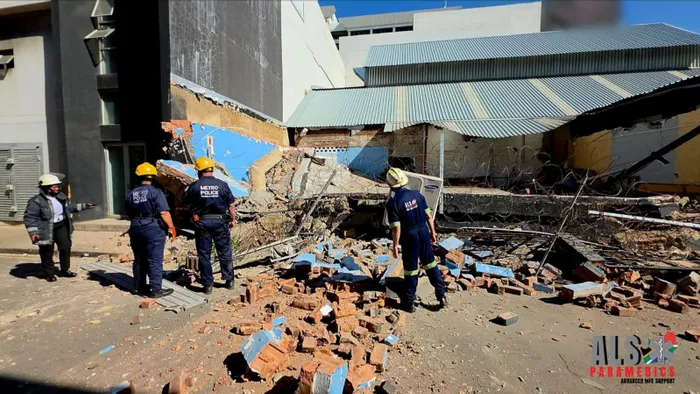
Emergency services personnel work together to safely extricate contractors trapped beneath a collapsed wall on Monty Naicker (Pine) Street in Durban. A Building Industry Bargaining Council spokesman says there should be a balance between regulatory reform and protections designed to safeguard workers.
Image: ALS Paramedics Medical Services
In an economy often burdened by high levels of unemployment and underemployment, the South African building sector finds itself at a crossroads, caught in a tug-of-war between the pressing need for regulatory reform and the indispensable protections designed to safeguard its workforce. This ongoing conversation has gained significant traction, with calls to reduce what critics frame as 'red tape' frequently posited as essential for fostering growth.
Yet, the Building Industry Bargaining Council (BIBC) for the Cape of Good Hope urges a more nuanced discussion, emphasising that the conflation of regulation with bureaucratic inefficiency obscures vital distinctions. For Danie Hattingh, the BIBC's spokesperson for business, the dilemma does not lie in the existence of regulation. Instead, he posits that the focus should be on achieving a balance that promotes economic viability while respecting the dignity of workers.
“There is a difference between inefficient bureaucracy and appropriate regulation,” Hattingh states. “One creates unnecessary obstacles. The other creates predictability, accountability and fairness, which are essential in a sector like construction, of which the building industry forms a significant part.”
The BIBC, established under the Labour Relations Act, plays a critical role in promoting fair labour practices in the building sector. It actively contributes to policy discussions, advocating for adjustments that could ease compliance burdens, particularly for small businesses grappling with economic strain. However, Hattingh raises alarms over an increasing tendency to broadly decry regulation as red tape without acknowledging its protective facets.
“Reducing unnecessary burdens should never mean removing core protections relating to worker safety, fair wages or basic employment standards,” he warns.
Given that the construction and building industry is among South Africa's most labour-intensive sectors, the importance of these protections cannot be overstated. They facilitate access to entry-level positions while laying foundations for careers in skilled trades such as plumbing, electrical work and bricklaying. Yet, the sector faces substantial hurdles including labour exploitation, informal employment, and perilous working conditions.
“The pressure of rising business costs is real and cannot be ignored,” Hattingh acknowledges. “But exploitation cannot become the solution to complex economic problems.”
Of particular concern is the increasing reliance on undocumented and vulnerable workers through informal employment networks. A recent enforcement operation conducted by the Department of Home Affairs alongside the Border Management Agency unearthed troubling realities at a high-end residential development site, revealing that of the 248 workers present, 211 were foreign nationals.
“The concern is not about nationality,” explains Hattingh. “It is about exploitation and the creation of a labour market built around vulnerability, where workers are underpaid, unprotected and easily replaced.”
This scenario is indicative of broader implications, where informal labour practices result in compromised workmanship, unsafe working conditions, and precarious subcontracting arrangements. Hattingh contends that the trajectory towards exploitation yields poor outcomes, underscoring a globally observed phenomenon.
“There are no examples anywhere in the world where exploitation consistently produces high-quality outcomes,” he remarks. “In construction and building especially, poor labour conditions and poor building standards usually exist together.”
Hattingh draws attention to international cases, such as Melbourne, Australia, where weak regulatory environments have contributed to significant failures in the construction industry, including unsafe work sites and structural defects in properties. Such scenarios serve as cautionary tales on the consequences of insufficient oversight.
“The lesson from international examples is not that regulation should disappear,” he states. “It is that appropriate regulation, properly enforced, creates stability and trust in the market.”
Moreover, the BIBC asserts that regulation inherently provides predictability for responsible employers in the formal economy. Under collective agreements, even the lowest-paid workers in the sector earn above the National Minimum Wage and gain access to essential benefits such as sick pay, annual leave and pension rights.
Hattingh argues for a balanced approach, grounded in the understanding that the long-term sustainability of the building industry hinges on the delicate interplay between fostering business growth and ensuring worker protection.
“A sustainable building industry depends on balance,” he concludes. “Businesses need room to grow and innovate, but workers also need protection and fair conditions. Those objectives are not mutually exclusive.”
IOS