
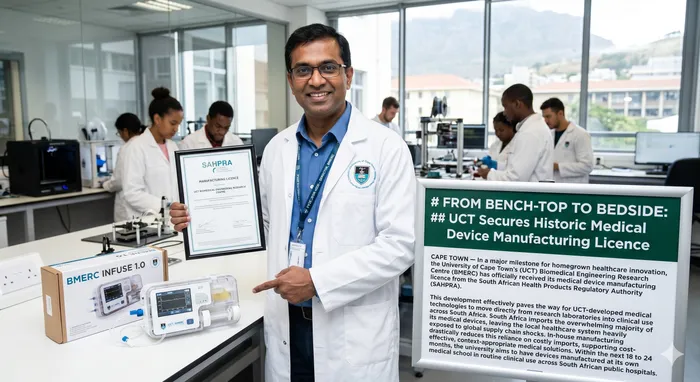
The University of Cape Town’s (UCT) Biomedical Engineering Research Centre (BMERC) has officially received its medical device manufacturing licence from the South African Health Products Regulatory Authority (SAHPRA).
Image: AI generated/Gemini
In a landmark achievement for local healthcare development, the University of Cape Town’s (UCT) Biomedical Engineering Research Centre (BMERC) has officially obtained its medical device manufacturing licence from the South African Health Products Regulatory Authority (SAHPRA). This milestone authorises the centre to manufacture, distribute and wholesale medical devices, facilitating the transition of innovative UCT-developed technologies from research lab benches to clinical applications across South Africa.
Professor Sudesh Sivarasu, director of BMERC, highlighted the importance of this milestone, stating, “In practical terms, it means the devices we design and develop here, for African patients in an African context, can now be produced and brought to market with the full weight of regulatory recognition behind them.”
Professor Sivarasu noted, “South Africa imports the overwhelming majority of its medical devices, which leaves our healthcare system exposed to supply chain shocks and forces our clinicians to work with technologies that were designed, almost without exception, for high-income settings.” The newly acquired licence represents a critical solution to these structural challenges.
For more than a decade, UCT MedTech and BMERC have built one of Africa’s most productive academic medical device pipelines, achieving milestones such as 23 patent families, the establishment of five spinout companies, and the distribution of over 100,000 devices globally. Despite these accomplishments, the absence of a certified local manufacturing route had hindered the potential for these devices to be deployed ethically and legally within the South African healthcare system. Professor Sivarasu further explained, “In the medical device sector, quality is synonymous with patient safety; without the ability to demonstrate that our devices were manufactured under a rigorous, audited quality management system, we could not ethically or legally deploy them with patients.” The new licence effectively dismantles this barrier, reopening the pathway to innovation and implementation.
The licencing achievement unlocks several crucial benefits:
Professor Sivarasu emphasised that this achievement was not merely the result of individual influence but a collective effort contributed by researchers, students and staff at UCT, alongside partnerships with the national Department of Science, Technology, and Innovation (DSTI), the National Research Foundation (NRF), and clinical collaborators across the Western Cape Department of Health. “The licence belongs to UCT, but the journey has belonged to many,” he affirmed.
The immediate next steps for BMERC are set to be transformative. “It has been one of the most transformative undertakings I have been part of at UCT,” Sivarasu remarked. The focus will now shift to converting a pipeline of late-stage prototypes into clinically validated products produced on-site. “Our goal is that, within the next 18 to 24 months, devices manufactured at UCT’s medical school are in routine clinical use in South African public hospitals,” he stated. This ambitious timeline aligns with UCT’s mission to foster innovative medical technology products, train skilled innovators, and ultimately enhance the quality of life for patients in the region.
This accomplishment resonates strongly with several of the United Nations' Sustainable Development Goals (SDGs). As noted by Sivarasu, the focus on good health and well-being (SDG 3), industry innovation and infrastructure (SDG 9), quality education (SDG 4), reduced inequalities (SDG 10), and global partnerships (SDG 17) speaks volumes about the far-reaching impact of this licencing achievement. It exemplifies a shift towards locally-driven solutions tailored to meet the unique needs of the African context, showcasing the capabilities of a homegrown academic institution in the healthcare sector.
IOS