
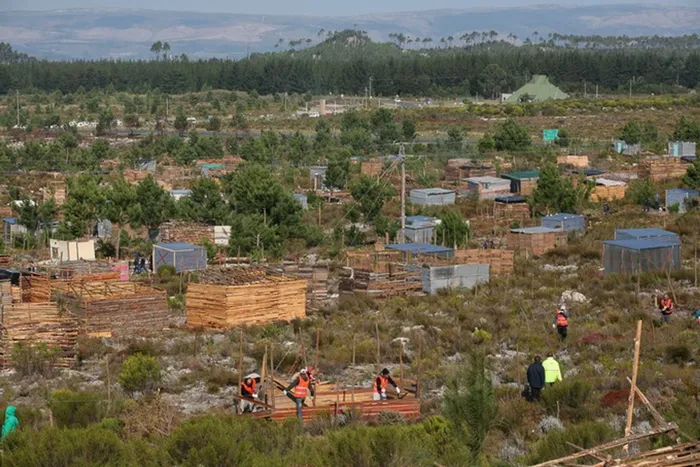
Civil society organisations and unions described the proposed Prevention of Illegal Eviction and Unlawful Occupation of Land (PIE) Amendment Bill of 2026 as a fight against the poor.
Image: File picture
The government has been accused of introducing 'apartheid era laws' that deprive the poor of access to the land, following the release of the Prevention of Illegal Eviction and Unlawful Occupation of Land (PIE) Amendment Bill of 2026.
The bill was gazetted for public comment on April 16, 2026.
Presented by Minister of Human Settlements, Thembi Simelane, the bill seeks to review and strengthen current laws to make them easier to understand and simpler to enforce.
The bill takes a firm stance against those who unlawfully sell land or property they do not own and those who incite illegal land invasions. It proposes hefty fines and the forfeiture of assets acquired through these illegal means.
The Inner City Federation (ICF), a self-organised coalition of tenants and occupiers in Johannesburg, argued that the language that is being used in the amendments is criminalising the marginalised people and violating the human rights that are set out in the Constitution.
The group said that evictions were essentially politically and ideologically charged and were specifically aimed at furthering the segregation plans of apartheid by expelling so-called “squatters” from land, using criminal proceedings.
It said the motive was to forcibly remove black people from land and relocate them to racially designated areas.
The coalition added that criminalising occupiers for occupying land or buildings is a violation of human rights in terms of the Constitution.
“The Minister and her cabinet want to bring back The Prevention of Illegal Squatting Act (PISA) by amending section 3(1) (a) (b) and section 2, any person who contravenes a provision of subsection (1) is guilty of an offence and liable on conviction to a fine not exceeding R2 000 000.00 or imprisonment not exceeding two years, or to both such fine and such imprisonment. This is a violation of section 18 of the Constitution of South Africa, 1996,” ICF said.
The coalition added that people occupied land because there is no land where they can build their own homes, adding that occupying the land is the only solution for poor people since “our government has failed to come up with policies or legislation that allows poor people to have access to land".
Simelane previously insisted that the bill is not “anti-poor” and does not promote homelessness, but rather protects ordinary South Africans and brings fairness to the housing system.
She also said that these amendments will simplify legal recourse for landlords dealing with delinquent tenants.
Shack dwellers’ movement Abahlali baseMjondolo said that the original bill provided important protections, although they were limited.
“It required a court order before eviction and required courts to consider what is just and equitable, including whether people would be left homeless,” said spokesperson Thapelo Mohapi, who added that these amendments weaken those protections and shift the law against the poor.
“For the poor, this so-called freedom has not brought access to land, secure housing, or safety. Every year, more and more people live in shacks, facing fires, floods and eviction. In the cities, business, politicians, and the rich are united against the poor,” Mohapi added.
In a joint statement, issued by civil society organisations and unions such as Reclaim the City, Rent Control, The Socio-Economic Rights Institute (Seri), and South African Federation of Trade Unions (Saftu), as well as the General Industries Workers Union of South Africa (Giwusa), said the amendment process unfolds at a moment of profound national housing crisis with more than about 3,7 million families without housing, a number that is growing by 178,000 every year.
The organisations added that these legal concerns cannot be separated from the broader political and socio-economic context, as South Africa’s housing crisis is not accidental, but a product of policy choices, inadequate investment in affordable housing, and the slow pace of land reform.
“Mechanisms exist within our legal framework, including expropriation in the public interest and the release of state land, but they have not been effectively utilised to ensure equitable access to land. As a result, the burden of systemic failure is borne by the poor, who are then stigmatised and, increasingly, threatened with criminal sanction for seeking to meet their basic need for shelter.”
The organisations added that any amendment that weakens protections against eviction into homelessness, that criminalises occupation and activism, or that dilutes the obligations of the state, would be an alarming step backwards from the transformative vision of the Constitution.
“We therefore call for an amendment process that is guided by constitutional principles, grounded in the lived realities of affected communities, and committed to strengthening, rather than eroding, existing protections. In fact, it should go beyond the existing protections and affirm the need for the courts to explicitly consider the social value of land in their deliberations. Public participation in this process is essential, particularly from those most directly impacted by evictions and housing insecurity. The legitimacy of any reform depends on it,” read the statement.
The Human Settlements Department has provided a 60-day window for written submissions from all interested parties, including citizens and civil society organisations.
manyane.manyane@inl.co.za