
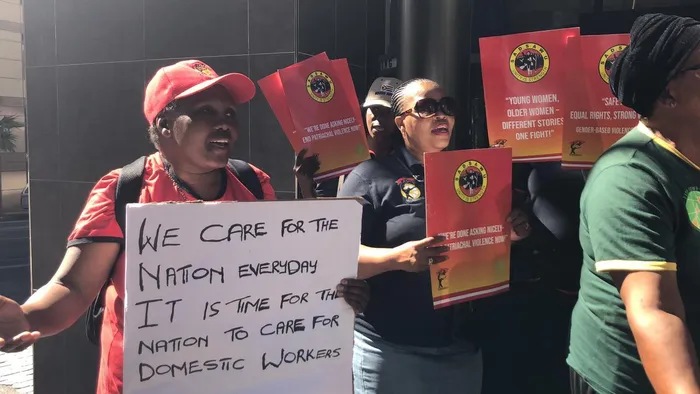
Domestic workers march on Human Rights Day for rights to be afforded to their colleagues. The writer says the daily struggles of South Africa's workers go far beyond merely collecting a salary; they embody a collective hope and responsibility that deserves recognition and support.
Image: Lilita Gcwabe
South Africa’s workforce is often defined by a single, sobering statistic. The national unemployment rate remains above 31%, rising to over 40% when discouraged work seekers are included. It is a number that dominates headlines and shapes national debate, and rightly so. But it is not the whole story.
Alongside it sits another reality, one that is often overlooked but no less important. More than 17 million South Africans go to work every day, and for many of them, employment is not a marker of financial comfort but the beginning of a far more complex responsibility.
To be employed in South Africa today is to carry weight. It is to stretch a salary across rising costs, extended family obligations, and the persistent expectation to build some form of future security.
While inflation may be moderating on paper, the lived experience tells a different story. According to the Competition Commission South Africa, electricity prices have increased by 85% over the past six years, with water costs rising by 68%. These are not abstract figures. They are monthly realities that shape how households survive, adjust, and often sacrifice.
For many workers, a payslip is already spoken for before it arrives. It must feed a household, support relatives, service debt, and still somehow stretch toward savings for a retirement that can feel distant and uncertain. In this environment, employment becomes a daily balancing act between what is needed now and what will be needed later.
Data from Momentum Corporate’s 2025 behavioural research points to a workforce that is trying to engage, to understand, and to make better decisions. At the same time, the data reveals a divide that cannot be ignored. Those who feel financially informed and supported are far more likely to preserve their retirement savings, even under strain. Those who feel uncertain or disconnected from their benefits are significantly more likely to withdraw, often trading long-term security for short-term relief. The difference lies not only in income, but in access to information, in clarity, and in confidence.
Consider the experience of a mid-level manager in Pretoria who, when changing jobs, faced the very real temptation to access his retirement savings to settle a high-interest debt. With the benefit of clear projections, he was able to see what that decision would cost him over time, including the loss of hundreds of thousands of rand in compounded growth. Faced with that reality, he chose to preserve. It is a simple example, but it speaks to something much larger. When the long-term impact becomes visible, the decision itself begins to change.
This is where the role of the financial sector becomes critical. It is no longer enough to measure how people are coping. The real question is whether we are creating an environment where better financial outcomes are genuinely possible. That means simplifying complexity, improving transparency, and ensuring that the tools designed to support people are not only available, but usable and understood.
As South Africa marks Workers' Day, there is an opportunity to shift the narrative. Not away from unemployment, but alongside it. To recognise that being employed in this country often means carrying more than one’s own livelihood, and that the resilience of the workforce is doing more heavy lifting than we sometimes acknowledge.
Because behind every working South African is not just an individual earning an income, but a network of dependence, responsibility, and hope. If employment is the engine of the economy, then financial resilience is what sustains it. Strengthening that resilience is not a nice-to-have. It is essential to ensuring that the effort people put in every day translates into something more secure, more stable, and ultimately more lasting.
*Siyasanga Kashe is Executive Member Solutions at Momentum Corporate