
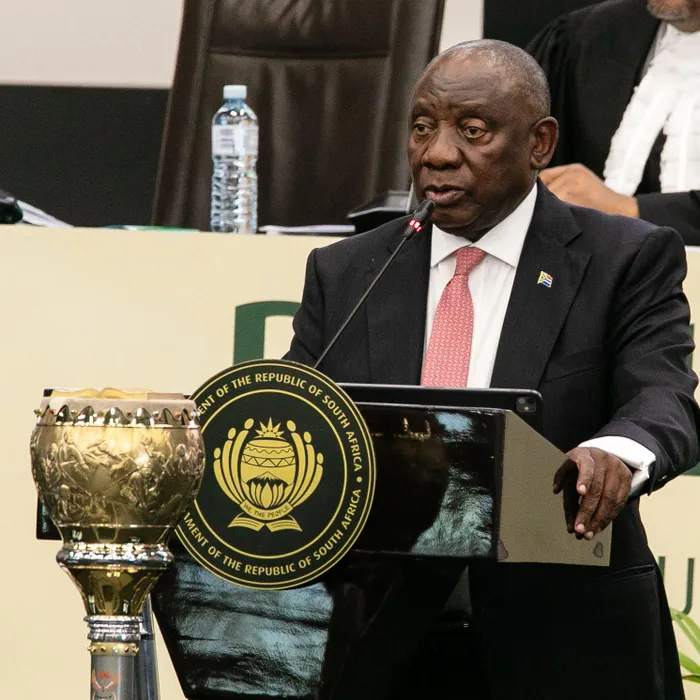
Can President Cyril Ramaphosa’s commitment to constitutionalism and accountability withstand the pressures of public scrutiny? The writer says Ramaphosa's approach reflects a broader vision for governance in a complex socio-political landscape.
Image: GCIS
As South Africa prepares to commemorate the 50th anniversary of the 1976 Youth Uprising, the nation is reminded of the sacrifices made by young people in the struggle for democracy, justice, constitutionalism, and accountable governance. The Soweto Uprising of 1976 was not only a revolt against apartheid education policies, but also a broader fight for dignity, equality, and democratic freedoms. The democratic Constitution that South Africans enjoy today was built on the courage and determination of those young people who challenged oppression and demanded a society governed by the rule of law rather than arbitrary power.
It is within this historical and democratic context that President Cyril Ramaphosa’s address following the Constitutional Court's "Phala Phala" judgment should be understood. At a time when South Africa reflects on its democratic journey and the values for which the youth of 1976 fought, the President’s speech emphasised respect for constitutional processes, judicial independence, accountability, and democratic governance. His decision to remain in office while pursuing lawful review procedures reflects the very constitutional principles that emerged from South Africa’s struggle against injustice and authoritarianism.
The President’s address following the judgment reflects a leader attempting to balance constitutional accountability, political stability, and democratic integrity. The speech was delivered at a moment of heightened political tension and public uncertainty after the court ruled that aspects of the National Assembly’s rules governing impeachment proceedings were unconstitutional. While critics interpreted the judgment as a moral and political indictment of the President, Ramaphosa’s response presents a strong constitutional and democratic argument for why he should remain in office until due legal processes are completed. His speech demonstrates commitment to the rule of law, judicial independence, and constitutional procedure rather than personal political survival.
One of the strongest aspects of Ramaphosa’s speech is his clear respect for the Constitutional Court and the Constitution itself. In democratic societies, the legitimacy of political leadership depends not only on popularity but also on adherence to constitutional principles. Ramaphosa openly stated that he “accepts and respects the Constitutional Court’s ruling,” reinforcing the principle that no one is above the law, including the President. Unlike leaders who undermine judicial institutions when faced with scrutiny, Ramaphosa acknowledged the authority of the Court and committed himself to co-operating with all constitutional processes. This demonstrates political maturity and respect for democratic governance.
Fundamentally, the judgment did not find Ramaphosa guilty of misconduct or corruption. The Court merely found procedural flaws in the National Assembly’s impeachment rules and ordered that the independent panel’s report be referred to the impeachment committee. Ramaphosa correctly argued that the judgment did not establish evidence of wrongdoing nor order his resignation. In constitutional democracies, allegations alone are not sufficient grounds for removal from office. The principles of fairness, justice, and due process require that accusations be properly tested through lawful institutional mechanisms before conclusions are reached. By refusing to resign prematurely, Ramaphosa defended not only his own rights but also the constitutional principle that individuals are innocent until proven guilty.
The President’s decision to seek judicial review of the independent panel’s report further strengthens his argument. Ramaphosa explained that his legal team advised him that the panel’s findings contained “grave errors of law and unfounded conclusions of fact.” Seeking judicial review is a lawful constitutional remedy available to every citizen, including the President. Rather than obstructing justice, his decision demonstrates faith in South Africa’s legal institutions and confidence that the courts can fairly assess the validity of the panel’s conclusions. In fact, the Constitutional Court itself acknowledged the possibility of review by stating that the impeachment process should proceed “unless and until the report is set aside on review.” Ramaphosa’s approach therefore aligns with constitutional procedure rather than defying it.
Another important aspect of the speech is Ramaphosa’s emphasis on national stability. South Africa continues to face serious economic and social challenges, including unemployment, crime, corruption, energy insecurity, and global economic pressures. In times of uncertainty, abrupt political leadership changes can weaken investor confidence, disrupt governance, and deepen social instability. Ramaphosa argued that the country needs stability at this critical moment. His decision to remain in office until constitutional processes are finalised can therefore be interpreted as an effort to preserve continuity in governance and avoid unnecessary political turmoil.
Furthermore, Ramaphosa highlighted the broader reform agenda his administration has pursued since 2018. He reminded South Africans of efforts to rebuild state institutions damaged during the era of state capture. Under his leadership, the State Capture Commission and the Madlanga Commission were established to investigate corruption and criminality within public institutions. His government has also intensified efforts against organised crime and strengthened prosecutorial processes. These reforms demonstrate a government attempting to restore institutional credibility and accountability after years of governance failures.
Critics may argue that Ramaphosa’s continued leadership undermines public trust because of the allegations surrounding the Phala Phala matter. However, it is important to distinguish between allegations and proven misconduct. Democratic systems are built on evidence-based accountability rather than political pressure orpublic speculation. If resignation was demanded whenever allegations emerged against a public official before due process was completed, democratic institutions would become vulnerable to manipulation through politically motivated accusations. Ramaphosa’s insistence on following constitutional procedures protects the integrity of democratic governance and prevents dangerous precedents from being established.
The speech also demonstrates effective political communication. Ramaphosa sought to reassure citizens by emphasising constitutionalism, accountability, and continuity. He framed his decision not as a personal refusal to accept responsibility, but as a defence of constitutional order. By repeatedly referring to the Constitution, judicial independence, and democratic processes, he positioned himself as a leader committed to institutional governance rather than populist politics. This message is particularly important in a country where public trust in political institutions has been weakened by years of corruption scandals and governance crises.

Sifiso Sonjica, the ANC KZN Task Team spokesperson.
Image: File
Additionally, Ramaphosa’s speech reflected an awareness of the broader historical and political context of South Africa. He acknowledged the country’s challenges while expressing optimism about rebuilding institutions and renewing society. His reference to economic recovery, anti-corruption reforms, and social renewal was intended to remind citizens of the long-term national project beyond immediate political controversies. In doing so, he appealed to unity and collective responsibility rather than division and political instability.
Nevertheless, while supporting President Ramaphosa’s right to remain in office, it is also important to acknowledge that public accountability remains essential. The impeachment committee and judicial review processes must proceed transparently and independently to ensure public confidence. President Ramaphosa’s defence of constitutional process will only remain credible if he continues to co-operate fully with all legal and parliamentary investigations. Accountability and constitutional rights must operate together within a democracy.
Ramaphosa’s speech presents a persuasive constitutional and democratic justification for remaining in office. The Constitutional Court judgment did not find him guilty of misconduct nor require his resignation. Instead,it reaffirmed the importance of proper constitutional procedures. By respecting the Court, seeking judicial review through lawful means, and emphasising stability and institutional reform, Ramaphosa demonstrated commitment to democratic governance and the rule of law. His decision to remain in office is therefore not an act of defiance against accountability, but rather a defence of constitutional democracy and due process in South Africa.
Sifiso Sonjica is ANC KZN spokesperson.