
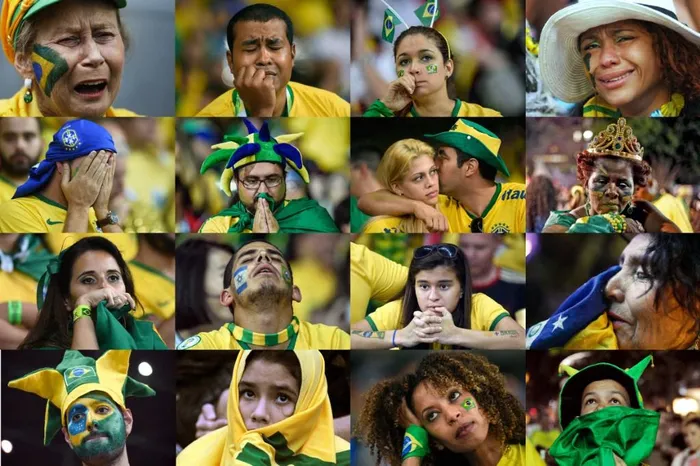
From the "Hand of God" to the heartbreak of the Maracanã, World Cup history is written in moments of pure magic and absolute madness. Photo: AFP
Image: AFP
With nearly 100 years of history, there are many moments that can be coined as iconic at the Fifa World Cup. Here, we look at five of those historic and significant moments that will be remembered beyond living memory.
Few could have predicted the carnage that would unfold in the semi-final of the 2014 World Cup between hosts Brazil and Germany.
Both unbeaten as they reached the last four of the tournament, a close encounter full of tension and drama was expected. There was drama aplenty, but it was the type that shocked a nation and brought a country to tears.
In a ruthless display, eventual champions Germany blitzed Brazil 7-1. The Germans were 5-0 up by the 30th minute, essentially securing progression to the final. They slotted in another two goals in the 69th and 79th minutes through Andre Schürrle to complete the humiliation.
Brazil managed to pull one goal back in the 89th minute, but by that time the nation had already gone into mourning.
Charged politically due to the Falklands War between Argentina and the UK, the quarter-final of the 1986 World Cup in Mexico was already a tense affair before kick-off.
Argentina had the better chances during the first half of the clash, which ended 0-0. Six minutes into the second half, legendary Argentine striker Diego Maradona took the match by the scruff of the neck.
Making a trademark run into the penalty area, Maradona outjumped the much taller English goalkeeper Peter Shilton, reaching a looping, miscued clearance from Steve Hodge. Maradona’s left fist reached the ball first, nudging it over Shilton and into the net.
Afterwards, the Argentine great said of the awarded goal that it was, "a little with the head of Maradona and a little with the hand of God." Maradona’s second goal was just as iconic, as he eviscerated the English defence to score the "Goal of the Century".
Hungary were undoubtedly the hot favourites to win the 1954 World Cup. The "Golden Team" were expected to sweep all aside as they made their way to the final, and that is largely what they did.
Unbeaten in 31 matches before the tournament, they swept aside South Korea 9-0, crushed West Germany 8-3, and then dispatched both Brazil and Uruguay 4-2 in the knockouts. In the final, they were scheduled to meet West Germany once again.
The result, it was believed, was elementary, but what developed in Bern, Switzerland, is still considered one of the great upsets in World Cup history. Locked at 2-2 going into the 80th minute, Helmut Rahn made a masterful run into the 18-yard area, shooting hard and low past goalkeeper Gyula Grosics to win the match 3-2 and claim Germany’s first world title.
A tense final between Italy and France came to a head in extra-time in Berlin in 2006. Both teams had scored in the first 20 minutes of the encounter, but locked at 1-1, neither could break the deadlock in regular time.
With the match headed into extra time, emotions boiled over in the 110th minute when France great and captain Zinedine Zidane headbutted Marco Materazzi of Italy in the chest.
After Italy won the championship 5-3 on penalties, Materazzi admitted to provoking Zidane after the Frenchman had mockingly offered his shirt to the Italian midfielder. Materazzi had responded by saying: "I prefer your sister."
Many speculate that the hot-headedness of "Zizou" in his final international match cost France the title, as he was unavailable for the penalty shootout.
The foundations of modern football were set down during the irrepressible displays of a powerful and talented Netherlands team in the 1970s. Heavy favourites to win the 1974 and 1978 events — which they failed to do — the Dutch inspired awe with their "Total Football" approach.
Although Johan Cruyff probably did not invent the dribbling move per se, the legend of the Oranje during this period has solidified the claim to the "Cruyff Turn". It is an evasive play now seen not only at the highest levels but on training pitches and parks worldwide.
In the 22nd minute against Sweden in a group game, Cruyff feigned a pass, dragged the ball behind him, turned on his heels, and accelerated away, leaving the opposition defence in his wake.