
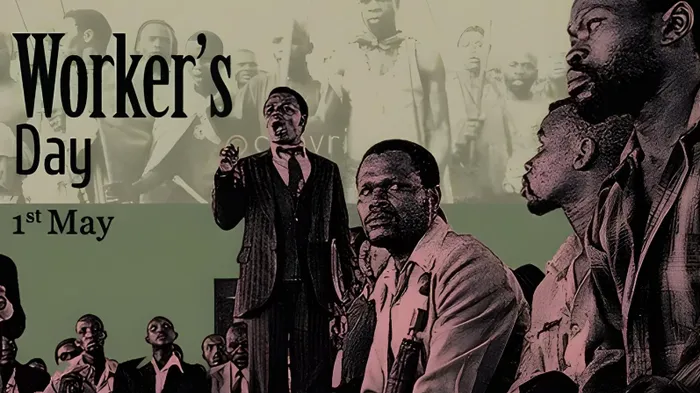
Workers' Day is celebrated on 1 May
Image: SA History.org
South Africa's Workers Day is turning more into Jobless Day, as the unemployment rate is rising spurred on by the impact of AI and imports.
Almost all economic experts, trade unionists and labour specialists bemoaned the loss of jobs across all sectors because of these threats and unfriendly labour legislation.
Professor Armand Bam, Head of Social Impact and Leadership Development at Stellenbosch Business School, said the shift has been both structural and socially significant.
“South Africa’s work environment has shifted from relatively stable, labour-intensive industrial employment toward a more fragmented, service-oriented, technology-mediated and precarious labour market. Traditional manufacturing sectors such as clothing, textiles, footwear, leather and jewellery once absorbed semi-skilled workers, especially women and workers without tertiary qualifications. Their weakening has therefore not only reduced jobs, but removed a key pathway into formal employment,” he explained.
The decline of these industries has been severe and sustained over time, with long-term consequences for employment and economic inclusion.
“The Retail, Clothing, Textile, Footwear and Leather Master Plan notes that between 2000 and 2008 the sector was losing between 10,000 and 15,000 jobs annually, alongside factory closures and deep de-industrialisation. It links this to loss of export market share, rising imports, customs fraud, and increased sourcing from China. Earlier analysis also found that China’s share of South African clothing and textile imports rose from 16.1% in 1996 to 60.7% in 2008, while about 69,000 jobs were lost in the sector over six years (SAIIA),” he noted.
He added that while imports have brought benefits to consumers, they have simultaneously weakened local industry and job security.
“The impact of imports should not be reduced to China alone, but Chinese import penetration has clearly intensified pressure on local producers. Lower-cost imports have benefited consumers through cheaper goods, but they have also undermined local manufacturing margins, reduced production volumes, and weakened job security in sectors where South Africa competes mainly on price rather than design, quality, speed, localisation or ethical production,” he said.
Recent trade data reflects this imbalance, pointing to a widening gap between imports and exports.
“Recent trade analysis also shows South Africa’s trade deficit with China widening to US$9.71 billion by 2023, suggesting a structural imbalance between what South Africa imports and what it exports (ISS),” he added.
The consequences of this shift are evident in South Africa’s labour market, where unemployment remains persistently high. With an official unemployment rate of 31.4% recorded in the fourth quarter of 2025, the country continues to struggle to create sufficient opportunities, particularly in productive sectors like manufacturing.
“This indicates that even when headline employment improves, traditional productive sectors remain vulnerable,” he explained, pointing to continued job losses in manufacturing despite slight improvements in overall employment figures.
Economist Dawie Roodt said the transformation of South Africa’s labour market cannot be attributed to global forces alone, but must also be understood within the context of domestic policy and institutional change.
“Labour market structure has changed over the past three decades. In South Africa's case, labour was much more politically aligned and politically active 20 or 30 years ago than what they are today. And labour was also much stronger than what they are today,” he said.
He noted that declining participation in trade unions has weakened organised labour’s influence and shifted the balance of power in the workplace.
“One is that people are not joining trade union or organized labour anymore. So that is sort of not the thing to do anymore. So the trade union movements have lost a lot of political power that they used to have in the past, but they also used to be much more politically aligned and much less so today,” he explained.
Roodt said global trade, particularly the rise of China, has had a major impact on South Africa’s industrial base, but added that domestic policy failures have compounded the problem.
“The Chinese phenomenon had a massive impact on South Africa, not only South Africa, many countries in the world. But teh wrong macroeconomic policies actually exacerbated everything. tThis coupled with just straightforward incompetence and quite often corruption,” he said.
“The result of that was that South Africa pretty much became de-industrialized. And of course, that means if you lose your factories, then you lose your potential for job creation,” he added.
He said the burden of this transformation has fallen most heavily on vulnerable workers.
“Especially lower skilled workers that are losing out big time here. And another reason has to do with labour legislation, making labour priced out of the market,” he said.
Economic expert Ulrich Joubert added that South Africa’s exposure to global competition must also be understood in the context of policy decisions taken after the end of apartheid, when the economy was rapidly opened up.
“We were in a situation, because of the international sanctions imposed against the country, the local manufacturing industry was protected by a wall of tariffs and protection measures. Then after 1994, these protections were removed and the economy was opened to international competition. Unfortunately, our industries were not given enough time to adjust,” he explained.
He said this led to factory closures and significant job losses, particularly in the textile sector, as local industries struggled to compete globally.
“If you open up to the rest of the world and your industries are not competitive, then they close down. That is what happened in South Africa, especially in labour-intensive sectors,” he noted.
Joubert added that additional pressures, including rising electricity costs and infrastructure challenges, continue to weigh heavily on manufacturing and mining sectors, limiting their ability to grow and create jobs.
Alongside these structural shifts, artificial intelligence and automation are introducing a new layer of disruption into an already fragile labour market. Advaita Naidoo, Africa MD at Jack Hammer Global, cautioned against reacting too quickly to global trends.
“In the US, AI has already been linked to job reductions, with many driven by anticipation of productivity gains rather than proven results. This has led to leaner teams and heavier workloads,” she said.
She described what is emerging as a “productivity paradox,” where the adoption of AI tools is increasing pressure on employees rather than reducing it.
“This is a messy transition phase. Parts of jobs are accelerating quickly, but that doesn’t mean the overall workload is decreasing,” she explained.
Professor Bam reinforced this concern, noting that the impact of AI is not simply about job losses, but about a deeper restructuring of the labour market.
“Artificial intelligence and automation add a second layer of pressure. In manufacturing and adjacent sectors, automation reduces demand for routine manual and administrative tasks, while increasing demand for technical, analytical, digital, maintenance, design and process-optimisation skills. The risk is not simply ‘job loss’; it is occupational polarisation,” he said.
Roodt agreed that AI will have a significant and disruptive effect on employment patterns.
However, Joubert offered a more balanced view on automation, noting that its impact depends on how it is implemented.
“It’s not necessarily the case that automation and artificial intelligence will lead to job losses. In many cases, workers can be trained and upskilled to work alongside these technologies, improving productivity rather than replacing labour,” he said.
Dr Mario Landman from The IIE and ADvTECH’s Academic Centre of Excellence said universities are redesigning curricula to prioritise real-world application, interdisciplinary learning, and human-centred skills.
With global projections indicating that nearly 40% of core job skills will change by 2030, there is a growing emphasis on adaptability, critical thinking, communication, and digital literacy, skills that are less susceptible to automation and remain in high demand.
Looking ahead, the outlook for South Africa’s labour market remains uncertain. Professor Bam said without coordinated intervention, current trends are likely to continue.
“My five-year outlook is cautiously pessimistic unless industrial policy, skills development and localisation become more coordinated. The main risks are continued de-industrialisation, cheap import dependence, weak enforcement against illegal imports, energy and logistics constraints, and a skills mismatch between available workers and emerging forms of work,” he said.
Roodt was more direct in his outlook. “I'm afraid, given what we have in South Africa, the wrong policies and all that, I'm afraid that the economic growth over the next couple of years is going to be like what we've experienced the last 15 years. It's going to be weak and with an increase in unemployment and poverty and everything that goes with that. So I'm not very optimistic,” he said.
tracy-lynn.ruiters@inl.co.za