
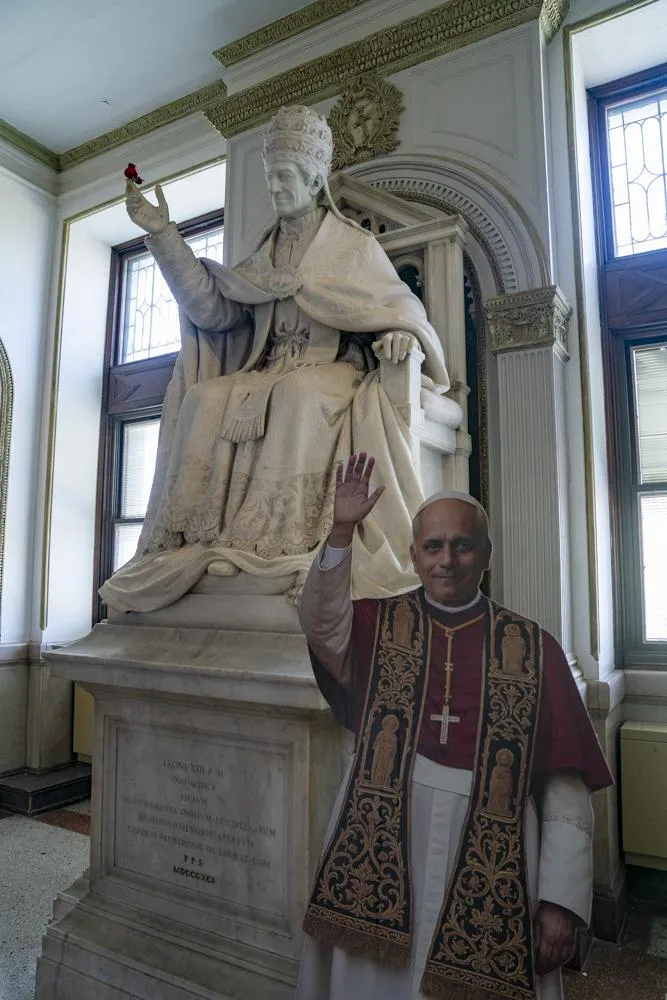
A statue of Pope Leo XIII next to a cardboard cutout of Pope Leo XIV inside McMahon Hall at Catholic University in DC.
Image: Maxine Wallace/ The Washington Post
Michelle Boorstein
The much-anticipated encyclical issued at the Vatican on Monday marks the second time in modern history that a pope named Leo singled out - in one of the highest-profile ways a pope can - the challenges to ethics and spirituality posed by modernization.
In 1891, Pope Leo XIII issued a major document to grapple with what he saw as the most pressing issue of his time: the plight of the working class and socioeconomic conflicts arising from the Industrial Revolution.
The current Leo, formerly Robert Prevost and now Pope Leo XIV, selected his papal name last year in honor of that previous Leo, who is considered the father of the Catholic church’s social teaching.
The 1891 encyclical, “Rerum Novarum,” “Of New Things” established Catholicism as offering a middle way between socialism and capitalism.
Leo XIV, since his election, has said that today’s industrial revolution is artificial intelligence, which according to the leader of the world’s 1.4 billion Catholics poses new challenges for the defense of human dignity, justice and labor.
Aspects of “Magnifica Humanitas,” - “Magnificent Humanity” - Leo XIV’s first encyclical, are similar to “Rerum Novarum,” but there are also notable differences reflecting the different eras and different popes.
Here is a comparison of some key excerpts:
Both popes launched their encyclicals by spelling out their era as one of revolutionary change.
1891: “That the spirit of revolutionary change, which has long been disturbing the nations of the world, should have passed beyond the sphere of politics and made its influence felt in the cognate sphere of practical economics is not surprising.” (Sec. 1)
Today: “The Holy Spirit challenges us today regarding our relationship with technology and the ongoing digital revolution. Scientific discoveries are talents entrusted to humanity so that they may bear fruit. Technology has the power to heal, connect, educate and protect our common home; but it can also divide, exclude and generate new forms of injustice.” (Intro. 9)
A central concern of Leo XIII was the growth of socialism and the idea that class warfare was the way to understand social problems. Socialism is also often associated with atheism. Leo XIV focuses more on the dehumanizing aspects of modern technology, but makes clear that states and communities, not a small number of individual elites, must be the ones to shape decisions about the future of AI.
Leo XIII was saying “workers, you are right to be concerned about your lives, come over here,” said Joseph Capizzi, dean of moral theology at Catholic University. “What they both say is we’re connected to one another. When some people are vulnerable and suffering, that’s not good for any of us.”
1891: “Hence, it is clear that the main tenet of socialism, community of goods, must be utterly rejected, since it only injures those whom it would seem meant to benefit, is directly contrary to the natural rights of mankind, and would introduce confusion and disorder.” (Sec. 15)
Today: “In a world where data, computational resources and regulatory influence remain in the hands of a few, to speak of the common good means exposing this new form of epistemic, economic and political asymmetry and naming the new monopolies of AI.” (Sec. 109)
“In the past, it was largely up to the State to guide and direct innovation. Today, however, the main drivers of development are private, often transnational, parties that are endowed with resources and the capacity to intervene that surpass those of many Governments. Technological power thus takes on an unprecedented, predominantly “private” aspect, which makes it even more challenging to discern, govern and direct such power toward the common good.” (Sec. 5)
In the 1890s, Pope Leo XIII felt the need to assert the church’s standing in an era of its weakening authority, compared to earlier eras when popes and bishops would expect to be consulted by kings and prime ministers. Today, with President Donald Trump and others in his administration telling popes to stay in their lane, Leo XIV’s encyclical again argues that the church has its place.
1891: “The Church uses her efforts not only to enlighten the mind, but to direct by her precepts the life and conduct of each and all; the Church improves and betters the condition of the working man by means of numerous organizations; does her best to enlist the services of all classes in discussing and endeavoring to further in the most practical way, the interests of the working classes.” (Sec. 16)
Today: “The Church’s presence in the world is also expressed through her relationship with civil society and public institutions. By engaging with these entities, the Church acknowledges the value of social and political realities and honors their specific responsibilities, supporting everything that fosters the well-being of individuals and strengthens the fabric of society. The Church does not claim to assume the functions belonging to the State. On the contrary, she esteems those who serve the common good, and she firmly acknowledges the responsibility that civil institutions hold within society. At the same time, the mission entrusted to the Church prompts her to address the real suffering of the men and women of our time.” (Sec. 21)
Both Leos emphasize the distinction in Catholic social teaching between owning property and the appropriate use of property. Leo XIII, however, was very focused on money as wealth, whereas Leo XIV centers on technology as the modern-day gold.
1891: “Man should not consider his material possessions as his own, but as common to all, so as to share them without hesitation when others are in need … True, no one is commanded to distribute to others that which is required for his own needs and those of his household; nor even to give away what is reasonably required to keep up becomingly his condition in life … But, when what necessity demands has been supplied, and one’s standing fairly taken thought for, it becomes a duty to give to the indigent out of what remains over.” (Sec. 22, quoting Thomas Aquinas)
Today: “There is a right to private property, which has its own specific meaning and purpose, yet it is always subordinate to the universal destination of goods … In the Church’s tradition, property has been viewed as a means of protecting and managing goods so that they may better serve the common good. Since the Christian tradition has never recognized the right to private property as absolute or inviolable, its social function must not be considered a mere theological opinion, but a doctrine of the Church … Today, among the goods that are universally intended for everyone, we must also include new forms of property, such as patents, algorithms, digital platforms, technological infrastructure and data. In a context where the wealth of nations depends increasingly on knowledge and technology, when these goods remain concentrated in the hands of a few, without adequate forms of sharing and access, a new imbalance is created. (Sec. 66-67)