
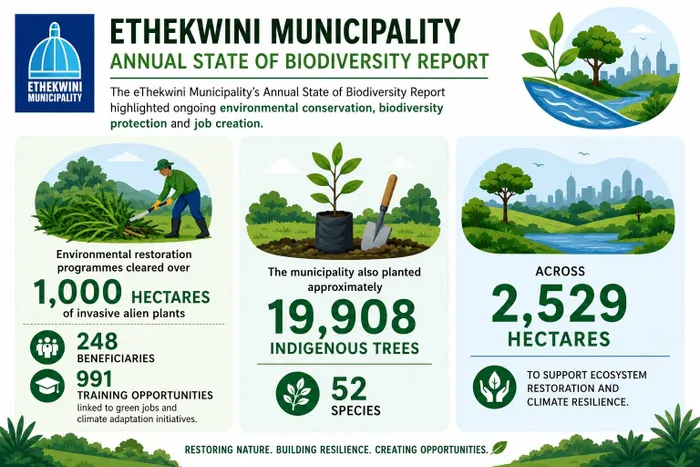
The eThekwini Municipality’s Annual State of Biodiversity Report highlighted environmental restoration programmes linked to green jobs and climate adaptation initiatives.
Image: ChatGPT
The eThekwini Municipality’s Annual State of Biodiversity Report highlighted ongoing environmental conservation, biodiversity protection, and job creation.
The report was released during a municipal committee meeting this week, aligning with the International Day for Biological Diversity commemoration on Friday.
The municipality’s report outlined interventions to protect natural ecosystems, restore degraded environments, manage invasive alien species, strengthen coastal and riverine management, and conserve biodiversity assets.
During the reporting period, environmental restoration programmes cleared over 1,000 hectares of invasive alien plants, benefiting 248 beneficiaries and creating 991 training opportunities linked to green jobs and climate adaptation initiatives.
The municipality also planted approximately 19,908 indigenous trees comprising 52 species across 2,529 hectares to support ecosystem restoration and climate resilience.
“The municipality continues to prioritise biodiversity protection as a key component of sustainable development, recognising the role healthy ecosystems play in supporting tourism, water security, climate adaptation, disaster risk reduction, and community well-being,” the report stated.
Addressing delegates during the commemoration in Johannesburg on Friday, Narend Singh, Deputy Minister of Forestry, Fisheries and the Environment, said South Africa is updating its National Biodiversity Strategy and Action Plan (NBSAP) to fully align with the Kunming-Montreal Global Biodiversity Framework (KMGBF), adopted in December 2022.
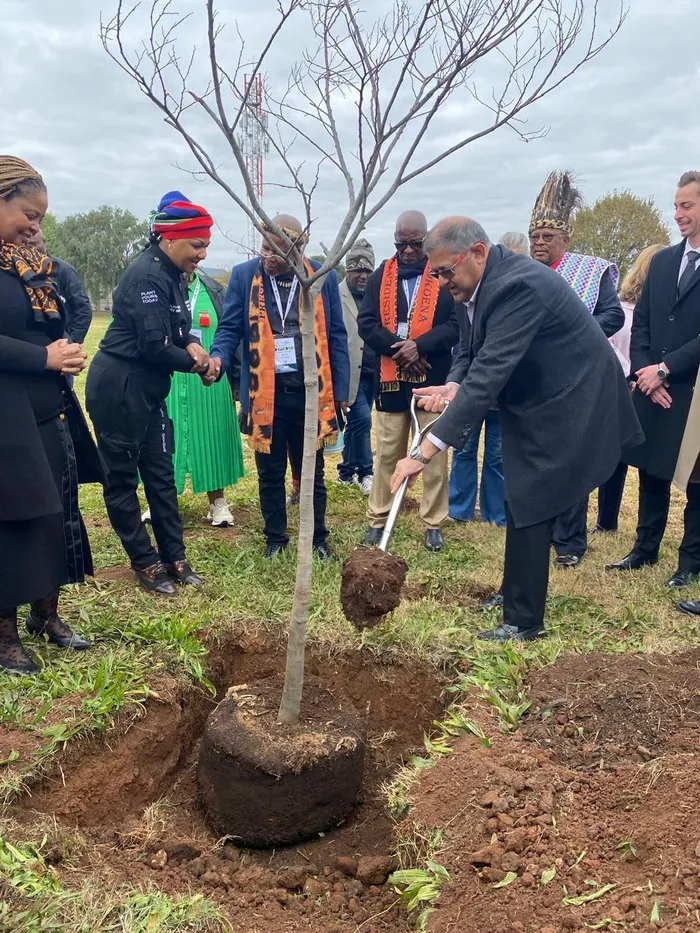
Narend Singh, Deputy Minister of Forestry, Fisheries and the Environment, plants a tree during the International Day for Biological Diversity commemoration held in Gauteng on Friday.
Image: Department of Forestry, Fisheries and the Environment
Singh said the country is honoured to be the first official host of the International Day for Biological Diversity, which culminated in important engagements held over the past several days, including the Biodiversity Governance Lekgotla and the National Biodiversity Strategy and Action Plan consultative processes.
“Protecting biodiversity includes action close to home with positive ripple effects that can reach far beyond. Global ecological survival does not begin in international conferences; it begins in our backyards, our cities, and our local community actions. Our survival depends on shifting from exploiting nature to acting as stewards who work with it.”
However, Singh highlighted that the Biodiversity Expenditure Review (BER) (2016-2024) reveals a growing finance gap undermining the country’s capability to conserve and sustainably use biodiversity.
“Insufficient financial resourcing is one of the key constraints to biodiversity stewardship, despite it being a cost-effective way to support and expand protected areas and job creation.”
Singh highlighted that biodiversity stewardship empowers communities as owners and co-managers of conservation, creating inclusive pathways to improved livelihoods and local economic development.
At the Babanango Game Reserve, in KwaZulu-Natal, biodiversity stewardship has enabled socio-economic benefits for surrounding communities.
“The reserve has created approximately 280 diverse employment opportunities for neighbouring communities through ecosystem restoration and enterprise development. Similarly, the Bela Bela Communal Property Association in Limpopo has created employment opportunities for approximately 280 people,” Singh said.
The Bela Bela CPA also employs young women at its highly automated egg production farm, which produces 150,000 eggs per day.
zainul.dawood@inl.co.za